Parents can reinforce occupational therapy (OT) goals at home by turning everyday routines — mealtime, bath time, dressing, and play — into short, repeated practice moments. Consistency across just 10–15 minutes a day, guided by the child’s therapist, often matters more than long, one-off sessions. Below, we break down exactly how to do this, backed by recent research and real examples from families at our clinic.
If your child attends occupational therapy sessions at a clinic, you’ve probably asked yourself: what happens to all that progress once we walk out the door? The honest answer is — it depends almost entirely on what happens at home between sessions.
At Rehab for Autism and ADHD, an autism therapy centre in Patna, we tell every parent the same thing during their first visit: therapy in the clinic plants the seed, but home practice is what makes it grow. A child who sits for a 45-minute OT session once or twice a week gets a fraction of the repetition their brain actually needs to build a new skill. The rest has to come from daily life.
This guide walks you through simple, realistic ways to reinforce OT goals at home — without turning your living room into a clinic or your evenings into a battle.
Why Home Practice Actually Changes Outcomes
There’s a reason therapists keep asking about your child’s routine at home instead of only focusing on clinic time. Research consistently shows that when caregivers are actively involved in setting and practicing therapy goals, children hold onto their gains longer and generalize skills better across settings.
A 2026 study published in the American Journal of Occupational Therapy on an aquatic OT program found that caregivers who took part in choosing and refining their child’s goals reported feeling more capable, and this directly supported better and more lasting outcomes for the child. Separately, a randomized controlled trial on a program called OT-Parentship, aimed at parents of autistic adolescents, found measurable improvements in both parental confidence and the child’s ability to manage daily tasks after parents were trained to actively coach their child at home, rather than staying passive observers during sessions.
Closer to home, this shift is exactly what’s shaping care across India right now. On World Autism Day 2026, one of India’s largest neurodevelopmental care networks publicly reaffirmed its parent-led model, describing parents as “co-therapists” in their child’s development rather than bystanders. Our own founder, Dr. Kapil Dev, echoed this same philosophy when he shared the stage with medical experts at the Times of India’s “Understanding Autism” conclave in Patna — reinforcing that structured therapy paired with active family involvement is what drives real independence for neurodivergent children.
The takeaway for parents is simple: your involvement isn’t a bonus add-on to therapy. It’s part of the treatment itself.
Turn Daily Routines Into Practice, Not Extra Work
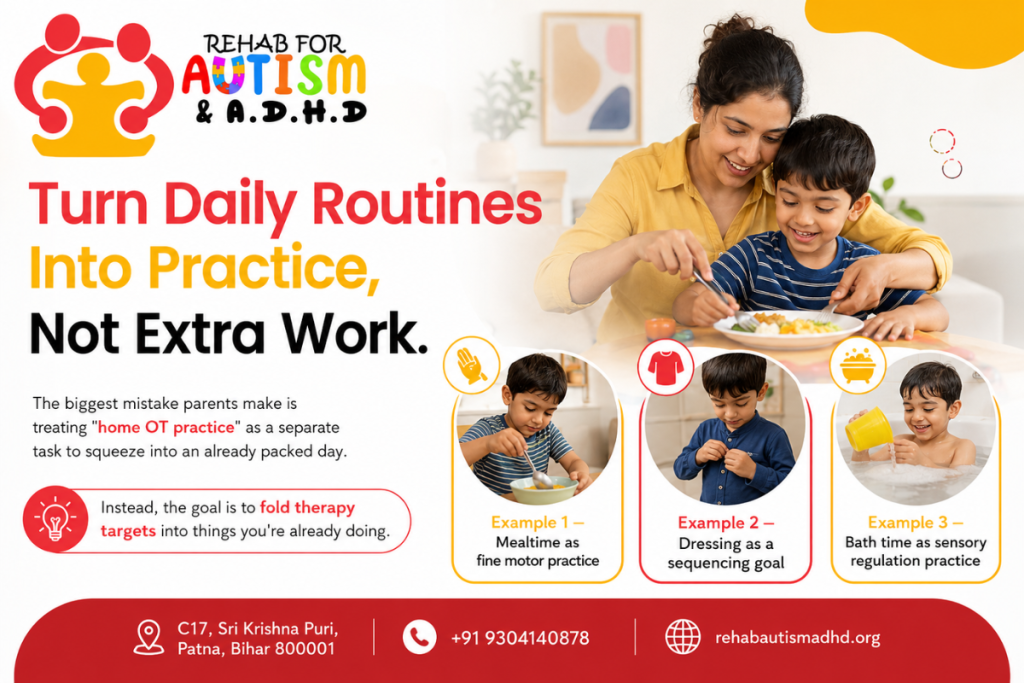
The biggest mistake parents make is treating “home OT practice” as a separate task to squeeze into an already packed day. Instead, the goal is to fold therapy targets into things you’re already doing.
Example 1 — Mealtime as fine motor practice: If your child’s OT goal is improving grip strength or hand-eye coordination, let them help scoop rice, pour water from a small jug, or use a spoon independently instead of being fed. Five minutes at every meal adds up to far more repetition than one clinic session a week.
Example 2 — Dressing as a sequencing goal: Many children at our Occupational Therapy centre in Boring Road, Patna work on multi-step sequencing. Getting dressed — shirt, then shorts, then socks, in order — is a built-in daily opportunity to practice exactly this, without it feeling like “therapy.”
Example 3 — Bath time as sensory regulation practice: For children who are sensitive to touch or temperature, a predictable bath-time routine with the same towel texture, water warmth, and order of steps each day helps the nervous system learn what to expect, which is often a direct extension of the sensory integration goals therapists work on in session.
Supporting Sensory Regulation Outside the Clinic
Sensory processing challenges don’t stay inside the therapy room — they show up at the dinner table, in the car, at a cousin’s noisy wedding, or during school drop-off. A consistent “sensory diet” at home (a set of planned physical activities recommended by your therapist, like wall push-ups, swinging, or weighted blankets during quiet time) helps a child stay regulated through the day rather than reaching a meltdown point by evening.
If your child is being seen by an Autism Doctor in Boring Road, Patna or an occupational therapist, ask them to write down two or three sensory strategies specific to your child, rather than relying on generic lists from the internet — every child’s sensory profile is different, and what calms one child can overstimulate another.
Where Speech Goals and OT Goals Overlap at Home
Occupational therapy and speech therapy targets frequently reinforce each other, especially during play. A child working on requesting (“more,” “help,” “open”) during a Speech Therapy centre in Patna session is also practicing turn-taking and joint attention — both of which are core OT goals. At home, simple activities like blowing bubbles, stacking blocks together, or a “your turn, my turn” ball game quietly reinforce both sets of goals at once, without needing separate practice time for each.
Recent Research Parents Should Know About
A few recent findings are worth mentioning because they directly shape how home programs are designed today:
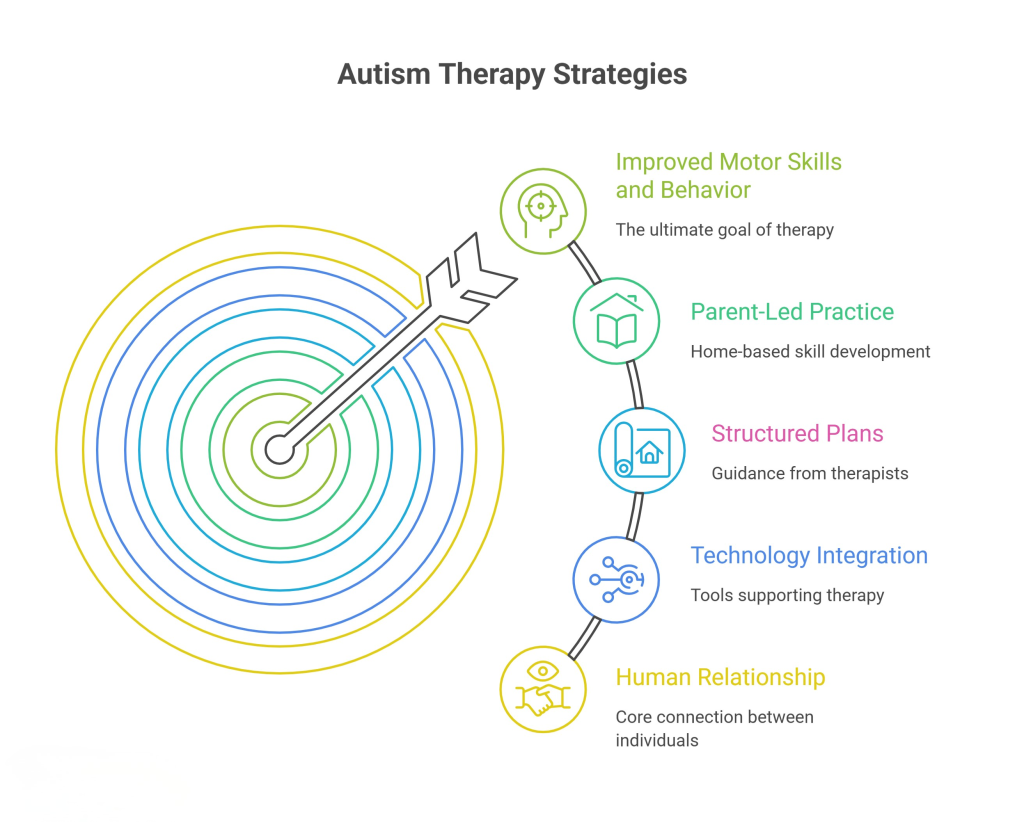
- A 2025 pilot study on motor skills training in children with autism found that parent-led, home-based practice of fundamental motor skills — running, jumping, ball skills — produced measurable improvement when guided by a structured plan from the child’s therapist, not left to guesswork.
- A mobile-app-assisted parent training trial had parents complete a structured 12-week home program and found a meaningful drop in problem behavior scores compared to families who didn’t receive the structured program, showing that even short, guided daily input from parents can shift outcomes.
- At the National Conference on Autism 2026, hosted by a leading college of occupational therapy, experts discussed integrating technology into sensory integration therapy while stressing that tools should support — never replace — the human relationship between therapist, parent, and child. That balance is exactly what we aim for with every family at our centre.
Common Mistakes Parents Make at Home
- Practicing too long, too rarely. Ten focused minutes daily beats one hour on a Sunday.
- Correcting instead of coaching. Constant correction can make a child associate the activity with failure. Prompt, then wait — give your child time to attempt it themselves.
- Skipping the therapist check-in. Goals evolve. What worked last month may need adjusting; always loop back with your child’s team every few weeks.
- Copying generic checklists online. Every child’s plan from an Autism Treatment Centre in Patna is individualized — a strategy that works for one child’s sensory profile may not suit another.
When Home Practice Isn’t Enough
If you notice your child plateauing, becoming more resistant to practice, or regressing, it’s a signal to bring it up with your therapist rather than pushing harder at home. Families visiting our Autism Treatment Center in Boring Road, Patna often come in specifically because home strategies stopped working as their child grew — and that’s a completely normal part of the journey, not a failure on the parent’s part.
Conclusion
Reinforcing OT goals at home isn’t about becoming a therapist yourself — it’s about noticing the small windows already built into your day and using them with intention. A child’s brain doesn’t distinguish between “clinic time” and “home time”; it simply responds to repetition, consistency, and calm guidance, wherever that happens. With the right support from your child’s therapy team, home becomes an extension of the clinic rather than a separate, disconnected space.
If you’re looking for personalized, one-on-one guidance for your child’s occupational therapy, speech therapy, or behavior goals, our team at Rehab for Autism and ADHD, Boring Road, Patna is here to help you build a home plan that actually fits your family’s routine.
📞 Ready to Build a Home Plan That Works for Your Child?
Mail us : Rehabforautismandadhd2019@gmail.com
info@rehabautismadhd.org
Frequently Asked Questions
Q1. How much time should parents spend on OT practice at home each day?
Most therapists recommend 10–15 minutes of focused, goal-specific practice, repeated 2–3 times a day within normal routines, rather than one long session.
Q2. Can home practice replace clinic-based occupational therapy?
No. Home practice reinforces and extends what’s built in structured sessions with a trained therapist; it works best alongside, not instead of, professional therapy.
Q3. What if my child refuses to practice at home?
Resistance is common. Shortening the activity, embedding it into play, and avoiding pressure or correction usually helps more than extending practice time.
Q4. How do I know which OT goals to focus on at home?
Always ask your child’s occupational therapist for 2–3 specific, current goals rather than working off general internet advice — every child’s plan is different.
Q5. Where can I get a personalized home program for my child in Patna?
You can visit our Occupational Therapy centre in Boring Road, Patna for an assessment, after which our team will provide a home plan tailored to your child’s specific goals.