
Occupational Therapy
Helping your child write, dress, play, and cope. We use play-based, one-on-one sessions to improve motor, sensory, and self-care skills.
What is Occupational Therapy for Children?
Picture a six-year-old who grips his pencil in a tight fist, hates the feel of his school socks, and melts down when the bell rings. His parents wonder whether he is stubborn, shy, or something else. Often, the answer lies in how his body and brain handle movement and sensation. That is where occupational therapy in Boring Road, Patna can help.
At Rehab for Autism & ADHD, our therapists work one-on-one with children to build the skills that fill an ordinary day. We run sessions at C17, Sri Krishna Puri, about 2 km from Boring Road Chauraha.
Occupational therapy is not drill or homework. A session might include swinging on a platform swing, threading beads, pressing clay, or crawling through an obstacle course. Every activity serves a goal: stronger hands, steadier balance, calmer reactions to noise or touch.

Led by Expert Pediatric Care
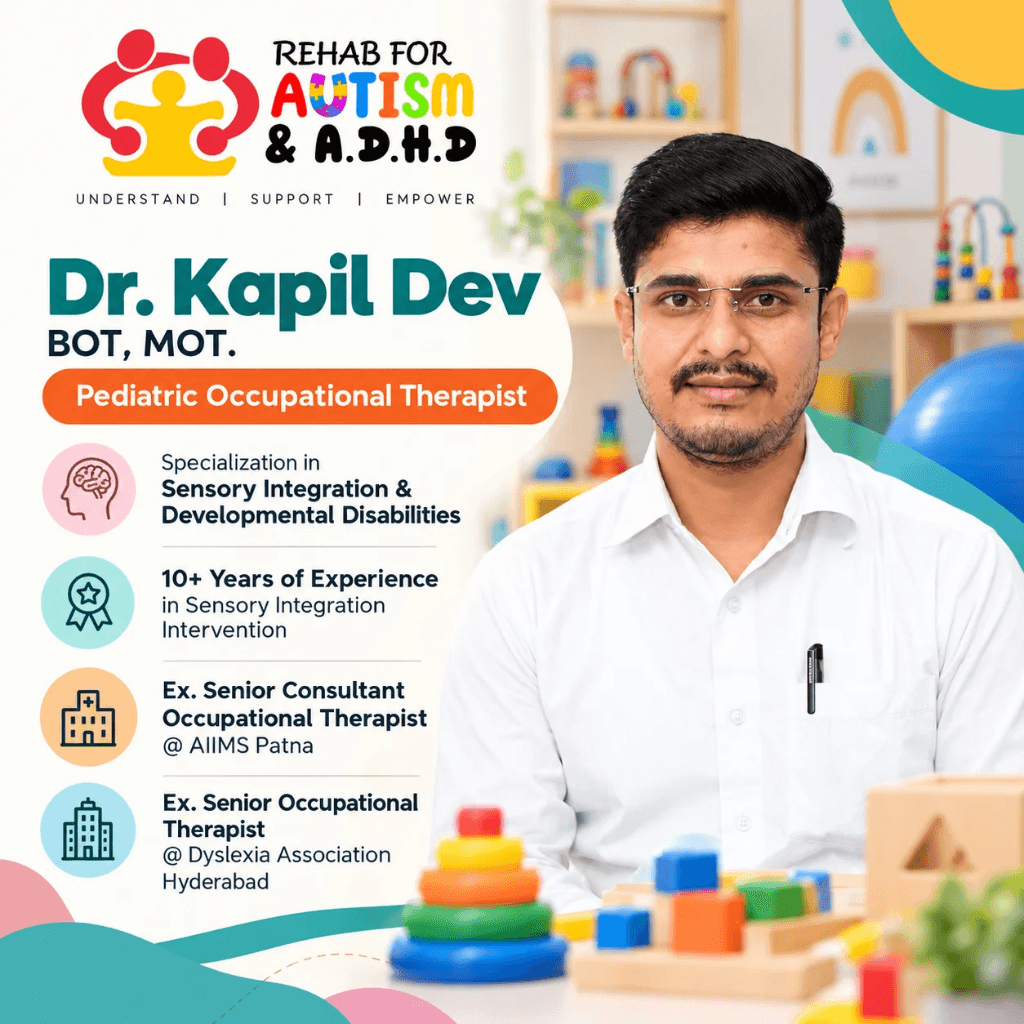
Dr. Kapil Dev leads our team of occupational therapists:
- Qualifications: He holds BOT and MOT degrees.
- Experience: He has over 10 years of experience in sensory integration and developmental disabilities.
- Previous role: He worked as Senior Consultant Occupational Therapist at AIIMS Patna.
- Our approach: Our therapists write each plan around one child’s strengths and goals.
Signs Your Child May Need Occupational Therapy
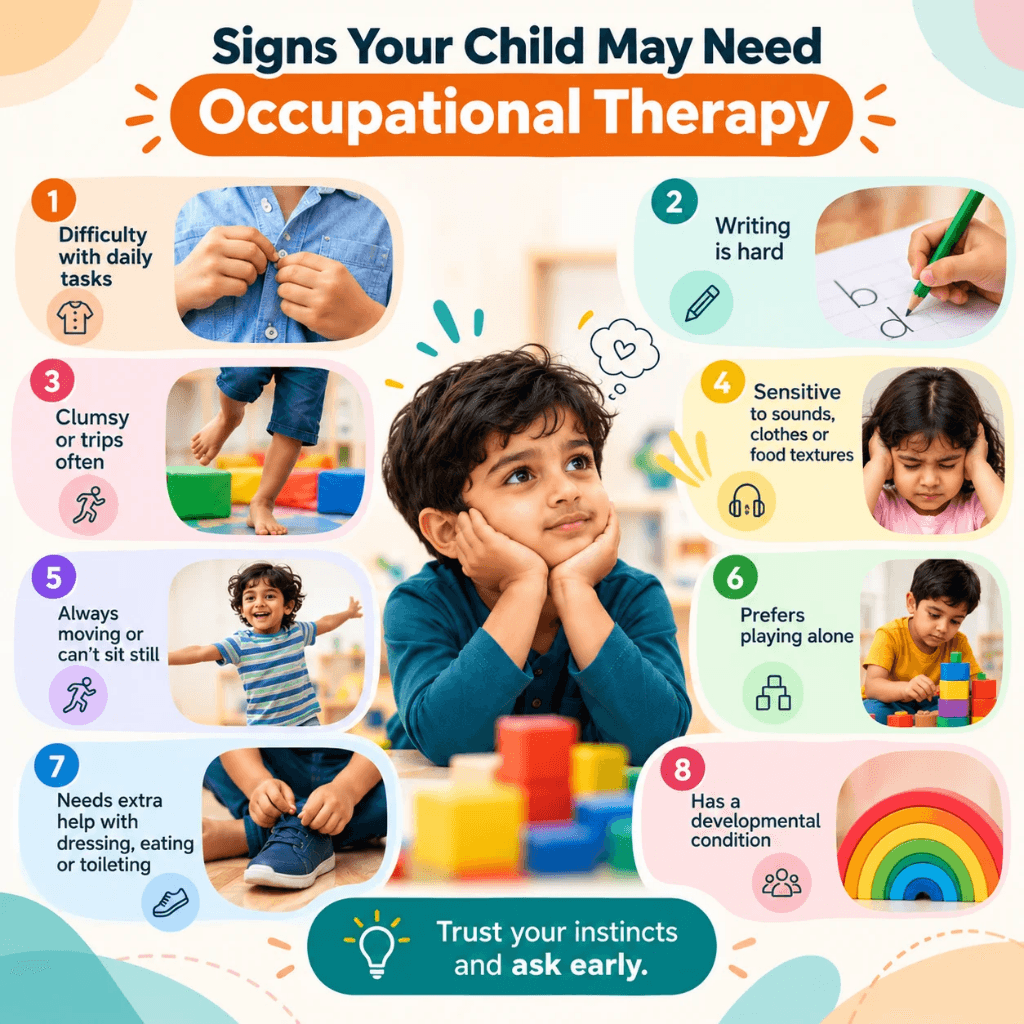
One hard day proves nothing. A pattern deserves attention. Consider an occupational therapy assessment if your child:
- Struggles with buttons, zips, spoons, scissors or pencils.
- Writes letters of uneven size, reverses them often or tires quickly.
- Bumps into furniture, trips often or seems unsure how to climb, jump or catch.
- Covers their ears, refuses certain clothes or food textures, or panics in crowds.
- Craves constant spinning, crashing or running, or cannot sit through a lesson.
- Plays alone, repeats the same game or needs help starting pretend play.
- Needs far more help with dressing, toileting or eating than peers of the same age.
- Has a diagnosis such as autism, ADHD, cerebral palsy, Down syndrome or global developmental delay (GDD).
Trust your instincts and ask early. Parents usually notice first.
How We Help Children With Different Needs
Tailored therapeutic approaches for neurodivergent and developmentally delayed children.

OT for Autism
Builds predictable routines, teaches self-care step by step, and uses sensory integration therapy to help the body feel safe. We widen a child’s play so games become shared experiences.
OT for ADHD
Provides movement breaks, visual checklists, and body-regulation tools for the classroom. Focuses heavily on posture and pencil control to reduce school-day stress.
Developmental Delay (GDD)
Breaks large skills into small, winnable steps. Early intervention helps young children learn quickly, where each new skill directly supports the next level of development.
Cerebral Palsy
Centres on hand function: reaching, gripping, releasing, and using both hands together. We suggest adapted tools like thicker grips and non-slip mats for safety.
Down Syndrome
Counteracts lower muscle tone and loose joints by building grip strength, feeding skills, and dressing independence one step at a time for less physical effort.
Learning Disabilities
Targets physical/visual skills behind schoolwork (copying from the board, tracking lines). Works perfectly alongside our in-house special educators in Patna.
Skills We Build in Therapy
Our therapists choose from a toolkit of focused programs:
- Fine motor skills: pinching, threading, cutting and buttoning.
- Handwriting skills: pencil grip, letter formation, spacing and speed.
- Gross motor skills: balance, climbing, jumping and core strength.
- Hand-eye coordination: catching, stacking blocks and copying shapes.
- Motor planning: teaching the brain to sequence new movements.
- Sensory processing: sorting sound, touch, light and movement safely.
- Self-care (ADL): dressing, brushing teeth, eating and toileting.
- Play skills: turn-taking, pretend play and shared games.
- School readiness: sitting posture, packing bags and following routines.
What Happens at an Assessment?
Every plan starts with a structured occupational therapy assessment:
1. Parent Interview
You describe daily routines, school feedback, worries and strengths.
2. Observation Through Play
Our therapist watches how your child moves, grips and reacts to environments.
3. Skill Checks
We use structured tasks for fine motor, gross motor, visual-motor and self-care.
4. Goal Setting
We agree on targeted goals, such as “fasten a shirt” or “write my name clearly.”
5. Therapy & Home Plan
Receive a session schedule and simple activities to practise at home.
How to Measure Progress & Choose Care
What you see at home vs. What OT works on
| What you notice (At Home) | Skill Area | What OT actually works on |
|---|---|---|
| Child drops cups, struggles with buttons | Fine motor | Grip strength, finger isolation, bilateral hand use |
| Messy, slow or tiring handwriting | Handwriting, visual-motor | Pencil grasp, letter formation, spacing |
| Trips, avoids playground equipment | Gross motor, motor planning | Balance, core strength, sequencing movements |
| Distress at noise, tags or food textures | Sensory processing | Gradual exposure, calming and alerting strategies |
| Cannot sit through a lesson | Regulation, posture | Movement breaks, seating, attention routines |
| Needs help to dress or eat | Self-care (ADL) | Step-by-step task training |
| Plays alone or repeats one game | Play and social | Play skills development, turn-taking |
Why choose Rehab for Autism & ADHD?
| Feature | Rehab for Autism & ADHD | Typical hospital / Home-visit OT |
|---|---|---|
| Session format | 1 child : 1 therapist | Varies, often limited equipment at home |
| Child focus | Autism, ADHD, GDD, CP, Down syndrome | Often serves all ages and generic conditions |
| Lead therapist | Dr. Kapil Dev, BOT, MOT (10+ years pediatric OT) | Varies by department |
| Services under one roof | OT, speech, behavior, sensory integration, special ed. | Usually OT only |
| Sensory equipment | Dedicated sensory integration setting | Limited at home / Varies in clinics |
Book Your Child's OT Assessment Today
How Parents Can Support Therapy at Home
- Turn chores into practice: Let your child peg laundry, pour water or stir batter.
- Keep play dough and tongs handy: Ten minutes of squeezing and pinching builds hand strength.
- Use a picture schedule: Show the morning routine in photos, so changes feel less sudden.
- Practise little and often: Short daily sessions beat one long weekend effort. Praise effort, not perfection.
Frequently Asked Questions
1. What is OT for children, and how does it differ from physiotherapy?
2. At what age can my child start occupational therapy?
3. How long before I see progress?
4. Can occupational therapy help my child with ADHD?
5. Where is the centre, and when does it open?
Medical Disclaimer: This article gives general educational information and does not replace advice from a qualified healthcare professional. Every child is different, and results vary. Consult a registered occupational therapist or your child’s doctor before you start any therapy or home program. If your child shows sudden changes in movement, speech or behaviour, seek medical care promptly.