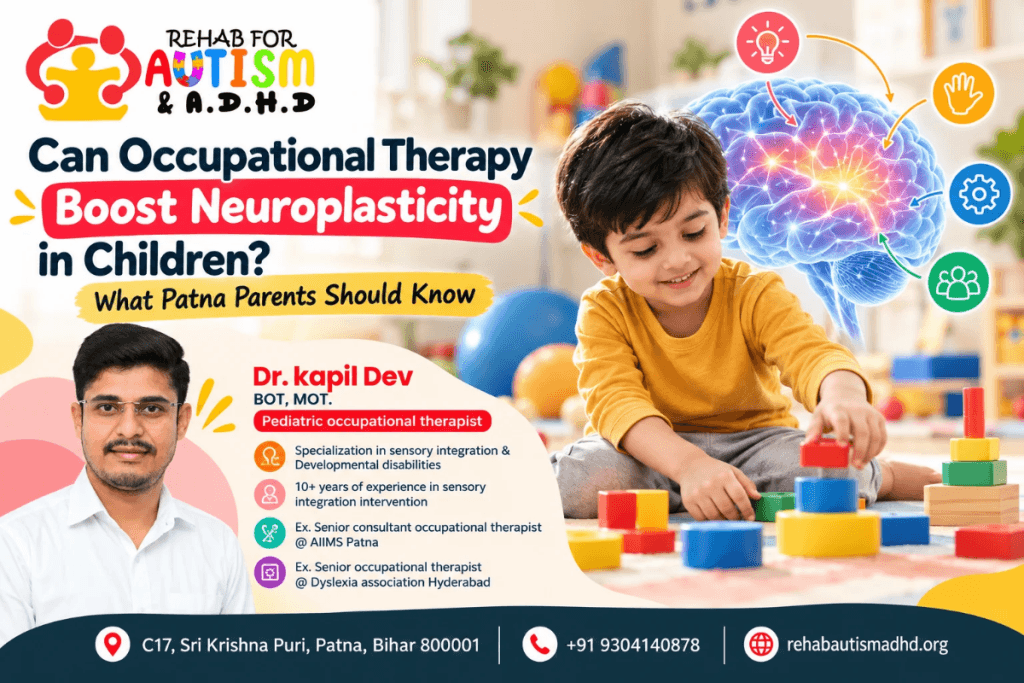
Yes. Occupational therapy can support neuroplasticity in children. Therapists use repeated, meaningful, play-based tasks that challenge the brain at the right level, and studies suggest this practice can improve motor, sensory and daily-living skills. Results depend on the child, the starting age, session quality and how much families practise at home.
- Neuroplasticity: the brain’s ability to build and strengthen connections through experience.
- How OT uses it: goal-based, repeated practice at a “just-right” level of challenge.
- Who it helps: children with autism, ADHD, Down syndrome, GDD and learning disabilities.
- What to expect: better daily skills. Brain changes on a scan are harder to prove.
Introduction
Your child fights the tag in a shirt, drops the pencil after two lines, or watches other children climb stairs without a hand on the rail. You wonder whether the brain behind those struggles can change. It can, and that ability has a name: neuroplasticity.
Occupational Therapy in Boring Road, Patna, puts that ability to work through structured, play-based practice. At Rehab for Autism & ADHD (C17, Sri Krishna Puri), pediatric occupational therapist Dr. Kapil Dev leads a team that treats children with autism, ADHD, Down syndrome and other developmental needs. This guide explains what neuroplasticity means, what research supports, where the evidence stays thin, and what you can do this week.
What is neuroplasticity, in plain words?
Your child’s brain holds billions of cells that talk to each other through connections. Each time a child repeats a movement, a sound or a thought, the connections involved get stronger and faster. Connections that nobody uses fade. Scientists call this experience-driven change neuroplasticity.
Young brains change fastest, which is why therapists push early assessment. Plasticity does not switch off at age six, though. School-age children and teenagers keep learning new skills too. The brain responds to what a child does often, with attention and a goal. It responds far less to what a child only watches. That single idea explains how occupational therapy works.
How does pediatric occupational therapy use neuroplasticity?
Pediatric occupational therapy helps children take part in their daily “occupations”: playing, eating, dressing, writing and learning. Therapists build each session around five principles that match how the brain learns:
- Repetition with variety. A child practises buttoning on big buttons, then small ones, then on a doll, then on a school shirt.
- The just-right challenge. Tasks that feel too easy teach little. Tasks that feel impossible cause shutdown. The therapist adjusts difficulty minute by minute.
- Meaningful goals. A child who wants to feed herself works harder than a child who traces shapes on a worksheet.
- Rich sensory input. Swinging, pushing, climbing and textured play give the nervous system organised sensation to learn from. This is the core of sensory integration therapy.
- Practice beyond the clinic. Therapists coach parents so the same skill shows up at the dining table and in the school bag.
What does the research say?
Researchers have argued for decades that sensory-motor experience reshapes the developing brain. A 2010 review in the American Journal of Occupational Therapy found a basis for the assumptions behind sensory integration theory, while warning that lab science cannot transfer directly to therapy. jefferson
Brain-imaging studies give a mixed picture. A systematic review of MRI studies in children with neurodevelopmental disorders concluded that rehabilitation can produce detectable brain changes, but it rated only 11% of the papers strong, 30% moderate and 59% weak. wiley
The fair summary: trial evidence for better everyday function keeps growing, while scan-based proof of brain change remains thinner. A good therapist promises skills, not scan results.
Five recent developments parents should know
1. 1 May 2025: a systematic review of randomised trials. Researchers pooled nine randomised trials with 344 children and concluded that Ayres Sensory Integration supports autistic children’s individual goals for performance, function and participation. The authors published it in the American Journal of Occupational Therapy. nih
2. August–October 2025: OT versus ABA in autism. A trial in Autism Research randomised children to occupational therapy using Ayres Sensory Integration, applied behavior analysis, or no treatment, and both active therapies improved individual goals and daily living skills at comparable levels. The paper appeared online on 15 August 2025 and in the October issue. Parents gain real choices from this result. citedriveclinicaltrials
3. 2025: OT plus a home program. In a randomised trial in the Journal of Autism and Developmental Disorders, children who received sensory-integration OT plus a home program scored significantly higher on occupational performance and satisfaction than children who followed the home program alone. Clinic sessions and home practice work better together. hacettepe
4. 2024: a small MRI study in toddlers. After 36 weeks of physical and occupational therapy, all five toddlers with unilateral cerebral palsy improved their motor function, and tractography showed small differences that may reflect altered brain connectivity. The study was small, so treat it as a signal, not proof. Frontiers in Neurology published it. nih
5. 30 April 2026: Bihar backs autism care. The Bihar cabinet approved a proposal for a Centre of Excellence for Autism in Patna to strengthen diagnosis, treatment and research. Later reporting placed the centre in Gardanibagh and listed preliminary diagnosis, speech therapy, behavioural therapy and parent counselling among its planned services. Patna Press reported both stories. Public attention to early diagnosis is rising, and families will need trained therapists nearby. patnapresspatnapress
Five real-world examples
These five scenarios are illustrative composites based on common presentations, not individual patient records.
Occupational Therapy for Autism: the child who refuses messy play
A four-year-old gags at wet sand and screams during hair-washing. The therapist starts with dry rice, then damp rice, then sand, and lets the child set the pace. Over weeks, the child tolerates more textures, and bath time gets easier. Parents repeat the same ladder at home. This is Occupational Therapy for Autism at work.
Occupational Therapy for ADHD: the child who cannot stay seated
A seven-year-old leaves his seat every five minutes and loses his place on the page. The therapist adds heavy-work breaks (carrying books, wall push-ups) before homework and builds a picture schedule. His seated time grows in small steps. This is Occupational Therapy for ADHD: building attention through movement, not demanding stillness.
Occupational Therapy for Down Syndrome: the child with tired hands
A five-year-old with low muscle tone drops her spoon and cannot manage buttons. The therapist builds hand strength with clay, tongs and pegboards, then moves to zips and buttons. Occupational Therapy for Down Syndrome often centres on hand strength, balance and self-care independence.
Occupational Therapy for GDD: the toddler who waits to be fed
A three-year-old with global developmental delay (GDD) lags in several areas at once. The therapist breaks “self-feeding” into small steps: grasp, scoop, lift, release. The child practises each step until it sticks. Occupational Therapy for GDD works on many skills side by side, so progress in one area supports the next.
Occupational Therapy for Learning Disabilities: the child whose handwriting hides her knowledge
A nine-year-old understands her lessons but writes slowly and untidily, so her marks suffer. The therapist trains visual-motor skills with tracing, letter-spacing games and posture adjustments. Occupational Therapy for Learning Disabilities targets the motor and sensory barriers, and teachers or special educators work on the learning itself.
Comparison table: what OT targets, by condition
| Condition | Main OT focus | Brain-friendly practice | Home carry-over |
|---|---|---|---|
| Autism | Sensory tolerance, play, daily routines | Graded sensory play, routine practice | Daily bath, meal and dressing steps |
| ADHD | Attention, self-regulation, handwriting | Movement breaks, visual schedules | Short homework blocks with breaks |
| Down syndrome | Hand strength, balance, self-care | Clay, tongs, buttons, stairs | Dressing and mealtime practice |
| GDD | Several skills at once, early self-care | Step-by-step task chains | Feeding and play routines |
| Learning disabilities | Handwriting, visual-motor skills, posture | Tracing, spacing games | Ten minutes of writing practice |
What does Occupational Therapy in Boring Road, Patna look like in practice?
At Rehab for Autism & ADHD, the process starts with an assessment led by Dr. Kapil Dev and the team. The therapists then build a one-to-one plan, with one child and one therapist in the room. Sessions run in a home-like setting so children feel safe enough to try hard tasks. Parents receive coaching, because home practice carries the skills forward.
The centre also offers speech therapy in Patna and behavior therapy under one roof, so therapists can coordinate goals. You can read more on the occupational therapy center in Patna page and meet Dr. Kapil Dev and the team.
The cost of delay
The brain keeps adapting, so starting late still helps. Waiting still carries real costs:
- Unhelpful habits, such as avoiding hand use or refusing foods, set in more firmly.
- School gaps widen, and a child’s confidence drops.
- Parents spend months worried instead of acting.
A single assessment answers the question “does my child need therapy?” and costs far less than months of guessing.
Conclusion
Occupational therapy does not magically rewire a child’s brain, and no honest therapist will promise that. It does something more useful: it gives the brain repeated, meaningful practice at the right level, and the research on daily skills keeps growing. If your child struggles with daily tasks, Occupational Therapy in Boring Road, Patna, offers a practical next step. Book an assessment and let the therapist show you where your child stands.
Call Us +91 9304140878 | Mail Us info@rehabautismadhd.org | Book an Appointment
FAQs
1. Can occupational therapy really change a child’s brain?
Therapy gives the brain repeated practice, and the brain adapts to practice. Trials show gains in daily skills. Scan evidence is still limited, so judge success by what your child can do.
2. When should my child start occupational therapy?
Start as soon as you notice a delay or a daily struggle. Younger brains adapt fastest, but older children still benefit.
3. How soon will I see results?
It varies. The Autism Research trial used 30 one-hour sessions, so expect weeks to months. Ask the therapist to set small goals and review them regularly.
4. Does OT help children with ADHD?
Yes. Occupational Therapy for ADHD focuses on self-regulation, attention, handwriting and routines, using movement and visual supports.
5. Can OT help Down syndrome, GDD and learning disabilities?
Yes. Therapists work on hand strength, self-care, handwriting and several early skills at once. The plan always depends on the child’s assessment.
6. What happens at the first visit?
The team assesses your child, listens to your concerns and drafts a one-to-one plan. Call +91 9304140878 or book online. The centre opens Monday–Saturday, 12 PM–8 PM.
Medical disclaimer
This article gives general information and does not replace advice from a qualified doctor or therapist. Every child is different. Consult a registered professional before you start or change any therapy.
Sources and further reading
- Systematic review of Ayres Sensory Integration RCTs, Am J Occup Ther, 1 May 2025: https://pubmed.ncbi.nlm.nih.gov/40193295/
- Schaaf et al., Autism Research, 2025: https://doi.org/10.1002/aur.70099
- OT with sensory integration for occupational performance, J Autism Dev Disord, 2025: https://research.hacettepe.edu.tr/en/publications/occupational-therapy-using-sensory-integration-for-enhancing-occu-2/
- Diffusion MRI after PT/OT in toddlers with cerebral palsy, Front Neurol, 2024: https://pmc.ncbi.nlm.nih.gov/articles/PMC11496308
- Rehabilitation-induced brain changes on MRI, systematic review: https://onlinelibrary.wiley.com/doi/10.1016/j.ijdevneu.2018.12.001
- Lane and Schaaf, Am J Occup Ther, 2010: https://jdc.jefferson.edu/otfp/23
- Patna Press, 30 April 2026: https://patnapress.com/bihar-autism-centre-excellence-patna-gardanibagh-approval/
- Patna Press, 24 May 2026: https://patnapress.com/center-of-excellence-for-autism-patna/