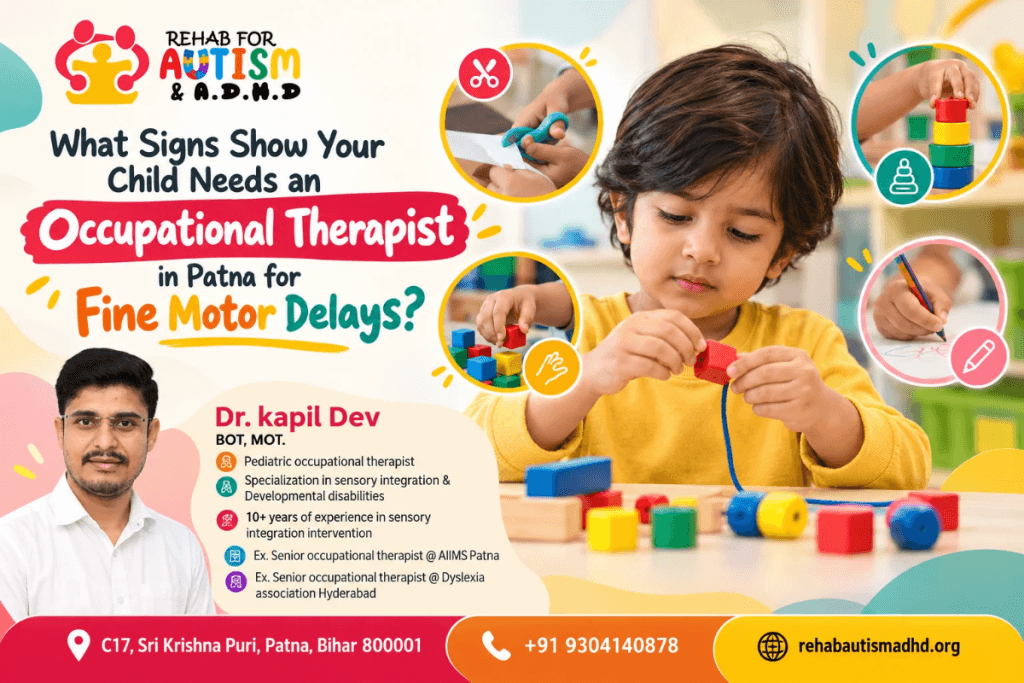
Your child may need an occupational therapist in Patna if they struggle to hold a pencil, use scissors, button clothes, feed themselves, or write legibly for their age. Other signals include avoiding drawing, tiring quickly when writing, and missing fine motor milestones. A pediatric occupational therapist assesses hand skills and starts therapy if needed.
Quick signs at a glance:
- Holds a pencil in a tight fist well past age 4–5
- Avoids drawing, colouring, puzzles or beads
- Struggles with buttons, zips, spoons or scissors
- Writes slowly, messily, or complains of a tired hand
- Seems clumsy or misses motor milestones
If your child grips a pencil like a dagger, cries over buttons, or finishes classwork long after everyone else, you may be searching for pediatric occupational therapy in Patna. These struggles often trace back to fine motor and gross motor skills that have not developed on schedule. This guide shows which signs matter, when to act, and what a pediatric occupational therapist does at an assessment.
Many Patna parents hear “he will grow out of it.” Sometimes children do catch up. Sometimes they don’t, and the gap becomes obvious once schoolwork begins. You don’t need to diagnose anything yourself. You only need to know what to watch for.
Fine Motor and Gross Motor Skills: What Is the Difference?
Fine motor skills use the small muscles of the fingers, hands and wrists. Picking up a bead, turning a page, cutting paper and writing all depend on them. Gross motor skills use the large muscles: sitting, crawling, walking, jumping and balancing.
The two work as a team. A child who slumps at the desk or tires from holding up their trunk has less energy left for hand control. Handwriting difficulties often reflect wider problems with fine motor control, postural stability or coordination. That is why an occupational therapist looks at the whole child and not just the hand.
Common Signs Your Child Needs Occupational Therapy for Fine Motor Difficulties
One sign alone rarely means a problem, because children develop at different speeds. Several signs together, lasting a few months, are worth an assessment.
Ages 2–4
- Avoids scribbling or drawing. Your child turns away from crayons or only makes a few quick marks.
- Struggles with blocks, beads or puzzle pieces. Small objects drop, or your child gets frustrated within seconds.
- Fumbles with a spoon. Your child needs far more help with feeding than other children of the same age.
Ages 4–6
- Uses a fist or an awkward pencil grip. Most children move toward holding the pencil between fingers and thumb around this age.
- Has trouble with scissors. Your child tears paper, holds the scissors upside down, or cannot cut along a line.
- Cannot manage buttons, zips or hooks. Your child still needs full help dressing when classmates dress independently.
Ages 6 and above
- Writes in a way others can’t read. Letters vary in size, float above the line, or crowd together.
- Tires quickly or presses too hard. Pencil tips snap, the hand cramps, and your child avoids writing tasks.
- Copies slowly from the board. Your child loses their place, reverses letters beyond the early grades, or leaves out words.
Handwriting Development: Why Writing Problems Often Start Before School
Handwriting development follows a sequence: scribbling, gripping, copying shapes, forming letters, spacing words, and finally writing at speed. A gap at any early step shows up later as messy or slow writing.
Occupational therapy for handwriting problems looks beneath the pen. A therapist checks hand strength, wrist stability, grip, visual-motor coordination, posture and attention. Practising letters repeatedly won’t help if the real issue is a weak grip or poor shoulder stability.
Many Patna students switch between English and Hindi script. Hindi adds the headline stroke and vowel marks, which demand extra control. A child who copes in English may struggle in Hindi, or the other way around.
Five Real-Life Situations Parents Describe
These are illustrative composites of what families commonly report. They are not individual patient records.
- Aarav, age 3½, refuses crayons and still can’t stack three blocks. His parents assumed he was “just not interested.”
- Ananya, age 5, needs help with every kurta button and tears paper when she tries to cut it. She dresses quickly only in clothes with elastic.
- Rohan, age 6, presses so hard that pencil leads snap. His hand shakes after five lines, so he starts avoiding homework.
- Ishita, age 7, is in Class 2. Her teacher writes “messy” on every page, and her Hindi matras sit in the wrong places.
- Kabir, age 4, trips often, slumps over the table and spills drinks. His clumsiness points to a gross motor component alongside the hand difficulties.
In each case, an assessment tells the family whether this is a normal variation, a skill that needs practice, or something that needs therapy.
What Recent Research and News Say
- Bihar’s new screening framework (April 24, 2026). At the Poshan Pakhwada closing ceremony in Patna, the state unveiled a Disability Protocol and Disability Screening Schedule for children aged 0–6. The same report says a referral system linking Anganwadi centres, ASHA and ANM workers, and district intervention centres is being strengthened. Early identification is becoming part of public policy in Bihar. (Source: Patna Press) patnapresspatnapress
- Handwriting and the brain (January 26, 2024). A Norwegian study in Frontiers in Psychology recorded brain activity in 36 university students. Handwriting produced far more elaborate connectivity patterns than typing, and the authors urged that children be exposed to handwriting activities from an early age. The participants were adults, so the findings suggest rather than prove an effect in young children. (Source: PubMed) nihnih
- Kids and fine motor skills (January 28, 2025). National Geographic reported that children appear to be losing fine motor skills, with screens a possible contributor. It noted that babies born in the first year of the pandemic scored lower on fine motor tests at six months. (Source: National Geographic) National GeographicNational Geographic
- Screen time and motor development (2025). An April 2025 systematic review examined how screen time in children under 5 relates to gross and fine motor development. A separate 2025 analysis of 3–4-year-olds found more screen time linked to lower odds of being on track for fine and gross motor skills. These are associations, not proof of cause. (Sources: PubMed Central, University of Strathclyde) nihstrath
- Milestones got a clearer benchmark (February 2022). The CDC and AAP revised their milestone checklists. The old versions listed skills that at least 50% of children could do. The new ones list skills that 75% can do. The change aims to discourage a wait-and-see approach. This is the most recent revision I found. (Source: Disability Scoop; Pediatrics, Feb 2022) disabilityscoopactiveforlife
Typical Development vs. Signs Worth Raising
Ages are approximate. Milestone checklists vary, so treat this as a guide and not a test.
| Skill | What many children can do | Signs to raise with a therapist |
|---|---|---|
| Pencil grip | Moves from a fist to fingers-and-thumb grip around age 4–5 | Fist grip or very tight grip after age 5 |
| Scissors | Snips paper around 3–4; cuts a line around 4–5 | Tears paper; cannot steady the paper with the other hand |
| Fasteners | Unbuttons around 4; buttons around 5 | Needs full help with buttons or zips by 6 |
| Copying shapes | Circle around 3; cross and square by 4–5 | Shapes stay scribbles after 5 |
| Handwriting | Prints some letters by 5; legible writing in early school years | Illegible, very slow, or painful writing in Class 2–3 |
| Posture and play | Sits upright for short tasks and runs and jumps with ease | Slumps, props head on arm, falls or bumps often |
What Happens at a Pediatric Occupational Therapy Assessment
At the Boring Road centre, the assessment covers gross and fine motor skills, handwriting, sensory processing, visual-motor skills, self-care and play. The team then sets a personalized therapy plan with clear, measurable goals. rehabautismadhdrehabautismadhd
Sessions run one child to one therapist. The centre is led by Dr. Kapil Dev (BOT, MOT), a former Senior Occupational Therapist at AIIMS Patna with 10+ years of experience. Parents also receive simple home activities after each session. rehabautismadhd
Bring your child’s school notebook, a few drawing samples, and a list of the tasks that cause trouble. These help the therapist see the real pattern.
Cost of Delay
Waiting isn’t harmless. Written work grows heavier from Class 3 onward, and a child who writes slowly falls further behind with each term. Frustration builds, and many children start avoiding writing, drawing and even play that needs small hand movements. Confidence suffers when classmates finish first.
The CDC’s own reasoning for revising its milestones was that a wait-and-see approach sometimes delayed diagnosis. Acting early costs you an assessment visit, and a delay costs your child time.
Conclusion
Fine motor delays are common, and they are manageable when someone spots them early. Watch for several signs at once, such as grip trouble, scissor struggles, dressing difficulty and tiring handwriting. If you recognise them, booking an assessment with an experienced occupational therapist in Patna gives you a clear answer and, if needed, a plan. You don’t have to wait for a school complaint.
📞 Call Us | 💬 Message Us | 📅 Book an Appointment
Rehab for Autism & ADHD, C17, Sri Krishna Puri, near Boring Road, Patna. Open Monday to Saturday, 12 PM to 8 PM.
Frequently Asked Questions
1. At what age should I worry about fine motor skills?
No single age applies to every child. Compare your child with milestone checklists, and book an assessment if you notice several signs lasting a few months. Concerns at any age are worth raising.
2. Is a fine motor delay the same as dyspraxia or dysgraphia?
No. They can overlap, but a delay describes a skill gap. Dyspraxia and dysgraphia are specific patterns that a qualified professional identifies after assessment.
3. How is occupational therapy different from handwriting practice?
Practice repeats the task. Occupational therapy for handwriting problems finds why the task is hard, such as weak grip, poor posture or visual-motor gaps, and builds those skills first.
4. Will my child outgrow it?
Some children catch up, and some don’t. You can’t tell which group your child belongs to without an assessment, so an early check is the safer path.
5. How long does therapy take?
It varies with the child, the goals and how often you attend and practise at home. The therapist sets measurable goals and reviews progress regularly.
6. What can I try at home before the appointment?
Offer play dough, bead stringing, tearing paper, clothes pegs, pouring water and helping with dough in the kitchen. Keep it playful and stop if your child gets frustrated. These activities support, but don’t replace, an assessment.
Medical Disclaimer
This article gives general educational information and isn’t medical advice, diagnosis or treatment. Children develop at different rates. Please consult a qualified pediatrician or occupational therapist about your child’s specific needs.
Sources & Further Reading
- Patna Press, “Bihar Tops India Again in Poshan Pakhwada 2026…” (April 24, 2026): patnapress.com/bihar-poshan-pakhwada-2026-disability-screening-anganwadi-smartphones/
- Frontiers in Psychology, “Handwriting but not typewriting leads to widespread brain connectivity…” (January 26, 2024): pubmed.ncbi.nlm.nih.gov/38343894/
- PsyPost, “Handwriting activates broader brain networks than typing” (December 19, 2024): psypost.org/handwriting-activates-broader-brain-networks-than-typing-study-shows
- National Geographic, “Kids are losing fine motor skills—and screens might be to blame” (January 28, 2025): nationalgeographic.com/science/article/why-kids-are-losing-fine-motor-skills
- “Assessing the Impact of Screen Time on the Motor Development of Children: A Systematic Review” (April 30, 2025): ncbi.nlm.nih.gov/pmc/articles/PMC12258109/
- Kwofie et al., sedentary behaviour and motor skills in 3–4-year-olds, University of Strathclyde (2025): strathprints.strath.ac.uk/92866/
- Disability Scoop, “CDC Revises Developmental Milestones For Young Kids” (February 10, 2022): disabilityscoop.com/2022/02/10/cdc-revises-developmental-milestones-for-young-kids/29698/
- Zubler et al., “Evidence-Informed Milestones for Developmental Surveillance Tools,” Pediatrics (February 2022)
- CDC, Learn the Signs. Act Early. program