There is no single center that is “best” for every child. The right Autism Treatment Center in Boring Road, Patna is the one that offers a certified pediatric occupational therapist, a genuine 1-to-1 therapy ratio, speech-language pathologists on staff, and a written assessment before starting therapy. Below is the full evaluation framework, backed by current research and data, so you can judge any center — including ours — on facts rather than marketing claims.
Why Parents in Patna Are Asking This Question More Often
Search interest around autism and ADHD care in Patna has grown steadily over the last two years, and the reason isn’t hard to find. In 2025, the INCLEN Trust International published the first large-scale, population-based study of neurodevelopmental conditions in India in PLOS Medicine. It found that roughly 1 in 100 children under age 10 in India show signs of autism, and nearly 1 in 8 children have at least one neurodevelopmental condition — a figure almost ten times higher than the 1.3% recorded in the 2011 census. That gap tells you something important: for decades, most Indian children with autism or ADHD simply weren’t being identified, let alone treated.
Patna families are catching up to this reality, and Boring Road — with its cluster of clinics, hospitals, and schools — has become the natural place to search for help. But a Google search for an Autism therapy centre in Patna now returns dozens of listings, many making similar claims. This article gives you a working framework to tell them apart, plus the recent research and news that should inform your decision.
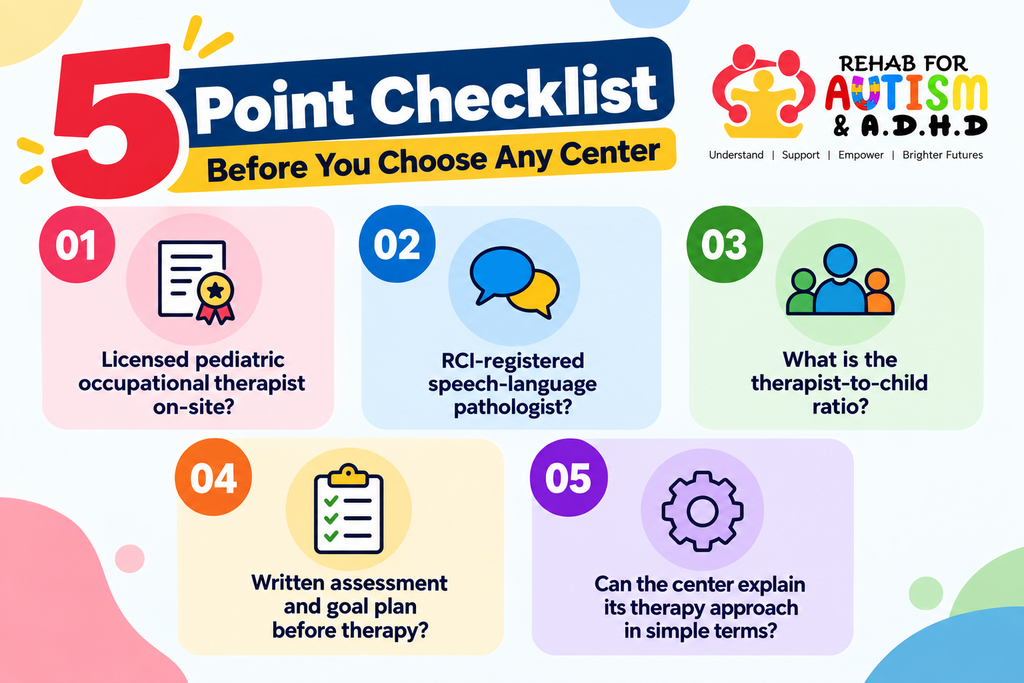
5-Point Checklist Before You Choose Any Center
Use this before booking your first appointment anywhere in Patna:
- Is there a licensed pediatric occupational therapist on-site, not just a general physiotherapist or “special educator” handling OT cases?
- Is speech-language therapy delivered by an RCI-registered speech-language pathologist, or outsourced/occasional?
- What is the therapist-to-child ratio during a session — one-on-one, or grouped with 3-4 other children?
- Is there a written assessment and goal plan before therapy starts, or does therapy begin without a formal evaluation?
- Can the center explain its therapy approach (sensory integration, behavior therapy, oral placement therapy) in plain language, and show you where sessions happen?
What “Best” Should Actually Mean: A Comparison Framework
Most articles answering “which center is best” either name-drop a business or make vague claims like “expert care” without giving you a way to check it yourself. Here is a criteria-based table you can literally carry into any clinic on Boring Road and score against.
| Evaluation Criteria | Why It Matters | Questions to Ask the Center |
|---|---|---|
| Therapist qualifications | A BOT/MOT-qualified occupational therapist and an RCI-registered speech-language pathologist are trained specifically for pediatric neurodevelopmental cases | “Can I see your therapists’ degrees and registration numbers?” |
| Therapist-to-child ratio | Individual attention allows the therapy plan to be adjusted session to session; group settings dilute this | “Is my child’s session 1-on-1 or shared with other children?” |
| Assessment process | A structured evaluation (not a five-minute chat) sets a measurable baseline | “What assessment tools do you use before starting therapy?” |
| Services under one roof | A child with autism often needs occupational, speech, and behavior therapy together — commuting between three different clinics adds stress and cost | “Do you offer OT, speech therapy, and behavior therapy at the same location?” |
| Environment | A calm, sensory-friendly, home-like space reduces meltdowns and improves engagement | “Can I see the therapy room before enrolling?” |
| Parent involvement | Therapy gains fade quickly without carryover at home | “Do you train parents on home strategies?” |
| Track record & reviews | Independent Google reviews (not just testimonials on the clinic’s own website) give an unfiltered picture | “Can I see your Google Business reviews?” |
Rehab for Autism and ADHD, located at C17, Sri Krishna Puri on Boring Road, was built around this exact checklist — it is led by Dr. Kapil Dev, a pediatric occupational therapist who previously worked as a Senior Occupational Therapist at AIIMS Patna, and the center runs a one-child-to-one-therapist model with occupational therapy, speech therapy, behavior therapy, and sensory integration therapy under a single roof.
Five Real-World Scenarios Parents in Patna Face
1. The late-talker at age 2.5. A toddler who isn’t combining words by 30 months is often told to “wait and watch” by well-meaning relatives. Research consistently shows the opposite: early intervention initiated before age 3 produces stronger gains in communication and adaptive skills than the same intervention started later. A Speech Therapy centre in Boring Road, Patna that accepts toddlers for evaluation — not just school-age children — is worth prioritizing for this age group.
2. The child who melts down over textures, tags, or noise. This is a classic sensory processing pattern, and it’s exactly what sensory integration therapy under occupational therapy is designed to address. Parents frequently mistake this for “bad behavior,” when it’s actually a nervous system regulation issue that a trained Occupational Therapy centre in Boring Road, Patna can assess with standardized sensory profiles.
3. The school-age child who can’t sit still or finish homework. This is often where ADHD gets picked up — usually by a teacher before a parent. A 2026 review in Frontiers in Psychiatry on ADHD in India found pooled prevalence estimates ranging widely (1.3%–28.9% across different studies, with a pooled figure near 7.1%), and noted that Indian children are frequently mislabeled “careless” or “unmotivated” in academically competitive settings instead of being clinically assessed. An Autism Doctor in Boring Road, Patna — or more precisely, a developmental pediatrician or occupational therapist trained in ADHD screening — can distinguish attention difficulties from a learning gap.
4. The diagnosed child whose parents are shopping for a second opinion. Not every diagnosis needs a second opinion, but families switching centers often report that their previous clinic ran group sessions with high child-to-therapist ratios, or that progress had plateaued. Switching to individualized therapy at an Autism Treatment Centre in Patna with documented goal-tracking often restarts measurable progress.
5. The family driving in from outside Patna city. Boring Road’s central location — close to A.N. College, Jyoti Punj Hospital, and GV Mall — makes it accessible by car or e-rickshaw from most parts of the city, which matters when therapy needs to happen two to three times a week, not once.
What Recent Research Actually Says About Therapy Outcomes
A few findings worth knowing before you commit to a therapy plan anywhere:
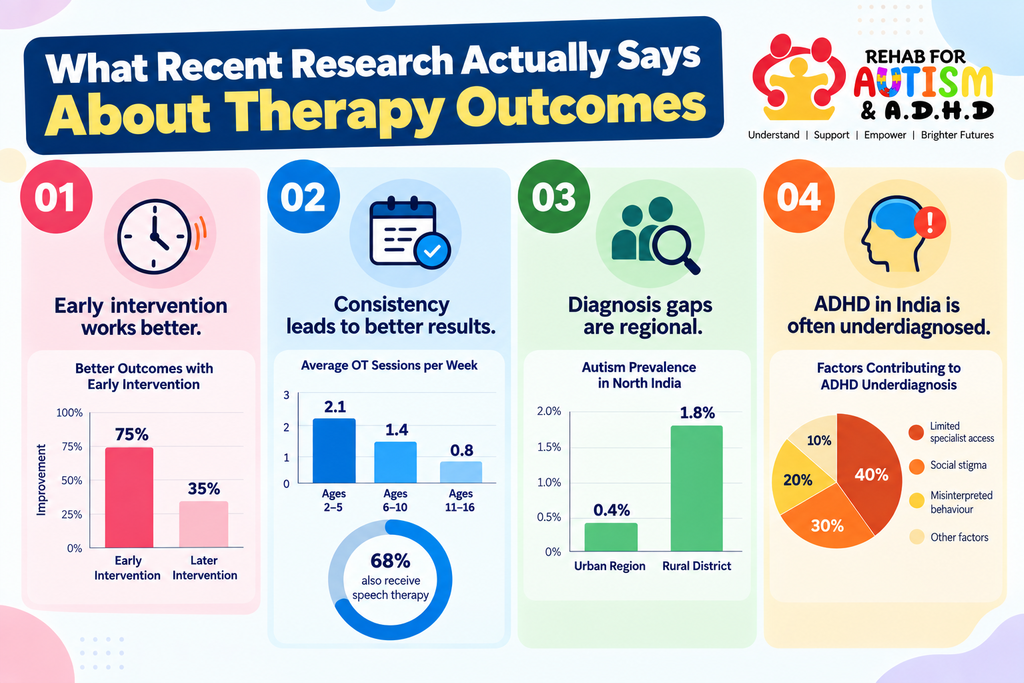
- Early intervention timing matters more than intensity alone. A 2025 narrative review in Cureus examining Early Intensive Behavioral and Developmental Interventions (including the Early Start Denver Model and Pivotal Response Training) found that occupational therapy and speech-language therapy, when integrated with broader developmental approaches and started young, produced measurably better communication, sensory regulation, and daily-living outcomes than therapy started later or delivered in isolation.
- Consistency beats occasional sessions. A 2025 analysis in the American Journal of Occupational Therapy tracking over 1,400 autistic children found that younger children generally received more frequent OT sessions per clinical guidance, and that a majority of children receiving OT were also receiving speech-language therapy at the same time — reinforcing why combined, one-location care tends to outperform fragmented care across multiple clinics.
- Diagnosis gaps are regional, not just individual. The INCLEN study found autism prevalence varying from 0.4% in one urban region to 1.8% in a rural district of North India, which researchers attributed largely to differences in awareness and access to screening — not actual biological differences in the population. This is directly relevant to Bihar, where formal screening infrastructure is still expanding.
- ADHD in India is systematically underdiagnosed, according to the 2026 Frontiers in Psychiatry review, partly due to limited specialist access outside major hospitals and partly due to social stigma that attributes behavioral symptoms to discipline problems rather than a neurodevelopmental condition.
Recent Developments Shaping Autism & ADHD Care in Patna and India
- The INCLEN Trust national prevalence study (published in PLOS Medicine, July 2025) gave India its first methodologically rigorous, population-level estimate of autism and neurodevelopmental conditions — a milestone that is already shaping how state health planners think about screening.
- World Autism Awareness Day 2026 (observed April 2, with the UN theme “Autism and Humanity — Every Life Has Value”) shifted the global conversation from pure awareness toward acceptance, accessibility, and inclusion in healthcare, schools, and workplaces.
- Dr. Kapil Dev of Rehab for Autism and ADHD shared a stage with medical experts at The Times of India’s “Understanding Autism” Conclave in Patna, part of a broader push to bring autism conversations out of metro cities and into Tier-2 cities like Patna.
- A 2026 epidemiology review in Frontiers in Psychiatry specifically flagged diagnostic inequity across Indian states as a public mental health concern, calling for context-specific screening models rather than importing Western diagnostic assumptions wholesale.
- WHO’s 2026 autism statement placed autism among the top 10 brain health conditions contributing to health loss worldwide, noting that access to timely, quality care remains uneven — a gap that regional centers like those on Boring Road are positioned to help close for Bihar families.
The Cost of Delaying Therapy
Waiting six months to “see if he grows out of it” is one of the most common — and costly — decisions parents make. Developmental windows for language and sensory regulation are most responsive between ages 2 and 6. Every month of delay isn’t neutral; it’s a month where a skill gap can widen rather than close on its own, and where school readiness pushes further out of reach. This doesn’t mean panic — it means treating an initial assessment as low-risk and high-value, even if you’re not sure your child needs ongoing therapy yet. An assessment costs far less, in time and stress, than a year of catch-up therapy started later.
Comparing Center Models: What You’re Actually Choosing Between
| Model Type | Typical Structure | Trade-off |
|---|---|---|
| Large group therapy classes | Several children per therapist, fixed curriculum | Lower cost per session, but less individualized attention |
| Single-therapy clinics (OT-only or speech-only) | Specialist in one discipline | Deep expertise in one area, but parents must coordinate multiple clinics for a child needing OT + speech + behavior therapy |
| Multidisciplinary 1:1 centers | One therapist per child, multiple disciplines under one roof | Higher consistency and easier scheduling, generally requires advance booking |
| Hospital-based developmental units | Attached to a larger hospital, doctor-led | Strong for initial diagnosis and medical comorbidities, often longer wait times for ongoing weekly therapy slots |
Rehab for Autism and ADHD operates on the multidisciplinary 1:1 model described in row three, combining occupational therapy, speech therapy, behavior therapy, and sensory integration therapy at one Boring Road location.
Sources & Further Reading
- INCLEN Trust International, national neurodevelopmental disorders prevalence study, PLOS Medicine, July 2025 — summarized at The Transmitter
- Chakrabarti B. et al., autism prevalence in school children, Kolkata, Autism Research, 2017 — NCBI PMC
- Mahin A. et al., “Attention-deficit/hyperactivity disorder in India: epidemiology, diagnostic inequities, treatment gaps,” Frontiers in Psychiatry, June 2026 — PMC
- Oringam M. et al., ADHD prevalence in urban and rural schools, Mysore District, Karnataka, January 2026 — PubMed
- Avula et al., “Impact of Early Intensive Behavioral and Developmental Interventions on Key Developmental Outcomes in Young Children With ASD,” Cureus, September 2025 — PMC
- World Health Organization, World Autism Awareness Day 2026 statement — WHO
- World Autism Awareness Day 2026 theme coverage — Business Standard
Evidence & Methodology Note (optional footer block for the published article, or keep internal-only)
- Data sources used: INCLEN Trust/PLOS Medicine (2025), Frontiers in Psychiatry (2026), Cureus (2025), American Journal of Occupational Therapy (2025), WHO (2026), Times of India event coverage — full citations above.
- Method: Publicly available peer-reviewed studies and health-authority statements published or updated within the last 12–18 months were prioritized over older sources; all figures are attributed to their original publication rather than restated as this center’s own outcomes.
- Abbreviations used in the article: ASD (Autism Spectrum Disorder), ADHD (Attention-Deficit/Hyperactivity Disorder), OT (Occupational Therapy), ST/SLP (Speech Therapy/Speech-Language Pathologist), EIBI (Early Intensive Behavioral Intervention), ESDM (Early Start Denver Model), INCLEN (International Clinical Epidemiology Network), WHO (World Health Organization).
- Suggested byline: “Reviewed by Dr. Kapil Dev, BOT, MOT, Pediatric Occupational Therapist” — only add this if Dr. Kapil Dev has actually reviewed the final published version; a false clinical-review byline is a compliance risk.
Medical Disclaimer
This article is intended for general educational purposes only and does not constitute medical advice, diagnosis, or treatment recommendations. Autism spectrum disorder, ADHD, and related neurodevelopmental conditions should only be diagnosed and treated by qualified healthcare professionals following an in-person evaluation. Every child’s needs are different, and therapy plans should be individualized by a licensed occupational therapist, speech-language pathologist, developmental pediatrician, or psychiatrist. If you have concerns about your child’s development, consult a qualified professional promptly rather than relying solely on information found online.
Conclusion
Choosing the right Autism Treatment Center in Boring Road, Patna isn’t about picking the clinic with the loudest marketing — it’s about checking therapist qualifications, therapist-to-child ratio, assessment process, and whether occupational therapy, speech therapy, and behavior therapy are genuinely available under one roof. National data now confirms what many Patna parents already suspected: autism and ADHD are far more common — and far more under-diagnosed — in India than previously assumed, which makes an early, well-informed evaluation one of the most valuable steps a family can take. Whichever Autism therapy centre in Patna you choose, use the checklist and comparison table above to ask direct questions before enrolling your child.
If you’d like a structured assessment for your child at our Sri Krishna Puri center on Boring Road, our team — led by Dr. Kapil Dev — is available Monday to Saturday, 12 PM to 8 PM.
📞 Call Us Now: +91 9304140878
💬 Mail Us : Rehabforautismandadhd2019@gmail.com
info@rehabautismadhd.org
📅 Book an Assessment: https://rehabautismadhd.org/book-appointment/
Rehab for Autism & ADHD, C17, Sri Krishna Puri, Boring Road, Patna, Bihar 800001 — Open Monday to Saturday, 12 PM to 8 PM.
Frequently Asked Questions
Is one autism treatment center really “better” than another in Patna? “Better” depends on your child’s specific needs — a toddler with a speech delay and a school-age child with sensory sensitivities may do best with different emphases. Judge centers on the checklist above rather than general reputation alone.
How do I know if my child needs occupational therapy, speech therapy, or both? A proper assessment should tell you this — not a guess over the phone. Most children on the autism spectrum benefit from both, since communication and sensory regulation are closely linked.
What age should a child start therapy? Earlier is generally better. Research on early intervention consistently links earlier start ages with stronger gains in communication and adaptive functioning, though therapy can still meaningfully help older children and adolescents.
Do I need a doctor’s diagnosis before starting therapy? A formal diagnosis helps with long-term planning and school documentation, but a qualified occupational therapist or speech-language pathologist can begin an assessment and early intervention even while a formal diagnosis is being pursued through an Autism Doctor in Boring Road, Patna.
How often should therapy sessions happen? This varies by child, but most evidence-based programs recommend at least one to three sessions per week for meaningful progress, decided jointly by the therapist and family based on the child’s plan.
Is ADHD treated differently from autism? Yes, though the two conditions frequently overlap and share some support strategies, particularly around attention, self-regulation, and behavior therapy. A center experienced in both should be able to explain how your child’s specific plan differs.