⚡ Quick Answer — What You Need to Know
Cerebral palsy (CP) is a group of neurological conditions that affect movement, posture, and muscle coordination. Occupational therapy (OT) helps children with CP gain independence in daily activities — eating, dressing, writing, playing — by targeting the specific motor, sensory, and cognitive challenges caused by their condition.
- Who needs it? Any child diagnosed with spastic, dyskinetic, ataxic, or mixed CP.
- When to start? The earlier, the better — ideally before age 6 when the brain is most adaptable.
- What does OT address? Fine motor skills, sensory processing, self-care, handwriting, posture, and play.
- How long does it take? Most children need consistent sessions over 6–24 months, depending on severity.
- Where to go in Patna? Rehab for Autism & ADHD is a certified Occupational Therapy centre in Boring Road, Patna, led by Dr. Kapil Dev (BOT, MOT).
What Is Cerebral Palsy — And Why It Affects Daily Life
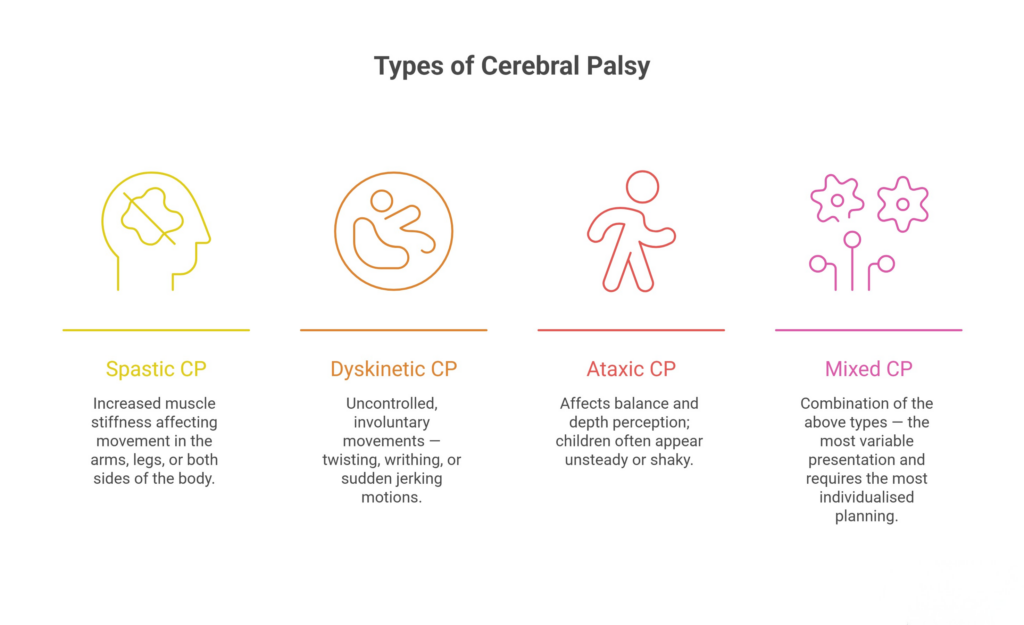
Cerebral palsy is the most common childhood physical disability worldwide. It results from damage to the developing brain — before, during, or shortly after birth — and affects how a child controls their muscles and body. Importantly, CP is not a disease that gets worse over time. It is a permanent, non-progressive condition, but its effects on a child’s ability to function in daily life can be profound if left without targeted intervention.
Children with CP may struggle with something as simple as holding a spoon, gripping a pencil, buttoning a shirt, or sitting upright in a classroom chair. These are not issues of intelligence or willingness — they arise because the brain’s signals to the muscles are disrupted. This is precisely where occupational therapy becomes indispensable.
What Is Occupational Therapy — And What It Is Not
Many parents in Patna are surprised to learn that “occupational therapy” for children has nothing to do with jobs or careers. In the world of paediatric rehabilitation, a child’s “occupation” is everything they need to do to grow up — playing, eating, learning, getting dressed, and joining their classmates at school.
At our Occupational Therapy centre in Boring Road, Patna, occupational therapists evaluate a child’s complete profile: their motor abilities, sensory processing patterns, visual-perceptual skills, and the routines that structure their day. From this, a specific, goal-directed treatment plan is created — not a generic programme, but one designed around what this child needs to do in this family’s life.
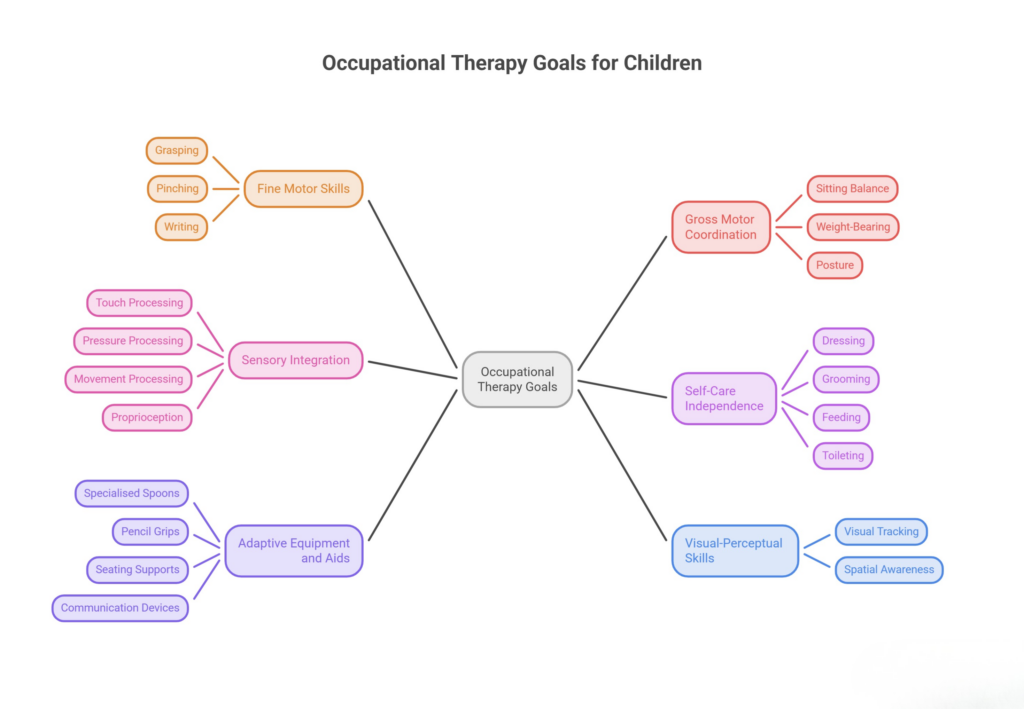
Core Areas Addressed by OT for Cerebral Palsy
- Fine motor skills: Grasping, pinching, writing, using cutlery, and manipulating small objects.
- Gross motor coordination: Sitting balance, weight-bearing, posture during activities.
- Sensory integration: Processing touch, pressure, movement, and proprioception (the sense of body position).
- Self-care independence: Dressing, grooming, feeding, and toileting tasks done with maximum possible independence.
- Adaptive equipment and aids: Recommending and training in tools like specialised spoons, pencil grips, seating supports, or communication devices.
- Visual-perceptual skills: Visual tracking and spatial awareness that support reading, writing, and safe movement.
📰 Recent Development — 2025 A 2025 systematic review published in Healthcare (MDPI) confirmed that new technologies including virtual reality, robotics, and assistive devices are emerging as effective tools within occupational therapy for children with cerebral palsy. These tools complement traditional hands-on therapy, helping improve motor and sensory outcomes in ways that were not possible a decade ago.
Why Early Intervention Is Non-Negotiable for Children with CP
The human brain is most adaptable during the first six years of life — a window that neuroscientists call neuroplasticity. During this period, the brain is actively forming new connections, and targeted therapeutic stimulation can literally reshape how the brain organises motor pathways. The longer a family waits, the smaller this window becomes.
This is why families visiting our centre — which also functions as an Autism Treatment Center in Boring Road, Patna — are consistently advised: do not observe and wait. If your child has received a CP diagnosis, begin a professional OT assessment within weeks, not months.
🔬 Research Finding — 2025 Meta-Analysis A major systematic review and meta-analysis registered with PROSPERO (CRD42025634706) and published in October 2025 in the Journal of Clinical Medicine reviewed randomised controlled trials from January 2024 through August 2025. The study evaluated OT-based interventions specifically for gross motor function and activities of daily living (ADL) independence in children with CP. The findings confirmed that structured OT programmes produce meaningful, measurable improvements in both motor function and independence in daily tasks — reinforcing the central role of occupational therapy in CP rehabilitation.
What Progress Really Looks Like — Three Real-Life Stories
Story 1 — Aryan, Age 4, Spastic Diplegia (Patna)
Aryan came to our centre unable to sit unsupported for more than a few minutes, and his hands were too tight to hold a spoon. After four months of twice-weekly OT sessions focusing on bilateral coordination, postural support, and progressive fine motor grading activities, Aryan began feeding himself independently. His mother, who had been hand-feeding him for four years, described this as “the moment our family changed.”
Story 2 — Sneha, Age 6, Mixed CP with Sensory Processing Difficulties
Sneha experienced meltdowns every morning during dressing because the sensory input of clothing on her skin was overwhelming. Our therapist introduced a structured “sensory diet” — specific tactile inputs in a graded sequence before dressing each morning. Within six weeks, Sneha’s morning routine had transformed. Her school attendance improved significantly because the daily battle at home had ended.
Story 3 — Rahul, Age 7, Ataxic CP and Classroom Struggles
Rahul’s teachers reported that he could not write legibly or maintain his seated posture. Our OT team evaluated his seating, provided a dynamic cushion and a pencil grip adapted to his hand strength, and added weekly sessions targeting hand-eye coordination. By the end of one school term, Rahul’s class teacher reported that he was completing written work and participating in group activities for the first time.
OT and the Connection to Speech, Behaviour, and Learning
Cerebral palsy rarely presents in isolation. Many children with CP also experience speech and language delays, learning differences, or behavioural challenges linked to frustration and sensory overload. This is why families who come to us for occupational therapy often benefit from coordinated care that brings in our Speech Therapy centre in Boring Road, Patna as well.
When a child’s hands work better, their ability to use communication devices, point to images, and engage in play-based interaction also improves. OT and speech therapy feed into each other in ways that multiply results. Similarly, when a child’s sensory system is better regulated through OT, they are calmer, more focused, and able to benefit more from learning environments — whether at home, at school, or in behaviour therapy sessions.
🔬 Research Finding — February 2025 A systematic review published in Healthcare (MDPI) in February 2025, drawing on searches across PubMed, Cochrane, Scopus, and five other databases, found that new technological approaches in OT — including robotic-assisted therapy and virtual reality-based exercises — significantly enhanced motor outcomes for children with CP when integrated with conventional occupational therapy. This signals a clear direction for how paediatric OT will evolve over the next five years.
The Role of Parents and Family in OT for CP
One of the most powerful — and most underestimated — factors in a child’s therapy progress is what happens outside the therapy room. Research consistently shows that children who practise OT-taught skills at home, guided by a well-informed parent, progress significantly faster than those who only practise during formal sessions.
At our centre, every OT session for a child with cerebral palsy is treated as a teaching session for the parent as well. We guide families on how to incorporate therapeutic activities into bath time, mealtimes, play, and the school routine. This is not extra work — it is the difference between a child who makes slow progress and one who surprises everyone.
Our team also conducts home programme counselling, where parents of children who visit our Autism Doctor in Boring Road, Patna — and those seeking CP rehabilitation — receive written, visual activity guides they can follow at home between sessions.
📰 Clinical Trial Update — 2026 A recently completed clinical trial at Lokman Hekim University (completed May 2025, published April 2026 on ClinicalTrials.gov) evaluated client-centred occupational therapy interventions specifically designed for the caregivers of children with cerebral palsy. The study confirmed that when OT addresses caregiver needs and skills directly — not only the child — the child’s overall functional outcomes and family quality of life improve substantially. This validates our family-inclusive approach at Rehab for Autism & ADHD.
What to Expect at Your First OT Session for a Child with CP
Many families come to us anxious about what therapy will look like for their child. Here is what actually happens at our Occupational Therapy centre in Boring Road, Patna during an initial assessment:
- Detailed parent interview: We want to understand your child’s daily routine, what they can and cannot do independently, and what goals matter most to your family.
- Standardised clinical evaluation: Dr. Kapil Dev and our OT team assess muscle tone, range of motion, fine and gross motor function, sensory responses, and daily living skills using validated paediatric assessment tools.
- Goal-setting discussion: You will be part of defining the therapy goals — not just told what will happen. Families who help set goals are more consistent in follow-through.
- Personalised therapy plan: Within the same session, you receive a written summary of findings and a proposed plan — the number of sessions per week, the focus areas, and the expected timeline for review.
📰 India Health News — 2025–2026
India’s rehabilitation therapy sector for children with developmental and neurological conditions is growing rapidly, driven by increased awareness of early intervention, government disability support schemes such as the RPWD Act 2016, and the expansion of specialised centres in tier-2 cities including Patna. Bihar families no longer need to travel to Delhi, Mumbai, or Hyderabad for quality paediatric OT — centres like Rehab for Autism & ADHD are bringing evidence-based care to the region.
How Rehab for Autism & ADHD Treats Children with CP — Our Approach
We are primarily known as a trusted Autism Treatment Center in Boring Road, Patna, but our clinical expertise extends fully to cerebral palsy, Down syndrome, global developmental delay, and other paediatric neurological conditions. Dr. Kapil Dev’s Master’s specialisation in sensory integration and developmental disabilities means that our approach to CP is grounded in the same evidence-based thinking that guides our autism and ADHD programmes.
Our CP Therapy Programme Includes:
- Neurodevelopmental therapy (NDT) techniques for normalising tone and facilitating movement
- Sensory integration therapy for children with CP who have secondary sensory processing difficulties
- Constraint-Induced Movement Therapy (CIMT) where appropriate, for children with hemiplegia
- Fine motor skill development using graded, play-based activities
- Assistive technology assessment and training — seating, pencil grips, adapted utensils
- School readiness and handwriting programmes for school-age children with CP
- Coordination with our Speech Therapy centre in Boring Road, Patna for integrated care
Conclusion
Cerebral palsy changes many things about a child’s development — but it does not close the door on a full, independent, and meaningful life. Occupational therapy is not a luxury or a supplement for children with CP. It is a core pillar of rehabilitation, supported by decades of research and thousands of individual success stories.
The children who make the most progress are those whose families start early, stay consistent, and choose a centre where they are treated as active partners in their child’s journey. At Rehab for Autism & ADHD, our Occupational Therapy centre in Boring Road, Patna, that is exactly the philosophy we work by — one child, one therapist, one goal at a time.
Whether your child has received a CP diagnosis recently or has been living with it for years, it is never too early and never too late to begin or intensify occupational therapy. Every week of intervention is a week of progress that cannot be taken away.
📍 Accessibility from Across Patna
Our centre at C17, Sri Krishna Puri is easily reachable from across central Patna. Families regularly visit from near Bihar Museum (900 m, 3 mins), Eco Park (1.9 km, 6 mins), Patna Museum (2.5 km, 8 mins), ISKCON Temple Patna (2.6 km, 7 mins), and Buddha Smriti Park (3.0 km, 10 mins). Families from the Sanjay Gandhi Biological Park (3.5 km, 9 mins) area, near Golghar (3.7 km, 14 mins), and P&M Mall (4.7 km, 16 mins) all reach us conveniently.
Consistent attendance is one of the most powerful factors in therapy progress. Choosing a centre close to home removes one of the biggest barriers to regular sessions.
Is Your Child Ready to Begin Occupational Therapy?
Book a free initial consultation with Dr. Kapil Dev and our team at Rehab for Autism & ADHD — the trusted Occupational Therapy centre in Boring Road, Patna.
Book Appointment: rehabautismadhd.org/book-appointment
Call Us: +91 93041 40878
Mail Us: info@rehabautismadhd.org
About the Author
Dr. Kapil Dev (BOT, MOT) is the Director of Rehab for Autism & ADHD, Patna. A Pediatric Occupational Therapist with 10+ years of specialised experience in sensory integration and developmental disabilities, he is a former Senior Occupational Therapist at AIIMS Patna. He leads a multidisciplinary team providing OT, speech therapy, behaviour therapy, and special education at C17, Sri Krishna Puri, Boring Road, Patna.
Frequently Asked Questions
Q. At what age should occupational therapy begin for a child with cerebral palsy?
A. The earlier, the better. The brain is most adaptable before age 6 — a period of high neuroplasticity. If your child has received a CP diagnosis, we recommend beginning an OT assessment as soon as possible. At our Occupational Therapy centre in Boring Road, Patna, we work with children from infancy through the school-age years. Even for older children and teenagers, OT continues to deliver meaningful functional improvements.
Q. How is occupational therapy different from physiotherapy for children with CP?
A. Physiotherapy primarily focuses on gross motor movement, walking, balance, and large-muscle function. Occupational therapy focuses on helping the child function in daily life — eating, dressing, writing, playing, and learning. For children with CP, both are valuable and often work best in coordination. Our centre provides OT and coordinates with physiotherapy professionals when needed.
Q. Does your centre treat conditions other than autism and ADHD?
A. Yes. While we are widely known as an Autism Treatment Center in Boring Road, Patna, our clinical team treats a full range of paediatric neurodevelopmental conditions including cerebral palsy, Down syndrome, global developmental delay, dyslexia, learning disabilities, and intellectual developmental disabilities. Dr. Kapil Dev’s specialisation in developmental disabilities makes our centre well-equipped for complex cases.
Q. Can occupational therapy help a child with CP write and attend mainstream school?
A. Yes, and this is one of the most common goals families bring to us. Our OT programme for school-age children with CP addresses handwriting (using graded pencil activities, adapted tools, and visual-perceptual training), classroom posture, attention, and the fine motor tasks that schoolwork demands. Many children we have worked with are now attending mainstream school successfully.
Q. How many sessions per week does a child with CP typically need?
A. This depends entirely on the child’s severity, age, and goals. Most children with CP benefit from 2–3 OT sessions per week in the early stages of therapy, combined with a structured home programme. After an initial assessment, Dr. Kapil Dev will recommend a specific frequency based on your child’s profile. Our Occupational Therapy centre in Boring Road, Patna operates six days a week to support consistent attendance.
Q. Is there a speech therapy option for children with CP who have communication difficulties?
A. Absolutely. Our Speech Therapy centre in Boring Road, Patna operates alongside our OT programme, and many children with CP benefit from both services. Our speech therapists address verbal communication delays, articulation difficulties, feeding and swallowing challenges (often present in CP), and augmentative communication strategies where needed. Coordinated OT and speech therapy is the most effective combination for children with complex needs.
Q. Do you have an Autism Doctor in Boring Road, Patna who also handles cerebral palsy?
A. Dr. Kapil Dev is a certified occupational therapist (BOT, MOT) with specialisation in paediatric conditions and sensory integration — not a physician, but a clinical expert. He serves as the lead therapist for all conditions at our centre, including autism, ADHD, and cerebral palsy. He previously served as Senior Occupational Therapist at AIIMS Patna, giving him deep clinical experience across a wide range of complex paediatric presentations.