Yes. Studies from 2024 and 2025 have demonstrated that proprioceptive input (deep pressure, joint compression, resistance and heavy muscle work) has a measurable positive effect on attention, decreases restlessness and helps with emotional regulation in children with ADHD, especially when it is administered as part of a planned occupational therapy program, rather than a random, one-time activity.
If you’ve seen your child crash into the sofa, hang upside down from the furniture, or push their whole body into a wall for no apparent reason, you’ve already seen proprioception in action. It’s not bad behavior. That’s your nervous system asking for information.
What Is Proprioceptive Input, Exactly?
Proprioception is the sense that tells the brain where the body is in space — through receptors in the muscles, joints and tendons. It’s the sixth sense that most people learn about in school, but it’s not often talked about until a child gets restless or clumsy, or has trouble sitting still.
In a child with ADHD, this internal feedback system may be under-responsive. The brain doesn’t process ” body position ” signals well . So the child unconsciously looks for strongerinput–jumping , bumping into people , chewing on sleeves , or pushing against furniture–to get a clearer picture of their own body .
Why the ADHD Brain Craves This Kind of Input ?
In 2025, a peer-reviewed neuroscience journal published a paper citing that motor learning in ADHD hinges on the simultaneous integration of multiple sensory channels, and that it’s not one faulty sense but inconsistent execution that makes up the condition. This is a handy distinction from autism where the brain tends to rely too much on proprioceptive feedback alone. In practical terms, it means that children with ADHD often need repeated and varied proprioceptive experiences to build a stable sense of body awareness, as opposed to a single type of input applied over and over.
A second systematic review of sensory-based interventions from 2015 to 2024 (2025) focused specifically on outcomes for children with ADHD and sensory processing challenges. It found that weighted tools used during movement, not just at rest, and other activities that combine proprioceptive and deep-pressure input, produced measurable improvements in sleep quality and daytime attention. The meta-analysis included two studies that found a statistically significant effect of better sleep, which is important since poor sleep in ADHD often results in increased impulsivity and a lack of focus the next day.
Research also estimates that 40% to 60% of children with ADHD have some form of sensory processing difficulty, with proprioception being one of the most commonly impacted systems. That’s a big enough number that most parents raising a child with ADHD will come across it in some form, even if no one’s named it yet.
Real examples that parents will know
The crash-and-bump child—the child who is always falling over onto cushions, wrestling with siblings, or slamming doors a little too hard. This is proprioceptive seeking and is generally well managed with scheduled heavy work activities such as pushing a loaded trolley or carrying grocery bags.
The class chair-rocker— a kid who is unable to sit still in a regular chair, but noticeably settles down on a wobble cushion or stability ball that provides constant, low level proprioceptive and vestibular feedback.
The bedtime resister, a child who falls asleep more easily after a warm bath and some firm blanket pressure, echoing the sleep findings above.
What’s New Recent Research and Local Developments
Interest in sensory-based, non-pharmacological support for ADHD has grown noticeably over the past year:
- A March 2025 randomized controlled trial on vestibular and proprioceptive exercises found a measurable drop in hyperactive behavior among children on the autism-ADHD sensory spectrum, adding to the case for structured, therapist-guided movement programs rather than unsupervised sensory play.
- The 2025 Frontiers systematic review referenced above is one of the most recent attempts to consolidate a decade of sensory-intervention research into practical, evidence-graded recommendations for occupational therapists.
- Locally, our own founder, Dr. Kapil Dev, shared a public platform with leading medical experts at the Times of India’s “Understanding Autism” conclave in Patna, where sensory processing and occupational therapy were discussed as central pillars of neurodevelopmental care in Bihar — a sign that this conversation is finally reaching families outside metro cities too.
Together, these developments point in the same direction: proprioceptive strategies work best when they are assessed, planned, and progressed by a trained professional — not applied at random.
How an OT Really Uses Proprioceptive Input ?
At a well run Occupational Therapy centre in Boring Road, Patna, proprioceptive work is never a shot in the dark. The first thing the therapist needs to do is to establish whether a child is a sensory seeker or avoider and to create a “sensory diet” – a planned series of activities such as swinging, resistance play, joint compressions or trampoline work, that are specific to the child’s nervous system and adapted as they get better. This is a lot different than just handing a child a weighted vest and praying they get something out of it.
Here again a proper diagnosis is of importance. Restlessness, difficulty concentrating, and clumsiness may look the same whether they are due to ADHD, a co-occurring sensory processing challenge, or something else entirely. That is why an evaluation at an Autism Treatment Center in Boring Road, Patna often starts with a comprehensive developmental and sensory assessment rather than immediately creating a therapy plan.
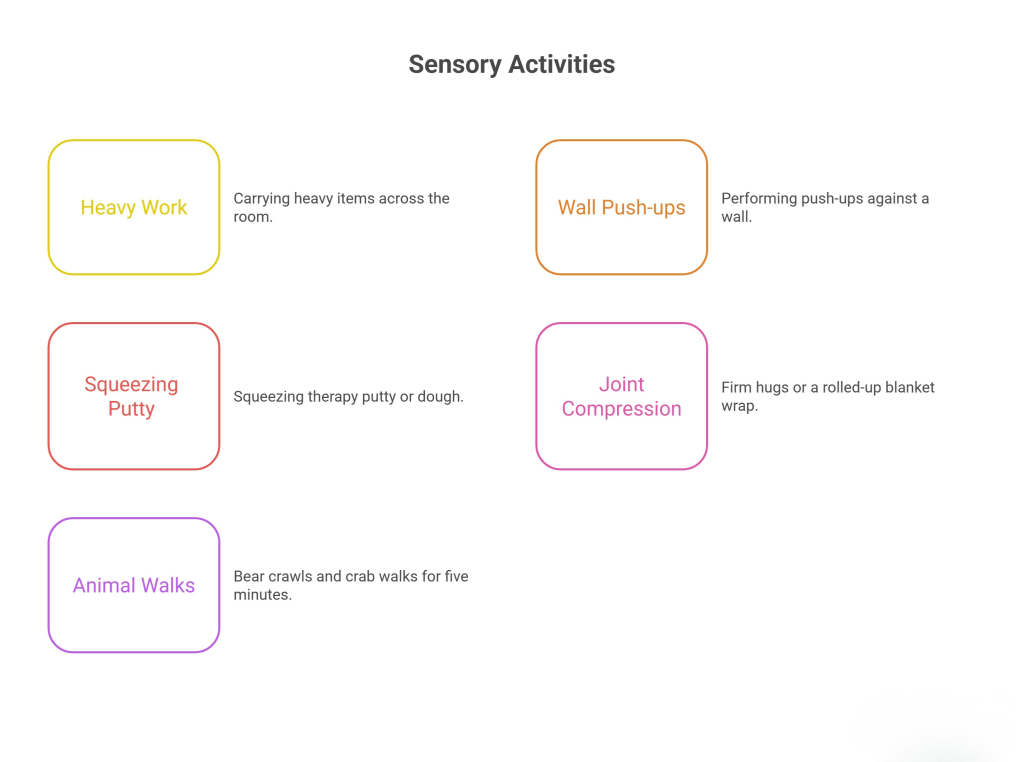
Simple Activities Parents Can Try at Home
- Carrying a heavy laundry basket or school bag across the room (“heavy work”)
- Wall push-ups before homework time
- Squeezing therapy putty or dough during quiet time
- Firm, joint-compressing hugs or a rolled-up “burrito” blanket wrap before bed
- Animal walks — bear crawls, crab walks — for five minutes between tasks
These are safe starting points, but they work best alongside — not instead of — a professional sensory assessment, especially if your child’s restlessness is affecting school performance or sleep.
When to See a Specialist
If sensory-seeking behavior is intense, disruptive, or paired with other developmental concerns like delayed speech or social difficulty, it’s worth consulting an Autism Doctor in Boring Road, Patna for a full evaluation rather than experimenting on your own. A correct diagnosis changes the entire therapy plan — what calms one child can overstimulate another.
Conclusion
Proprioceptive input is not a fad or a shortcut — it’s grounded in a growing body of 2024–2025 research showing real, measurable improvements in attention, sleep, and emotional regulation for children with ADHD. But the evidence is consistent on one point: it works best as part of a personalized, therapist-guided plan, not a Pinterest-style checklist of random activities. If your child is a proprioceptive seeker — crashing, climbing, chewing, or unable to sit still — that’s information, not misbehavior, and it deserves a proper assessment.
Ready to help your child feel calmer, more focused, and more in control of their body?
📞 Call Us Now: +91 9304140878
💬 Mail us: Rehabforautismandadhd2019@gmail.com
info@rehabautismadhd.org
📅 Book an Assessment: https://rehabautismadhd.org/book-appointment/
Frequently Asked Questions
Is proprioceptive input the same as sensory integration therapy? Not exactly. Proprioceptive input is one type of sensory input — the sensation of muscles and joints. Sensory integration therapy is the broader, therapist-led framework that may use proprioceptive activities alongside vestibular, tactile, and other sensory strategies.
Can proprioceptive activities replace ADHD medication? No. Sensory strategies are a supportive intervention, not a replacement for medical treatment. They work alongside behavioral therapy, and in some cases, medication, as part of a broader plan built with your child’s doctor and occupational therapist.
At what age can a child start proprioceptive-based occupational therapy? Most centers begin sensory assessments from toddlerhood onward, since early intervention tends to produce faster, more lasting improvements in self-regulation and motor planning.
How do I know if my child needs proprioceptive input or is just being active? A trained occupational therapist can tell the difference through a formal sensory profile assessment, which looks at patterns of seeking or avoiding behavior across different environments — home, school, and clinic.
How long before we see results from sensory-based therapy? Most published studies show measurable change within several weeks of consistent, individualized sessions, though timelines vary by child and by how consistently the sensory diet is followed at home.