Occupational therapy (OT) for autism and ADHD is not a single, standardized service. Outcomes depend heavily on the therapist’s specific training (such as Ayres Sensory Integration certification), the child-to-therapist ratio, whether goals are measured and reviewed, and how much the family is involved in the plan. Two clinics offering “OT” can produce very different results for the same child. Before you enroll anywhere — including an autism therapy centre in Patna — ask about the therapist’s credentials, session structure, and how progress is tracked.
Introduction
If you have searched for an occupational therapy centre in Boring Road, Patna, you have probably noticed something confusing: almost every center’s website says nearly the same thing. “Certified therapists.” “Personalized plans.” “Sensory-friendly rooms.” Parents are left comparing marketing language instead of comparing actual therapy quality.
That gap matters. Occupational therapy is one of the most researched, most recommended interventions for children with autism and ADHD — but the profession includes a wide range of training backgrounds, techniques, and levels of experience. A therapist who has completed advanced, certified training in sensory integration is not offering the same service as someone running loosely structured play sessions and calling it OT. This article breaks down what actually separates a strong occupational therapist from an average one, backed by recent research, real examples, and a practical checklist you can use before you book your first appointment.
What Occupational Therapy Actually Does for a Child with Autism or ADHD
Occupational therapy works on the everyday skills a child needs to function independently — holding a pencil, tolerating a noisy classroom, sitting through a meal, managing frustration without a meltdown, or getting dressed without a battle every morning. For children with autism, this frequently overlaps with sensory processing: many autistic children are either overwhelmed or under-responsive to sound, touch, light, or movement, and that sensory pattern affects almost everything else — attention, behavior, sleep, and learning.
A well-run autism treatment centre in Patna treats OT as one part of a bigger, coordinated plan — alongside speech-language support, behavior strategies, and family coaching — rather than an isolated 45-minute activity disconnected from the rest of the child’s day.
Why “OT” Is Not One Standard Service
Here is the part most families are never told: within the profession itself, there are multiple approaches, and they are not interchangeable.
- Training depth. Some therapists complete short workshops on sensory topics. Others complete multi-year, supervised, fidelity-checked certification in a specific model such as Ayres Sensory Integration (ASI). The difference in outcomes between the two is measurable, not theoretical.
- Session structure. Some clinics run group activity classes labeled “OT.” True sensory-integration-based OT is typically one-on-one, in an equipped sensory gym, with goals that are reassessed on a schedule.
- Goal tracking. A strong therapist writes measurable goals (for example, “tolerates group circle time for 10 minutes without leaving the mat”) and reviews them every few weeks. A weaker program offers vague reassurance (“he’s doing well”) with nothing written down.
- Family involvement. Skills built in a clinic room do not transfer home automatically. Therapists who actively coach parents produce faster, more durable progress than those who treat parents as bystanders.
Real-World Examples: What the Difference Looks Like
Example 1 — The child who “didn’t respond to OT.” A 5-year-old had attended six months of group sensory play sessions with no measurable change. When re-evaluated by a therapist trained in structured sensory integration, the root issue was identified — gravitational insecurity, not simple sensory-seeking — and a targeted, one-on-one program produced visible change within eight weeks, matching the improvement window reported in recent sensory-integration trials.
Example 2 — The handwriting myth. A 7-year-old was placed in generic “fine motor worksheets” for over a year. A properly trained OT identified poor core and shoulder stability as the actual cause of the shaky handwriting — a foundation issue worksheets alone cannot fix. Once trunk stability was addressed first, handwriting improved as a secondary result.
Example 3 — The teenager nobody planned for. Most local OT marketing targets toddlers. A 14-year-old with ADHD needed support with time management, transitions between subjects, and sensory regulation before exams — a very different OT goal set than what a 4-year-old needs, requiring a therapist experienced across age groups.
Example 4 — The “quiet child” who was actually overloaded. A child labeled “shy and withdrawn” at school was, on OT evaluation, found to be in a constant state of sensory shutdown from classroom noise and fluorescent lighting — not a behavioral or personality trait. A regulation plan (movement breaks, noise-reducing headphones, a quiet corner) changed classroom participation within weeks.
Example 5 — Two siblings, two different plans. Parents of two autistic siblings assumed one therapy plan would work for both. One child needed heavy proprioceptive input (deep pressure, weighted work) to stay regulated; the other was over-responsive and needed a calm, low-stimulation approach. Identical programs would have failed one of them — proof that individualized assessment is not optional.
What Recent Research Shows
Occupational therapy for autism is one of the more actively studied areas in pediatric rehabilitation right now, and 2025–2026 has brought several notable findings:
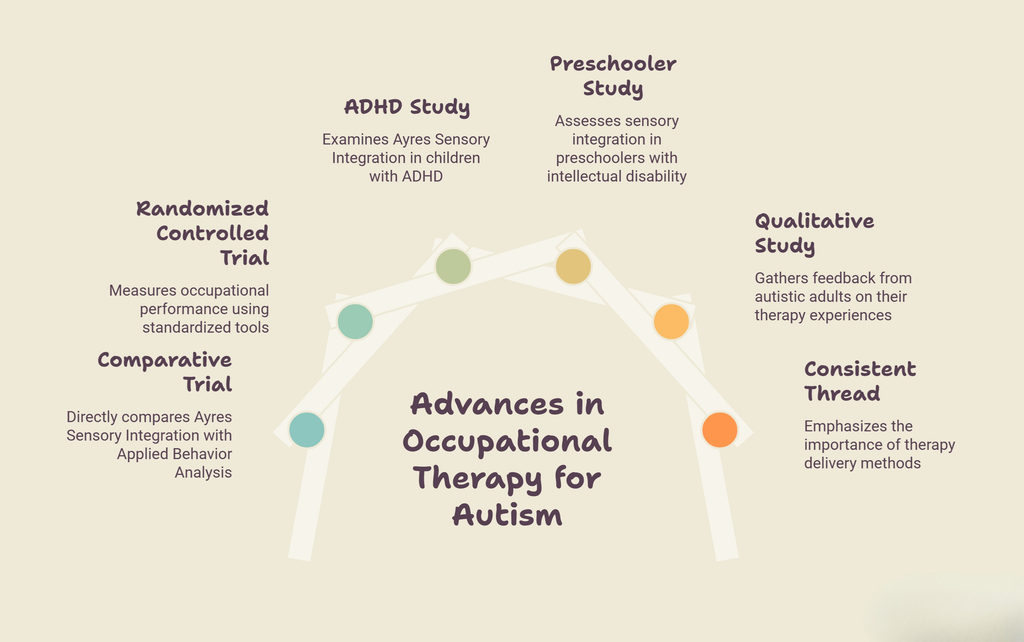
- A large NIH-funded comparative trial published in Autism Research (2025) directly compared Occupational Therapy using Ayres Sensory Integration against Applied Behavior Analysis approaches in autistic children, adding rigorous head-to-head evidence on how sensory-integration-based OT affects daily functioning — reinforcing that the specific model a therapist follows genuinely changes outcomes.
- A randomized controlled trial published in the Journal of Autism and Developmental Disorders (July 2025) measured occupational performance using the Canadian Occupational Performance Measure and Goal Attainment Scaling, showing that sensory-integration-based OT produced meaningful gains in individualized, family-identified daily goals — not just clinic-based test scores.
- A 2025 randomized controlled trial in the American Journal of Occupational Therapy examined Ayres Sensory Integration specifically in children with ADHD, expanding the evidence base beyond autism alone — relevant for families managing both diagnoses at once.
- A 2026 pre-post study on preschoolers with autism and co-occurring intellectual disability found improvements in communication, social skills, and daily living activities after structured, once-weekly sensory integration sessions, though researchers noted the need for larger, more rigorous studies — a useful reminder to ask any clinic what evidence supports their specific method.
- A 2025 qualitative study presented at the American Occupational Therapy Association’s conference gathered feedback directly from autistic adults about how they experienced sensory integration therapy as children — a growing and important shift toward including autistic voices in evaluating whether therapy actually felt helpful, not just whether it “worked” on paper.
The consistent thread across this research: outcomes are tied to how therapy is delivered — the specific model, the training behind it, and whether goals are individualized — not just the number of sessions attended.
What’s Happening in Autism & OT Care Right Now
- Autism is legally recognized as a disability under India’s Rights of Persons with Disabilities Act, 2016, giving children statutory entitlements to education support and certification — yet implementation still varies significantly by state, which is why families need to actively advocate for services rather than assume they’ll be offered automatically.
- Professional training and regulation for occupational therapists in India falls under the Rehabilitation Council of India (RCI) framework, which is exactly why checking a therapist’s registration number is a legitimate, meaningful screening step — not a formality.
- World Autism Awareness Day 2026 saw institutional programs at universities and hospitals across India centered on inclusion and lived experience rather than only diagnosis statistics, reflecting a broader shift in how autism is discussed publicly.
- Teletherapy and hybrid OT support have expanded access for families in smaller cities and towns, though most clinicians still agree that hands-on sensory work is difficult to fully replace remotely for younger children.
- Awareness events, including public conclaves bringing together pediatric specialists to discuss autism care, are increasingly common in Tier-2 cities like Patna — a sign that the conversation is moving beyond metro cities and that local families now have more informed options than they did even a few years ago.
Green Flags vs Red Flags: How to Evaluate a Therapist
| What to Check | Green Flag | Red Flag |
|---|---|---|
| Credentials | BOT/MOT degree, registered with RCI/state OT council, visible registration number | Vague “certified therapist” claim with no registration number shown |
| Assessment | Formal evaluation before therapy starts, written baseline | Therapy begins the same day with no assessment |
| Session ratio | One child, one therapist | Large group “batches” labeled as individual OT |
| Goals | Specific, measurable, reviewed every 4–8 weeks | General statements like “improving nicely” with nothing documented |
| Method | Named, evidence-based approach (e.g., sensory integration, fidelity-checked) | No explanation of which method is used or why |
| Family role | Parents coached on home strategies | Parents kept outside the therapy room with no guidance |
| Environment | Equipped sensory gym, safety measures visible | Repurposed general room with minimal equipment |
| Age range | Experience across toddlers, school-age, and teens | Programs built only for very young children |
How to Choose the Right Occupational Therapy Centre in Boring Road, Patna
When evaluating any occupational therapy centre in Boring Road, Patna, ask these questions directly, and expect direct answers:
- What is your therapist’s degree and registration number?
- Which specific therapy model do you use, and why is it appropriate for my child?
- Will my child have one-on-one sessions or group sessions?
- How will I know if therapy is working — what gets measured, and how often?
- Will you show me how to continue skills at home?
- Do you also coordinate with speech therapy or behavior support if my child needs it?
A center that answers these clearly — without deflecting to general reassurance — is far more likely to deliver consistent progress than one that relies on ambience and marketing alone.
The Cost of Waiting
Delaying therapy is not a neutral choice — it is a decision with consequences. Sensory and motor patterns that go unaddressed in early childhood tend to become more deeply established, harder-to-shift habits by school age. A child who struggles to sit, focus, or manage frustration at age 4 often carries that same struggle into a classroom at age 7, now compounded by academic pressure and social comparison with peers. Every additional month without a structured plan is a month the child spends practicing the unhelped pattern, not the corrected one. Early intervention consistently produces faster, more durable results than the same intervention started years later — one more reason an evaluation now is worth more than a “wait and see” approach with a growing child.
Medical Disclaimer
This article is for general educational purposes only and does not replace individualized medical, psychological, or therapeutic advice. Every child’s needs are different, and only a qualified, in-person evaluation by a licensed occupational therapist, pediatrician, or developmental specialist can determine an appropriate diagnosis or treatment plan. If you have concerns about your child’s development, please consult a qualified healthcare professional promptly rather than relying solely on information found online.
Conclusion
Choosing occupational therapy for a child with autism or ADHD is not just about finding a nearby clinic — it is about finding a therapist whose training, method, and structure actually match what your child needs. The research is consistent: individualized, well-supervised, family-inclusive therapy produces better outcomes than generic, unstructured sessions, regardless of how similar the marketing sounds. If you are evaluating an autism doctor in Boring Road, Patna, or comparing therapy centers across the city, use the questions and checklist in this article as your starting point — your child’s progress depends on getting this decision right the first time.
Ready to get a real evaluation for your child?
📞 Call Us Now: +91 9304140878
💬 Mail Us : Rehabforautismandadhd2019@gmail.com
info@rehabautismadhd.org
📅 Book an Assessment: https://rehabautismadhd.org/book-appointment/
Rehab for Autism & ADHD, C17, Sri Krishna Puri, Boring Road, Patna, Bihar 800001 — Open Monday to Saturday, 12 PM to 8 PM.
Frequently Asked Questions
1. How do I know if a therapist is actually qualified, and not just calling themselves an “OT”? Ask for their degree (BOT/MOT) and their registration number with the Rehabilitation Council of India or the relevant state OT council. A legitimate therapist will share this without hesitation.
2. Is group therapy less effective than one-on-one occupational therapy? For children with autism, one-on-one sessions generally allow more precise, individualized sensory and motor work. Group formats can be useful for social-skill practice, but they should not replace individualized OT for core developmental goals.
3. How soon should I expect to see progress? This varies by child, but recent trials have documented measurable gains within a period of roughly two to three months of consistent, individualized sensory-integration-based therapy. A therapist should be able to explain your child’s specific goal timeline.
4. Can occupational therapy help with ADHD, or is it only for autism? Yes. Recent randomized controlled trials have specifically studied sensory-integration-based OT in children with ADHD, showing it can support attention, self-regulation, and daily functioning alongside other ADHD interventions.
5. Is occupational therapy useful for teenagers, or only young children? It is useful across ages. Older children and teens often need OT support for time management, transitions, sensory regulation in academic settings, and independent living skills — not just fine motor tasks.
6. What is the difference between speech therapy and occupational therapy? Speech therapy focuses on communication and language. Occupational therapy focuses on sensory processing, motor skills, and daily functional independence. Many children benefit from both, delivered as a coordinated plan rather than in isolation.
Sources & Further Reading
- Schaaf, R., et al. “A Comparative Trial of Occupational Therapy Using Ayres Sensory Integration and Applied Behavior Analysis Interventions for Autistic Children.” Autism Research, 2025. onlinelibrary.wiley.com/doi/10.1002/aur.70099
- Çorakcı Yazıcıoğlu, Z., Bumin, G. “Occupational Therapy Using Sensory Integration for Enhancing Occupational Performance in Children with Autism: A Randomized Controlled Trial.” Journal of Autism and Developmental Disorders, 2025. link.springer.com/article/10.1007/s10803-025-06970-1
- Kaplan, B.H., Bumin, G., Öğütlü, H., et al. “Comprehensive Effects of Occupational Therapy Using Ayres Sensory Integration in Children With ADHD: A Randomized Controlled Trial.” American Journal of Occupational Therapy, 2025. research.aota.org
- “Sensory Integration Therapy for Preschool Children with Autism Spectrum Disorder and Co-Occurring Intellectual Disability.” Children, 2026. mdpi.com/2227-9067/13/4/569
- Copuyoc Khou, L.A., Rios, J.O.S., Angell, A.M. “Sensory Integration in Retrospect: How Did Autistic Adults Experience Sensory Integration Therapy as Children?” American Journal of Occupational Therapy, 2025. research.aota.org
- “Autism Awareness in India: Current State.” SETU Consortium / Pinnacle Blooms Network, 2026. pinnacleblooms.org
- Rights of Persons with Disabilities Act, 2016 — Government of India (official text via India Code portal).