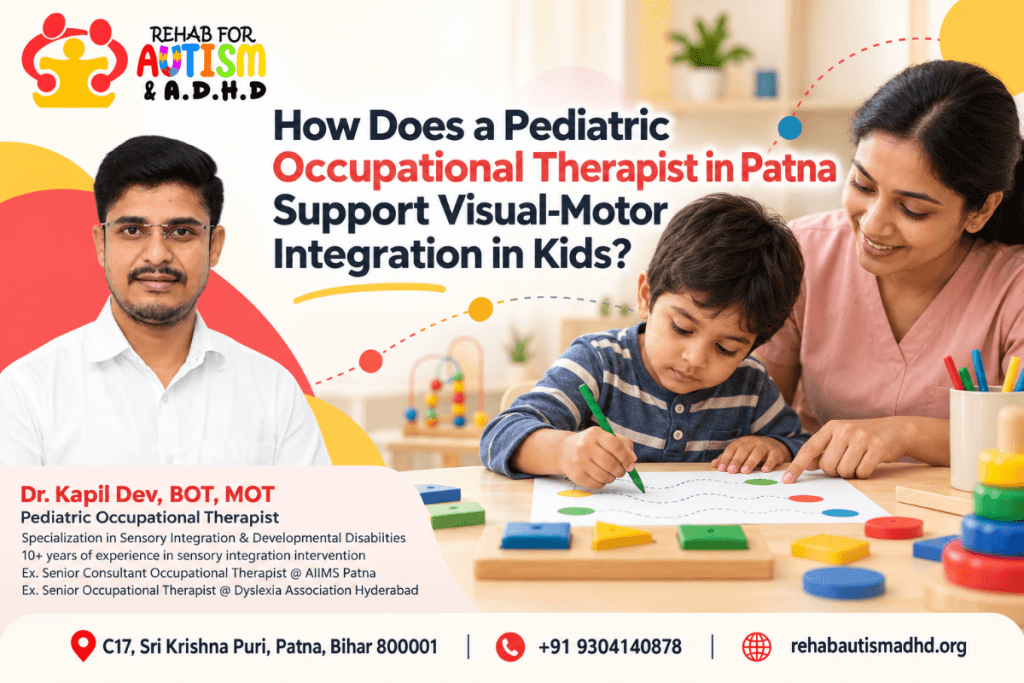
A pediatric occupational therapist in Patna supports visual-motor integration by first measuring how well a child’s eyes and hands work together, then using play-based activities to build that link. Therapy trains visual perception, hand control, and planning, so children copy shapes, write neatly, cut, catch, and complete daily tasks with less effort.
Therapy works on four things:
- Visual perception (making sense of what the eyes see)
- Fine motor control (pencil, scissors, buttons)
- Hand-eye coordination (catching, aiming, copying)
- Posture and motor planning (the base for steady hands)
Introduction
A child can look at a triangle on the board and still draw something closer to a lopsided circle. Parents in Patna often hear this described as careless handwriting or lack of effort. Often the cause sits elsewhere: the eyes and hands are not passing information to each other smoothly. Therapists call this skill visual-motor integration, or VMI. A pediatric occupational therapist measures it, finds the weak link, and builds it through play. This guide explains how that process works, what recent research says, and when to book an assessment for occupational therapy for children in Patna.
What Is Visual-Motor Integration, and Why Does It Matter?
Visual-motor integration is the brain’s ability to turn what the eyes see into a matching hand movement. Copying a letter, cutting along a line, threading a bead, catching a ball, or fastening a button all rely on three systems working together: vision, visual perception, and motor control. A weakness in any one can look like a problem in all of them.
VMI develops in a predictable order. Children roughly copy a vertical line around age two, a circle around three, a cross around four, a square around four to five, and a triangle near five. Ages vary, so treat these as guideposts, not deadlines.
At school, VMI shapes handwriting, spacing, copying from the board, and lining up maths columns. At home, it shapes dressing, eating, drawing, and play. A 2021 systematic review in Occupational Therapy International pulled together 24 articles on VMI in children with developmental disabilities and the role of occupational therapy, which shows how widely researchers study this skill.
Signs a Child May Need Help With Visual-Motor Integration
One sign alone rarely means much. A cluster that lasts is worth a professional look:
- Copies from the board slowly, loses place, or skips lines (in English or Hindi)
- Reverses or mis-sizes letters well beyond the early primary years
- Avoids drawing, colouring, puzzles, or building toys
- Struggles with scissors, buttons, zips, or laces
- Drops catches, misjudges distance, or bumps into furniture
- Grips the pencil very tightly and tires after a few lines
- Writes with uneven spacing and drifts off the line
- Speaks well but produces written work far below that level
Book an eye check as well. Vision problems can look similar, and the next section explains why therapists ask about it first.
How a Pediatric Occupational Therapist in Patna Supports Visual-Motor Integration
At Rehab for Autism & ADHD on Sri Krishna Puri, near Boring Road, Dr. Kapil Dev (BOT, MOT), a former senior occupational therapist at AIIMS Patna, leads a team that works one-on-one with each child. Sessions are play-based and goal-driven. Here is how the process usually runs.
Step 1: A detailed assessment
The center’s assessment looks at gross and fine motor skills, handwriting, sensory processing, and visual-motor and visual-perceptual skills, then sets measurable goals. Occupational therapists in many countries also use standardized tests such as the Beery-Buktenica Developmental Test of Visual-Motor Integration. In that test, the child imitates the first few shapes, then copies a series of forms that get harder. Ask your therapist which tools they use and when they will re-test, so you can see progress in numbers as well as in notebooks.
Step 2: Rule out vision problems first
Uncorrected eyesight can mimic or worsen a visual-motor problem. If a child has not had a recent eye test, the therapist suggests one with an eye doctor. Glasses and therapy then work side by side.
Step 3: Build the base with fine and gross motor skills development
Steady hands start at the shoulders and trunk. A 2015 South African study of Grade 2 children linked weak trunk stability with slower handwriting, which matches what therapists see in clinics. So early sessions often include crawling games, wall push-ups, swinging, and balance work before the pencil comes out. Strong fine and gross motor skills development gives the eyes something stable to guide.
Step 4: Practise visual-motor integration activities for children
Once the base is steady, therapy moves from big movements to small ones. Typical visual-motor integration activities for children include:
- Drawing and tracing on a vertical surface, such as an easel or wall
- Copying block designs and pegboard patterns
- Mazes, dot-to-dot pages, and line-tracing games
- Bead lacing and cutting along curved lines
- Copying shapes in the order children learn them: line, circle, cross, square, triangle
The therapist raises difficulty only when the child succeeds, because frustration shuts down learning.
Step 5: Add hand-eye coordination therapy for kids
Hand-eye coordination therapy for kids uses ball catching, bean-bag target throws, balloon volleyball, and obstacle courses. In the center’s sensory gym, swings and movement tasks keep children alert and calm while they practise tracking and reaching. Children with sensory processing difficulties often need this step before pencil work feels comfortable.
Step 6: Coach parents and review progress
Progress speeds up when practice continues at home. Each session ends with simple home activities, and the therapist reviews goals regularly as the child grows. Some children also benefit from speech therapy, behaviour support, or special education, and having these under one roof keeps the plan consistent.
Five Real-World Examples
These are composite scenarios based on common patterns, not individual client records.
1. The slow copier (age 6, Class 1). A child answers questions quickly yet needs twice as long as classmates to copy from the board, and letters drift off the line. Assessment shows weak tracking from board to notebook and low shoulder stability. Therapy starts with vertical-surface drawing, then moves to near-point copying. This pattern drives many referrals for occupational therapy for handwriting problems in kids.
2. The child who avoids drawing (age 4, autism). The child refuses crayons and puzzles and dislikes messy textures. The therapist pairs sensory play with short copying tasks that end in success. Visual-motor work and sensory work often run together for children with autism.
3. The distracted copier (age 8, ADHD). A child loses their place in maths columns and skips lines. Colour-coded grids, shorter tasks, and movement breaks help, and the teacher receives two or three simple classroom strategies.
4. The late builder (age 3, developmental delay). A child cannot stack blocks or imitate a vertical stroke. Occupational therapy for developmental delay in children starts with grasp and hand strength, then imitation of lines and circles, then copying. Starting early gives the child more time to catch up before school demands writing.
5. The child who misses catches (age 9). A keen gully-cricket player drops catches and bumps into desks. Ball-tracking drills, balance work, and hand-eye coordination therapy build timing, and the child’s confidence in games returns with it.
Five Recent Studies and News Items
May 18, 2026: India’s eye doctors urge yearly checks. The All India Ophthalmological Society released guidelines for World Myopia Week 2026 that recommend annual eye exams, school vision screening, and about two hours outdoors daily. School screenings by Sun Pharma across 13 cities found roughly 13.6 per cent of more than one lakh children had myopia. Source: PTI, via The Week. This supports the therapist’s habit of asking for an eye check first.
May 13, 2026: Early screens and toddler development. A scientific letter in the Indian Journal of Pediatrics studied 140 children aged 18 to 24 months. About 68 per cent started screens before 18 months, and early exposure was linked with higher odds of abnormal gross motor and personal-social development. The study is observational, so it shows association, not proof of cause.
January 2026: Kolkata study on screen time. A Cureus study of children aged 1 to 6 at a Kolkata pediatric institute found that about 68 per cent had more than two hours of daily screen exposure, and 15 children (18.7 per cent) showed fine motor delay on the screening chart. Eastern India’s data matches what Patna clinics see.
March 26, 2025: Each extra hour counts for eyes. A meta-analysis in JAMA Network Open, covering 45 studies and 335,524 participants, found that each added hour of daily screen time raised the odds of myopia by 21 per cent. Source: The South First.
July 22, 2021: The evidence base for OT. The Occupational Therapy International systematic review (24 articles) remains a key reference for VMI in children with developmental disabilities. It is older, but it anchors the research behind therapy.
Comparison: Ways Families Try to Help
| Approach | What it targets | Limits | Parent role |
|---|---|---|---|
| Extra handwriting practice or tuition | Letter formation | Repeats the task without fixing the base skill | Supervise homework |
| Screen-based tracing apps | Finger tracing | Flat screen, little body movement, adds screen hours | Limit time |
| Eye test alone | Eyesight | Cannot treat hand control or planning | Book and follow up |
| Pediatric OT for visual-motor integration | Vision-to-hand link, posture, motor planning, practice | Needs regular sessions and home practice | Practise short daily activities |
Cost of Delay
Visual-motor gaps rarely stay still. As lessons shift from colouring to long copying tasks, a child who is behind falls further behind. Many children respond by avoiding writing, rushing, or acting out, and teachers may read this as low effort. Confidence drops, homework takes hours, and more screen time fills the gap. Nobody can promise results, but starting assessment early gives therapy more time to work before school demands peak.
A Note for Grandparents, Teachers and Doctors
Grandparents: you often supervise homework. If a child tires quickly or hates copying, share it with the parents instead of urging more practice. Carrom, rangoli, kite flying, and kneading atta dough all build hand-eye coordination safely.
Teachers and pediatricians: a short referral note describing copying speed, pencil grip, and missed catches helps the therapist start with focus.
Conclusion
Visual-motor integration connects what a child sees with what the hands do. When that link is weak, handwriting, play, and confidence suffer, and effort alone does not fix it. A pediatric occupational therapist in Patna assesses the whole chain, checks the eyes, builds posture and motor skills, and trains the link through play. If your child shows several of the signs above, book an assessment at the center near Boring Road and take the first step.
Address: C17, Sri Krishna Puri, Patna, Bihar 800001 | Timings: Monday to Saturday, 12 PM to 8 PM
📞 Call Us | 💬 Message Us | 📅 Book an Appointment
Frequently Asked Questions
1. What is visual-motor integration therapy for kids? It is a set of play-based activities that train the eyes and hands to work together, starting with posture and big movements and moving toward pencil and scissor tasks.
2. At what age should I see a pediatric occupational therapist? See one whenever a pattern of signs lasts: late block building and drawing in the preschool years, or slow, tiring copying in school. Early assessment is easier than late catch-up.
3. Is this the same as weak eyesight? No. Eyesight is how clearly a child sees. Visual-motor integration is how well vision guides the hands. Children can have one without the other, so get an eye test too.
4. How long does therapy take? It depends on the child’s starting point, age, and attendance. The therapist sets goals after assessment and reviews them regularly, so the plan changes as the child improves.
5. What is the cost of occupational therapy per session in Patna? Fees depend on the type of evaluation, session length, and how often your child attends. Call +91 93041 40878 or message on WhatsApp for current fees and to book an assessment.
6. Can I do activities at home? Yes. Short daily play helps: tracing in a salt or sand tray, bead lacing, simple mazes, rangoli dots, balloon volleyball, and pinching dough. Your therapist can match activities to your child’s level.
Sources and Further Reading
- PTI via The Week, May 18, 2026, AIOS childhood myopia guidelines: https://www.theweek.in/wire-updates/national/2026/05/18/spend-two-hours-outdoors-daily-say-guidelines-amid-rising-childhood-myopia.html
- Indian Journal of Pediatrics, scientific letter, May 13, 2026: https://link.springer.com/article/10.1007/s12098-026-06179-9
- Cureus, January 2026, screen time and development in children aged 1 to 6: https://pmc.ncbi.nlm.nih.gov/articles/PMC12892146/
- The South First, March 26, 2025, reporting a JAMA Network Open meta-analysis: https://thesouthfirst.com/health/how-much-screen-time-before-your-child-needs-glasses-this-study-offers-answers/
- Occupational Therapy International, July 22, 2021, systematic review of VMI in children with developmental disabilities: https://pmc.ncbi.nlm.nih.gov/articles/PMC8321716/
- Dankert, Davies and Gavin (2003), American Journal of Occupational Therapy 57:542–549: https://sensoryhealth.org/sites/default/files/publications/OTVisualMotorSkillsPreschool.pdf
- University of KwaZulu-Natal (2015), electronic device use, dexterity and handwriting in Grade 2 children: https://researchspace.ukzn.ac.za/items/21c84634-799f-40fb-b064-38fa68c92532
- Systematic review of screen time and motor development in children aged 0–7: https://pmc.ncbi.nlm.nih.gov/articles/PMC12258109/
Medical Disclaimer
This article shares general information and is not a medical diagnosis or a substitute for professional advice. Every child develops differently. Consult a qualified clinician for your child’s assessment and treatment plan. Examples are illustrative composites, and research findings describe groups of children, not guaranteed results for any one child.