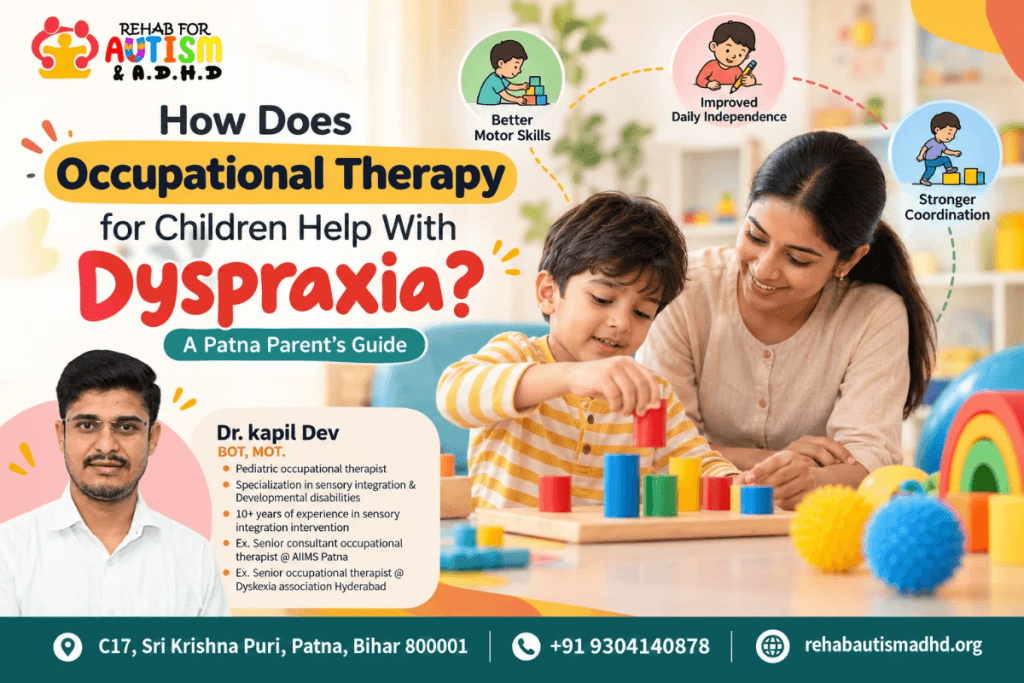
Occupational therapy for children helps kids with dyspraxia by breaking everyday movements into small, practised steps. Therapists train motor planning, fine and gross motor skills, hand-eye coordination and handwriting through play. Therapy does not cure dyspraxia, but it builds skills, confidence and independence.
What therapists work on:
- Planning and sequencing movements
- Balance, jumping and running
- Buttons, scissors and grip
- Handwriting and copying from the board
Introduction
A child trips on flat ground, struggles with shirt buttons and writes letters that drift across the page. That child is not lazy or careless. Many of these children have dyspraxia, which clinicians formally call Developmental Coordination Disorder (DCD). Occupational therapy for children gives them a structured way to practise movements until those movements feel automatic.
This guide explains how therapists approach dyspraxia, what 2026 research shows and when Patna parents should act.
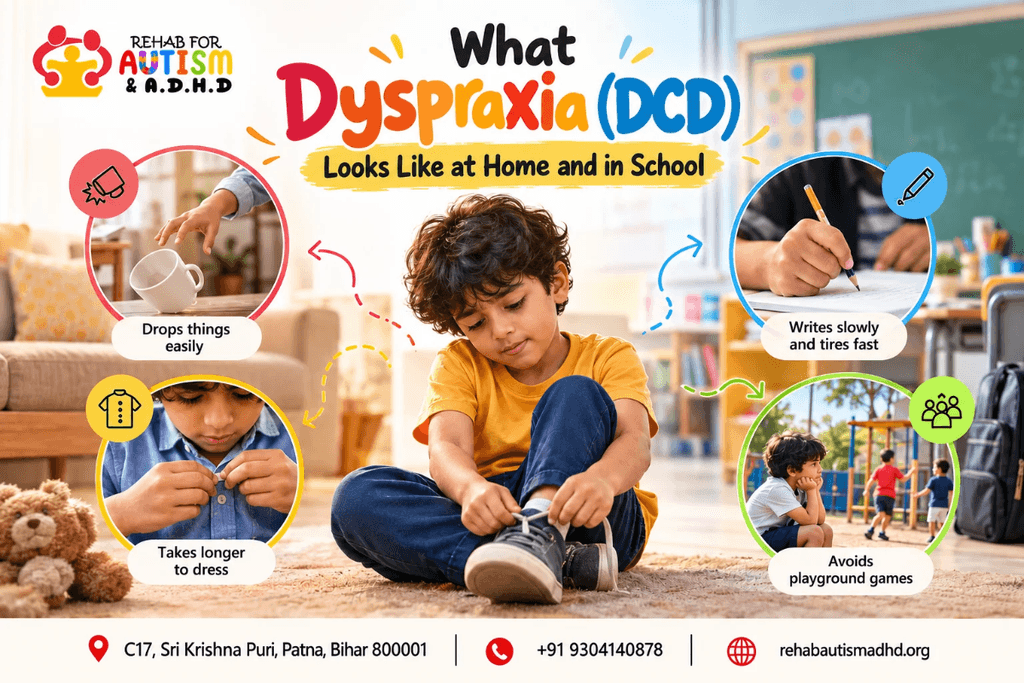
What Dyspraxia (DCD) Looks Like at Home and in School
Parents and teachers usually say “dyspraxia.” Doctors usually write “Developmental Coordination Disorder (DCD) in children.” Both terms describe a child whose motor coordination falls well below what their age and intelligence predict. DSM-5 estimates put the figure at roughly 5–6% of school-age children.
Parents often notice these signs:
- The child drops cups, bumps into furniture and avoids playground games.
- The child takes a long time to dress and still needs help with buttons or laces.
- The child grips the pencil tightly, writes slowly and tires fast.
- The child knows what to do but cannot make the body follow the plan.
That last point matters most. Clinicians call it a childhood motor planning challenge. The child understands the task, but the brain struggles to sequence the movements. Children with dyspraxia can also have ADHD or autism, so a full assessment checks all areas before it sets a plan.
How Occupational Therapy for Children Works
Occupational therapists start with the child’s real day: dressing, eating, writing, playing and moving around school. They assess motor skills, sensory responses and daily-living skills. Then they set measurable goals.
The 2019 international guideline from the European Academy of Childhood Disability recommends activity-focused and participation-focused intervention for DCD. It also refers to standard tools, such as the Movement Assessment Battery for Children. Sessions look like play, but each game trains a specific skill. At our centre, children work one-to-one with a therapist. A therapist also shows parents what to practise at home, because skills grow faster with repetition.
Five Skill Areas Therapists Train
Motor Planning Therapy
Motor Planning Therapy teaches the brain to sequence a movement before the body performs it. A therapist might build an obstacle course with four steps: crawl under, jump over, climb up and throw. The child says each step aloud, performs it and then repeats the course faster. Over time, the child plans new movements without help.
Gross Motor Skills Therapy
Gross Motor Skills Therapy builds balance, strength and whole-body coordination. Children practise hopping, catching, climbing stairs and riding a scooter. A sensory gym helps here, because swings and balance beams train posture and body awareness together. Our guide to sensory integration therapy explains how the gym works.
Fine Motor Skills Therapy
Fine Motor Skills Therapy trains the small muscles of the hand. Children pick up beads with tweezers, thread laces, squeeze putty and cut along lines. Each activity builds the grip strength and finger control that buttons, zips and pencils demand.
Hand-Eye Coordination Therapy
Hand-Eye Coordination Therapy links vision to movement. Children toss beanbags at targets, trace mazes and catch balloons. Therapists raise the difficulty slowly: smaller targets, faster throws and longer distances.
Handwriting Skills Therapy
Handwriting Skills Therapy combines posture, grip and letter formation. Therapists check seating height first, then teach pencil grip, then move to letter shapes and spacing. Children practise on textured and lined surfaces before they write in a notebook. Learn more about our occupational therapy in Patna.
What 2026 Research Says
Researchers published several studies on DCD this year. Five stand out.
- 26 February 2026: Jelsma and colleagues published a scoping review in Developmental Medicine & Child Neurology. They screened 30,637 hits and identified 202 studies covering 4,593 children and adolescents. Most interventions (130) showed significant improvement in motor performance, and small-group, large-group and one-to-one formats reported similar gains.
- Spring 2026: A review in Frontiers in Human Neuroscience linked motor intervention to measurable brain plasticity in children with DCD. The authors also noted small samples and limited long-term follow-up.
- 7 July 2026: A network meta-analysis in Frontiers in Physiology pooled 20 randomised trials published between 2000 and 2026. Interventions longer than eight weeks produced larger effects than shorter ones. Functional, task-centred training stood out for overall motor function, including fine motor skills and hand-eye coordination.
- 7 August 2026: Developmental Medicine & Child Neurology published a study on minor neurological dysfunction in children with DCD. The authors argue that a neurological examination belongs in every DCD assessment.
- September 2026: A Frontiers in Human Neuroscience editorial highlighted rhythm-based and aquatic interventions. It suggested that timing, sensory processing and motor coordination connect closely.
The message for parents: therapy works best when it is task-based, regular and sustained.
Five Real-World Examples
1. A school-based case report. A UK case study followed “Sue,” an 11-year-old with dyspraxia who showed poor coordination, weak focus and poor organisation. A trained staff member led two daily movement routines, called the “resisted crawl” and the “cat.” The report shows how short, daily activities can fit into a school day.
2. A graphomotor programme. Researchers in Slovakia ran an occupational therapy programme for five- and six-year-olds with dyspraxia symptoms. They focused on pencil-control skills and tested the children before and after. The authors report statistically significant differences between the two tests.
3. A strategy-based approach. A retrospective chart review looked at 50 children aged 8–12 with DCD who completed CO-OP, a method in which children choose a goal and learn their own strategies to reach it. The review mapped the goals and strategies children used, and it shows how much this method relies on the child’s own voice.
4. A school training trial. A trial registered as NCT07486856 tested a school-based programme that combined movement with thinking tasks. It ran from March to June 2025, and the title reports gains in executive function and motor competence.
5. An illustrative Patna scenario. This composite is not a real patient. Picture a Class 3 student in Patna who finishes maths orally but never finishes copying from the board. The teacher marks her “careless.” An assessment finds weak grip, slow hand-eye tracking and poor sequencing. The therapist sets three goals: sit with correct posture, copy a short line in two minutes and button a school shirt alone. The family practises ten minutes daily, and the therapist reviews progress every few weeks.
Occupational Therapy vs Other Support
| Option | What it targets | Strength | Limit |
|---|---|---|---|
| Occupational therapy | Daily tasks: writing, dressing, play, sensory regulation | Links motor skills to real activities | Needs regular visits and home practice |
| Physiotherapy | Strength, posture, movement patterns | Strong for gross motor and medical movement problems | Covers handwriting and self-care less directly |
| Special education | Reading, writing and maths in class | Fills academic gaps | Does not train the movement skills underneath |
| Home practice alone | Repetition | Free and flexible | Without an assessment, parents may practise the wrong skill |
Many children benefit from more than one option. Our special education support works alongside OT when learning gaps appear. Pediatric motor skills development responds best when professionals and parents set the same goals.
The Cost of Waiting
School demands rise every year. Classes 1 and 2 ask for neat letters, Class 4 asks for fast copying and sport asks for team coordination. A child with untreated coordination problems often avoids these tasks. Avoidance then lowers confidence, and classmates may tease the child. The 2019 guideline devotes a section to the psychosocial effects of DCD, because the emotional toll is real.
The July 2026 meta-analysis found larger effects from interventions longer than eight weeks. Starting early gives your child more time to build skills before school expectations climb.
Conclusion
Occupational therapy for children does not cure dyspraxia, but it gives children practical tools. A therapist trains motor planning, fine and gross motor skills, hand-eye coordination and handwriting through play, and parents reinforce the skills at home. If your child struggles with coordination, book an assessment. A clear plan beats months of guessing.
💬 Mail Us: Rehabforautismandadhd2019@gmail.com
info@rehabautismadhd.org
Rehab for Autism & ADHD, C17, Sri Krishna Puri, Patna, Bihar 800001. Open Monday to Saturday, 12 PM to 8 PM.
FAQs
1. Can occupational therapy cure dyspraxia?
No. Many people with DCD keep some coordination difficulty into adulthood, and the 2019 guideline includes recommendations for adolescents and adults. Therapy builds skills and strategies, and children gain independence.
2. When should my child start therapy?
Start when you notice persistent difficulty. A therapist can assess a young child and begin building motor skills before a formal diagnosis.
3. How long does therapy take?
The therapist sets the pace after the assessment. A 2026 meta-analysis found larger effects from programmes longer than eight weeks, so plan for steady, ongoing sessions.
4. Does my child need one-to-one sessions?
The 2026 scoping review reported similar gains in group and one-to-one formats. We use one-to-one sessions so the therapist sets goals around your child’s own difficulties.
5. Can dyspraxia occur with ADHD or autism?
Yes, the conditions can occur together. A full assessment checks motor, sensory, attention and communication skills before it sets a plan. You can read about our services.
6. What can I do at home?
Keep a steady routine, break tasks into small steps and allow extra time. Practise the skills your therapist assigns for a few minutes every day, and celebrate effort.
Medical Disclaimer
This article offers general information. It does not replace advice from a qualified doctor or therapist, and it does not diagnose any condition. Consult a healthcare professional about your child’s needs.
Sources & Further Reading
- Jelsma D. et al. (2026). Interventions for children with developmental coordination disorder: a scoping review. Developmental Medicine & Child Neurology. https://onlinelibrary.wiley.com/doi/10.1111/dmcn.70221
- Dong Y. et al. (2026, 7 July). Effects of exercise intervention on children with DCD: systematic review and network meta-analysis. Frontiers in Physiology. doi:10.3389/fphys.2026.1877672
- Motor intervention therapy for children with DCD: from behavioral improvement to neuroplasticity mechanisms (2026). Frontiers in Human Neuroscience. doi:10.3389/fnhum.2026.1757488
- Minor neurological dysfunction in children with DCD (2026, 7 August). Developmental Medicine & Child Neurology. https://onlinelibrary.wiley.com/doi/10.1111/dmcn.70475
- Cavalcante Neto J.L., Jelsma L.D., Draghi T.T.G. (2026). Editorial: Advancing understanding of DCD. Frontiers in Human Neuroscience. doi:10.3389/fnhum.2026.1954668
- Blank R. et al. (2019). International clinical practice recommendations on DCD. Developmental Medicine & Child Neurology, 61(3), 242–285. https://pmc.ncbi.nlm.nih.gov/articles/PMC6850610
- CO-OP for children with DCD: goals addressed and strategies used. Canadian Journal of Occupational Therapy. https://journals.sagepub.com/doi/10.1177/0008417420941980
- Case study of daily physical activity initiatives for a child with dyspraxia. Canterbury Christ Church University. https://repository.canterbury.ac.uk/item/8909y
- Clinical trial NCT07486856. https://clinicaltrials.gov/study/NCT07486856
- American Psychiatric Association, DSM-5-TR (prevalence estimate)