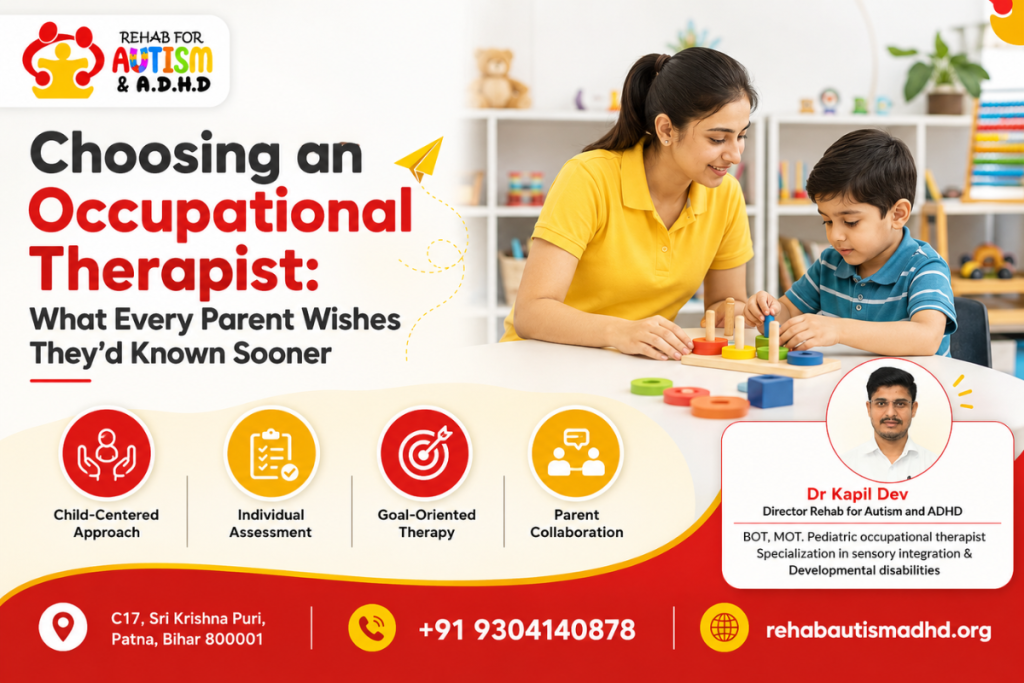
- A good occupational therapist looks at sensory processing, motor skills and daily-living independence, not just “behavior.”
- Look for 1:1 therapist to child ratio, a licensed BOT/MOT therapist and a written goal-based plan within the first 2 sessions.
- Waiting does not help. Research suggests that earlier intervention (before age 5-6) leads to better, faster gains.
- If you are looking for an Autism Treatment Centre in Patna or Autism Doctor in Boring Road, Patna, Families should ask three questions before they enroll: Who’s looking after my child? How do you measure progress? What if the plan is not working?
Why This Decision Feels So Hard
It’s not often a quiet day when a parent is told their child needs occupational therapy. There’s a diagnosis, or maybe just a teacher’s comment or a pediatrician’s raised eyebrows — and then a search that starts with “occupational therapist near me” and ends in a dozen open browser tabs, each website sounding almost identical to the last.
The real problem is its uniformity. Most clinics provide the same services — sensory integration, fine motor training, self-care skills — in almost the same words. But two “occupational therapy” centers can produce very different outcomes for the same child, depending on who is actually in the room with your son or daughter, and how often, and whether progress is being tracked or merely presumed.
We wrote this guide the way we wish someone had told us: plainly, with real research behind it, and without the marketing jargon that makes every clinic sound like every other clinic.
What Occupational Therapy Actually Does (and Doesn’t Do)
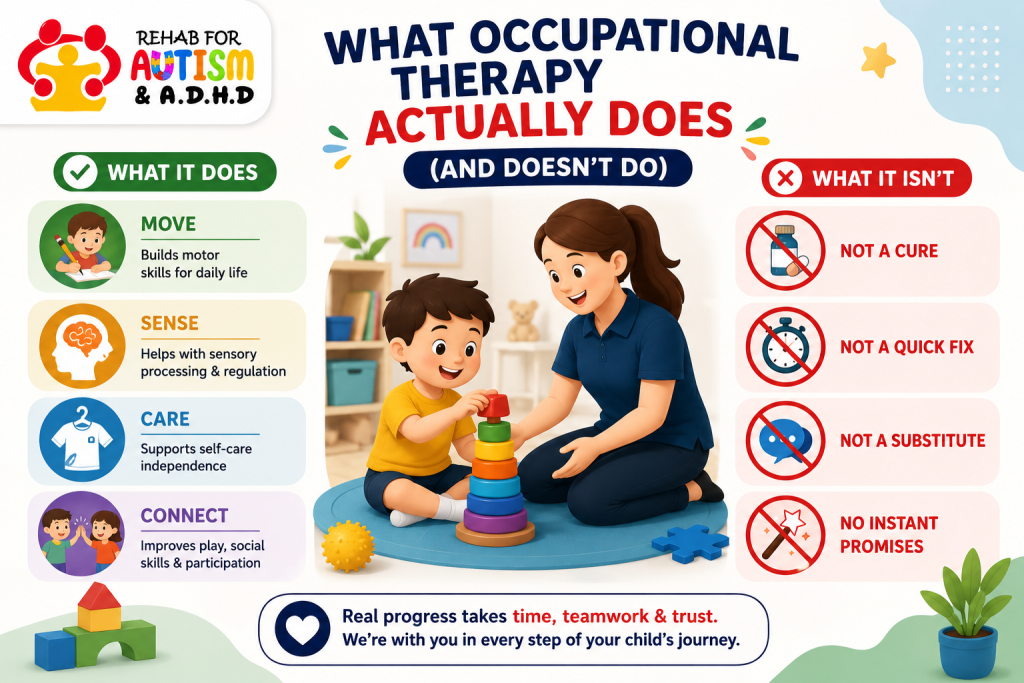
Occupational therapy isn’t a single technique. It is a broad discipline that helps a child function in his or her daily “occupations” — playing, eating, dressing, writing, socializing and regulating his or her own body and emotions. What does a pediatric occupational therapist work on?
- Fine motor skills – handwriting, buttoning a shirt, scissors, climbing stairs safely.
- Sensory processing – helping a child who is overstimulated by noise, textures or light (or under-responsive to them) to feel more regulated.
- Independence in self-care – toileting, eating, dressing and hygiene routines.
- Play and social participation– turn-taking, shared attention, and functional play skills that support friendships
What it isn’t is a cure, a quick fix or a substitute for speech therapy or medical treatment – although the three often work best together. Beware of a centre that promises instant transformation in a few sessions, true, permanent change is built session by session, and any responsible Autism therapy centre in Patna will tell you that upfront.
The Research Parents Should Actually Know About
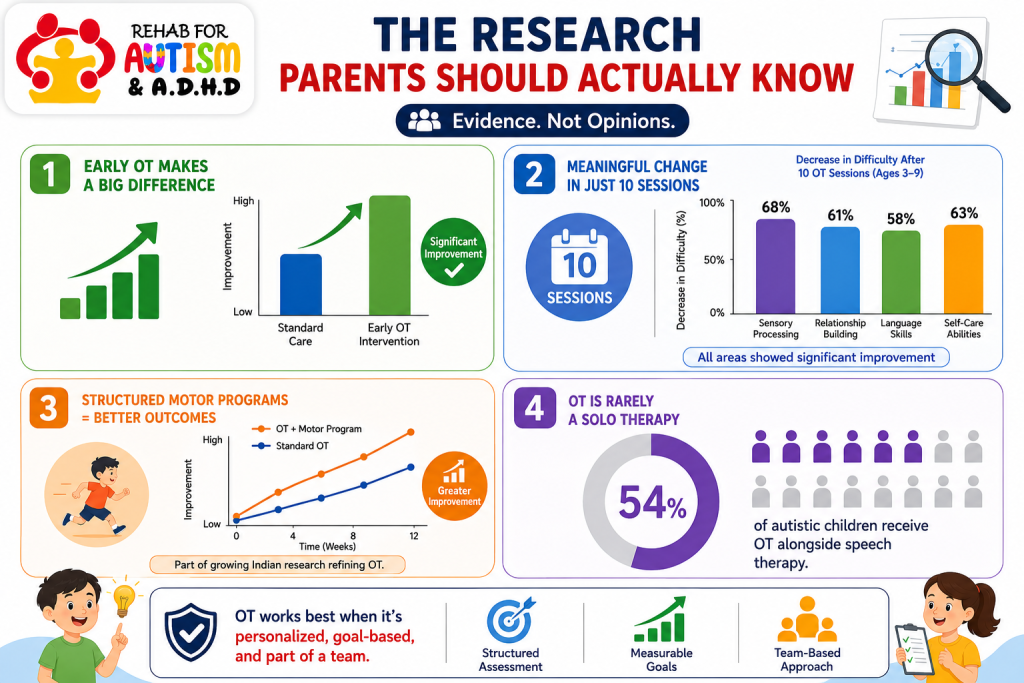
- A study published in the American Journal of Occupational Therapy found early intervention occupational therapy significantly improves the adaptive behaviours and social participation of autistic children. This supports the importance of timing as much as technique.
- In a 2025 prospective study of children from three to nine years of age, after ten sessions of occupational therapy, scores on sensory, relationship-building, language and self-care measures all showed a statistically significant decrease in difficulty — a meaningful improvement in a relatively short window.
- In a 2025 clinical trial, sixty children aged three to seven with autism spectrum disorder were enrolled to evaluate a structured motor-skills protocol in addition to conventional occupational therapy, with outcomes compared between a standard-care group and one receiving an added structured motor program — part of a growing body of Indian research specifically testing how OT protocols can be refined for better functional outcomes.
- The larger data published in 2026 indicate that a large portion of autistic children (over half in some samples) receive occupational therapy at the same time as speech-language therapy, emphasizing that OT is rarely intended to work in isolation.
This doesn’t mean every child needs the same intensity or approach – but it does mean occupational therapy supported by structured assessment and measurable goals, not guesswork, is what the evidence actually supports.
In the News: Autism Care Is Getting More Attention in India
Two recent developments are worth knowing about if you’re navigating this journey in Bihar:
- World Autism Awareness Day 2026 (observed April 2) carried the global theme “Autism and Humanity — Every Life Has Value,” with health commentators noting that in India, research places autism prevalence at roughly 1 in 68 children, though experts caution the real number may be higher because underdiagnosis remains common in rural and underserved areas.
- Closer to home, our founder Dr. Kapil Dev shared a stage with senior medical experts at the “Understanding Autism” conclave organized by The Times of India in Patna — a sign that conversations about early diagnosis and therapy access are finally reaching Bihar’s mainstream media, not just metro cities.
Both point to the same conclusion: awareness is rising faster than access. Families searching for an Autism Treatment Centre in Patna today have more information available than parents did even three years ago — but also more noise to filter through.
Three Real-World Scenarios (Composite Examples)
Example 1: “The child who just needed more time.” A four-year-old boy who struggled to hold a pencil and would have meltdowns at noisy birthday parties. His family was told that he’d “grow out of it.” An occupational therapy evaluation eighteen months later showed a sensory processing difference and a fine-motor delay. Structured OT sessions, not more waiting, allowed him to hold a pencil correctly within ten weeks and tolerate group settings with a clear coping strategy.
Example 2: The child who needed a different type of therapist. A 7-year-old girl with autism spectrum disorder was treated for 1 year in a general rehabilitation clinic without much success. When she switched to a therapist who focused specifically on pediatric sensory integration, her parents said she got better faster at self-feeding, and had fewer meltdowns in two months — the same “occupational therapy” label, very differently delivered.
Example 3: The child whose family asked the right questions early on. Parents who asked directly, “How will we know this is working?” were given a written, measurable plan from day one. Six months later, they had progress notes to show a school counselor, something families who didn’t request a structured plan often don’t have.
Comparison: What to Expect at Different Types of Centres
| Factor | Untrained / Generic Setup | Standard OT Clinic | Specialized Autism Therapy Centre (like Boring Road, Patna) |
|---|---|---|---|
| Therapist qualification | Often unclear or unverified | General occupational therapist | BOT/MOT pediatric OT with autism-specific training |
| Child-to-therapist ratio | Group-based, 1:5 or more | Often 1:2 or 1:3 | 1 Child : 1 Therapist |
| Assessment process | Minimal or none | Basic intake form | Structured evaluation before therapy begins |
| Progress tracking | Rarely documented | Occasional notes | Ongoing, goal-based tracking shared with parents |
| Family involvement | Limited | Occasional guidance | Structured parent coaching for home carryover |
| Environment | Clinical, unfamiliar | Standard clinic setting | Home-like, sensory-friendly space |
Questions to Ask Before You Enroll
Before choosing any Occupational Therapy centre in Boring Road, Patna, ask:
- What are the therapist’s qualifications, and have they specifically treated children on the autism spectrum?
- Will my child have one consistent therapist, or will this rotate?
- How will progress be measured, and how often will I get an update?
- What does a typical session actually involve?
- Is there guidance for what we should continue doing at home?
If a centre can’t answer these clearly, that’s information too.
The Cost of Delay
Delaying therapy rarely buys a family anything except lost time. Developmental windows in early childhood are when the brain is most responsive to new skills — which is exactly why research consistently points to early intervention before age five as showing the most effective outcomes. A six-month delay while “waiting to see” often means:
- A wider gap between your child and same-age peers by the time therapy begins.
- Harder-to-shift compensatory habits (like an awkward pencil grip or sensory avoidance patterns) that take longer to correct once established.
- More stress at home and school, since unaddressed sensory or motor challenges tend to show up as behavior concerns before anyone identifies the root cause.
This isn’t meant to alarm — it’s meant to reframe “let’s wait a bit longer” as a decision with a real cost, not a neutral one.
Why Families in Patna Choose Rehab for Autism & ADHD
We are an Autism Treatment Centre, Boring Road, Patna and we evaluate every child individually before designing a plan. Our team is led by Dr. Kapil Dev, a pediatric occupational therapist and former Senior Consultant Occupational Therapist at AIIMS Patna. We work on a strict 1 Child : 1 Therapist model, so your child never has to compete for attention in a group. Dr. Kapil Dev, an Autism Doctor in Boring Road, Patna, and the team of certified speech-language pathologists and occupational therapists work under one roof and families don’t need to coordinate with multiple clinics across the city. If you’re looking for an Autism therapy centre in Patna for the first time, or if you’re looking for an alternative centre that has not shown results, our C17, Sri Krishna Puri, near Boring Road, Patna location is designed to be a home-like, sensory-friendly space where children feel safe enough to actually make progress.
Conclusion
There is more to choosing an occupational therapist than logistics. It impacts the speed at which your child gains independence, confidence and comfort in his or her own daily life. The parents with the fewest regrets looking back are often the ones who asked the hard questions early on, who prioritized a true 1:1 therapeutic relationship over convenience, and who didn’t allow “wait and see” to become a year that flew by. If you are comparing your options for an Autism Treatment Centre in Patna, refer to the checklist and comparison table above – and don’t forget to visit a centre in person before taking admission. The first therapist your child sees is more important than almost any other choice you’ll make early on.
Ready to take the next step?
📞 Call Us Now: +91 9304140878
💬 Mail Us : Rehabforautismandadhd2019@gmail.com
info@rehabautismadhd.org
📅 Book an Assessment
Frequently Asked Questions
1. At what age should my child start occupational therapy? There’s no single “right” age, but research consistently shows the strongest gains when therapy begins before age five to six. That said, older children still benefit — starting later is far better than not starting at all.
2. How is occupational therapy different from speech therapy? Occupational therapy focuses on motor skills, sensory processing, and daily-living independence, while speech therapy focuses on communication and language. Many children benefit from both together, often delivered at the same centre for consistency.
3. How many sessions before I see improvement? Every child is different, but some studies have recorded measurable improvement in sensory and self-care scores after as few as ten sessions. A good therapist will set realistic, individualized milestones rather than a fixed timeline.
4. Is a 1 Child : 1 Therapist model really necessary? It isn’t mandatory everywhere, but it removes divided attention from the equation. For children with sensory sensitivities or attention challenges, undivided focus often accelerates progress meaningfully.
5. Do you treat ADHD as well as autism at your Boring Road centre? Yes. As a combined Autism Treatment Centre in Boring Road, Patna, our team treats ADHD, ADD, sensory processing disorder, developmental delays, and related conditions alongside autism spectrum disorder.
6. What should I bring to the first appointment? Any previous evaluations, a school report if available, and a list of behaviors or challenges you’ve noticed at home. This helps the therapist build an accurate picture from day one.