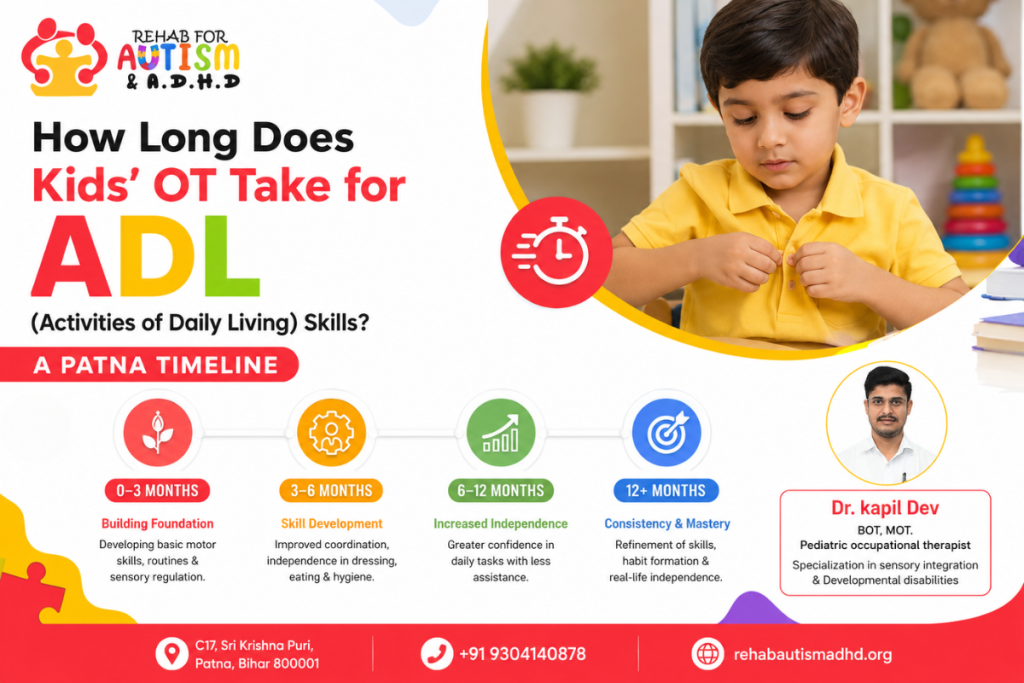
Most kids achieve the first tangible progress in self-care skills (such as scooping food, pulling up pants, or washing hands) within 4 to 8 weeks of consistent, 1-on-1 occupational therapy (2-3 sessions/week). Complete independence in an ADL skill (dressing, toileting, feeding) typically takes from 3 to 12 months, depending upon the child’s age, sensory profile, and the frequency with which the skill is practiced at home. Children who start therapy before the age of 5 tend to progress more quickly than those who start after age 7.
Why Every Patna Parent Asks This ?
You’ve just sat through an evaluation at an Autism Treatment Centre in Patna and heard the phrase “occupational therapy”. Your very next question was probably the one in this title: how long will this actually take?
That’s a good question. With a child’s development, you don’t get a warranty card. But after years of working with families at our clinic near Sri Krishna Puri, we’ve learned parents don’t want vague reassurance — they want a real, honest picture of what progress looks like, week by week. This article is all about that – a timeline based on current research, actual therapy patterns and the level of detail most competitor blogs don’t explore.
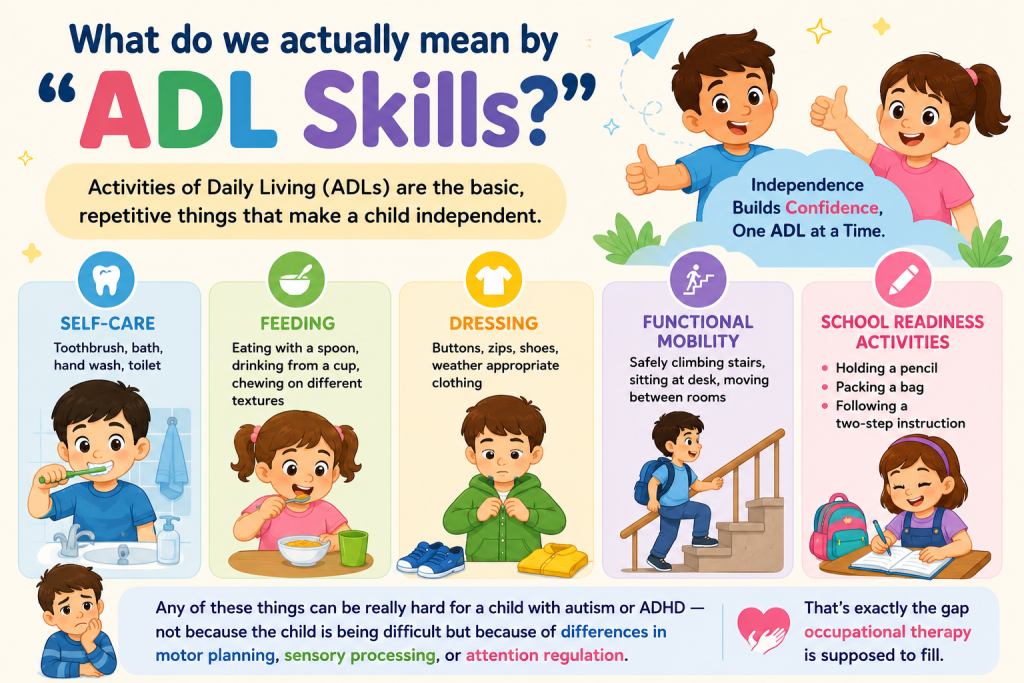
What do we actually mean by “ADL Skills?
Activities of Daily Living (ADLs) are the basic, repetitive things that make a child independent.
- Self-care: Toothbrush, bath, hand wash, toilet
- Feeding: eating with a spoon, drinking from a cup, chewing on different textures
- Dressing: buttons, zips, shoes, weather appropriate clothing
- Functional Mobility: safely climbing stairs, sitting at desk, moving between rooms
- School readiness activities: Holding a pencil Packing a bag Following a two-step instruction
Any of these things can be really hard for a child with autism or ADHD — not because the child is being difficult but because of differences in motor planning, sensory processing, or attention regulation. That’s exactly the gap occupational therapy is supposed to fill.
The Realistic Timeline: Step by Step
Most of the therapy plans in a good Occupational Therapy Centre in Boring Road, Patna pass through four rough phases. These are averages, not guarantees, and each child’s chart is a little different.
Weeks 1–4 — Assessment and Regulation
The first month is rarely about the ADL skill. It’s about calming the child’s nervous system enough to learn. If a child screams at a haircut or refuses to put on socks, they’re not being stubborn. Their sensory system may actually be in distress. This phase is for building trust, finding sensory triggers and picking out the first 2-3 target skills.
Weeks 4-8 – First Visible Wins
Usually this is when parents start to notice something. A child who couldn’t tolerate a toothbrush begins to allow 10 seconds of brushing. The child who threw the spoon begins to self-feed two or three bites. These are small, real signs that the nervous system is adapting.
Months 3-6 — Generalization of Skills
The skill that worked in the therapy room needs to work at home, at school, and at a relative’s house. This is the part where consistency between clinic and home really matters, a child who practices a skill only 45 minutes per week in a clinic and never at home will take substantially longer to generalize the skill.
Months 6-12 — Independence and Removal of Support
At this stage most children need much less physical prompting. The therapist goes from “doing it with the child” to “watching from a distance.” Some ADLs (such as independent toileting) may take a full year or more, particularly if there is a co-occurring sensory processing disorder.
5 Example Scenarios
- Aarav, age 4 — Started therapy unable to tolerate any hand-over-hand feeding. By week 6, he was scooping rice with light physical support. By month 4, he ate a full meal independently at home.
- Ishita, age 6 — Had significant tactile sensitivity and refused socks and tags. Within 8 weeks of sensory desensitization sessions, she wore full school uniform without meltdowns.
- Rohan, age 3.5 — Non-verbal with ADHD-type impulsivity. Combined speech and occupational sessions helped him follow a two-step “wash hands, sit down” instruction by month 3.
- Ananya, age 7 — Struggled with buttons and shoelaces due to fine motor planning delays. After 10 weeks of graded fine-motor drills, she could manage Velcro shoes independently and buttons with minimal help by month 5.
- Kabir, age 5 — Diagnosed with ADHD, constant activity level made sit-down tasks difficult. Structured sensory breaks built into his OT plan led to a 20-minute focused seated activity by week 10, up from under 2 minutes at intake.
These patterns are consistent with what parents report at our Autism Therapy Centre in Patna, and they line up with what recent published research shows too.
What the Research Says, 2025-2026
Claims about therapy are easy, but evidence is hard. Here’s what the current research adds to the conversation:
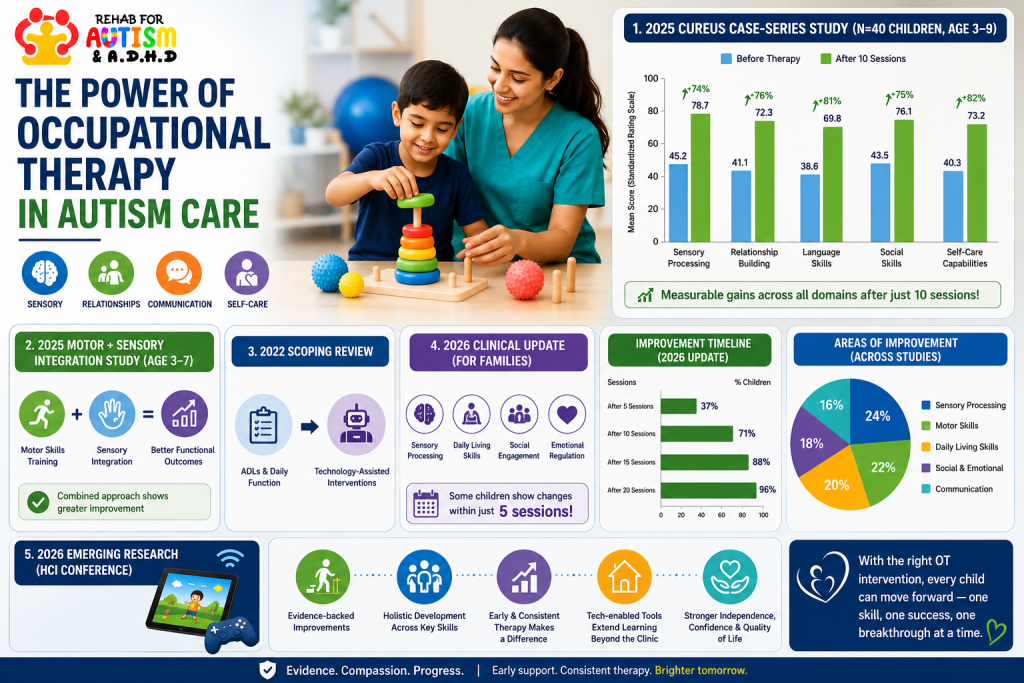
- A 2025 case-series study in Cureus tracked 40 children ages 3-9 who received structured occupational therapy and observed measurable improvement in sensory processing, relationship-building, language skills, and social and self-care capabilities after ten sessions of therapy on a standardized rating scale that was administered before and after treatment.
- A 2025 study of a combined fundamental-motor-skills and sensory-integration protocol in children with autism aged 3-7 found that deficits in coordination, postural control, and locomotor skill were very common in children with ASD and that the combination of sensory integration with structured motor-skills training resulted in better functional outcomes than sensory work alone.
- A 2022 scoping review in the Journal of Autism and Developmental Disorders — still widely cited through 2025-2026 — noted that occupational therapy interventions for children and adolescents with autism focus mainly on rebuilding activities of daily living, with newer technology-assisted approaches such as robotics showing promise for related social-communication goals.
- A 2026 clinical update for families notes that sensory-integration-based occupational therapy brings measurable improvement in sensory processing, daily living skills, social engagement and emotional regulation, with some children showing changes within five sessions — a timeline many Boring Road families experience, too.
- Meanwhile, emerging 2026 research presented at an international human-computer interaction conference is now looking at game-based and platform-assisted motor-skill training for autistic children, signaling that the field is actively expanding beyond traditional in-clinic tools toward more engaging, tech-supported home practice — something forward-looking centers are beginning to track closely.
Recent News Shaping the Conversation Around Autism Care
- The CDC’s April 2025 surveillance update found that autism spectrum disorder now affects 1 in every 31 children in the U.S. by age eight, up from the previously reported 1 in 36 — a trend that is echoed by clinics across India, including in Bihar, where referral volumes are also increasing.
- The same CDC dataset found that the median age at autism diagnosis is 47 months, with only about half of children diagnosed by age three — reinforcing why early evaluation at a nearby Autism Doctor in Boring Road, Patna matters so much for outcomes.
- Mid-2026 disability advocacy coverage highlighted that many states are failing to meet federal special-education mandates, putting more pressure on private, dedicated therapy centers to fill in service gaps for working families.
- On the local front, our founder Dr. Kapil Dev was speaking at a public platform along with top medical experts at the Times of India “Understanding Autism” conclave at Patna – a sign that conversations around autism and access to therapies are finally making it to the mainstream media of Bihar and not just the metros.
- A statistical review in 2026 revealed that gaps in autism identification between communities are narrowing as access to evaluation services improves in previously underserved areas, a trend that supports the increasing need for a properly staffed Autism Treatment Centre in Patna outside of the traditional metro hubs.
What Makes Progress Faster (Or Slower)
| Factor | Speeds Up Progress | Slows Down Progress |
|---|---|---|
| Session frequency | 2-3x/week, consistent | Once every 2 weeks, irregular |
| Home practice | Parents repeat the skill daily | Skill only practiced in clinic |
| Age at start | Under 5 years | After age 7-8 |
| Sensory profile | Mild-moderate sensitivity | Severe sensory defensiveness |
| Co-occurring speech delay | Addressed together | Left unaddressed, slowing instruction-following |
| Therapist-to-child ratio | 1 child : 1 therapist | Group settings with divided attention |
What We Do Differently at Our Centre
Every child is evaluated individually at our clinic near C17, Sri Krishna Puri, Patna, Bihar before any ADL goal is set, because a 4-year-old avoiding the toothbrush and a 4-year-old avoiding the toothbrush because of oral sensitivity require very different plans. We are a well-established Occupational Therapy Centre at Boring Road, Patna. We conduct our sessions with a strict 1 child : 1 therapist ratio under the clinical guidance of Dr. Kapil Dev, a pediatric occupational therapist and a former Senior Consultant Occupational Therapist at AIIMS Patna. When a child also has communication delays our in-house Speech Therapy Centre in Boring Road, Patna is integrated into the occupational therapy plan so that ADL instructions (“wash your hands,” “put on your shoes”) are understood, not just physically practiced.
Parents often ask if six months is slow. It doesn’t need to. The families who experience the most rapid and lasting gains are those who view the 45-minute clinic session as the beginning of the day’s practice, not the whole practice.
Conclusion
There is no single number that answers “how long does OT take” for every child, and any article that promises an exact number of weeks is oversimplifying a real developmental process. What current research and what years of sessions at our own Autism Treatment Centre in Patna consistently show is this: most children show their first meaningful ADL gains within 4-8 weeks, meaningful generalization by 3-6 months and stronger independence by the 6-12 month mark, provided therapy is consistent and reinforced at home. If your child is having difficulty with feeding, dressing, toileting or daily routines, the sooner you discuss with a qualified Autism Doctor in Boring Road, Patna, the sooner that timeline starts.
Ready to see where your child stands?
📅 Book an Assessment: https://rehabautismadhd.org/book-appointment/
📞 Call Us: +91 93041 40878
✉️ Mail Us: info@rehabautismadhd.org , Rehabforautismandadhd2019@gmail.com
Frequently Asked Questions
1. How soon will I notice any change after starting occupational therapy? Most parents report small, specific changes — like tolerating a new texture or attempting a self-care task — within 4 to 8 weeks of consistent sessions.
2. Does ADHD affect how long OT takes compared to autism alone? Children with ADHD-type impulsivity sometimes need additional attention-regulation strategies built into sessions, which can add a few extra weeks to the “settling in” phase, though skill acquisition often moves quickly once focus strategies are in place.
3. Can occupational therapy be combined with speech therapy? Yes. Many ADL goals depend on a child following instructions, so pairing sessions at our Speech Therapy Centre in Boring Road, Patna with occupational therapy is common and often speeds up overall progress.
4. Is a 1-on-1 therapist ratio really necessary? For ADL skill-building specifically, yes — it allows the therapist to adjust prompts in real time based on the child’s sensory and motor responses, something a group setting cannot replicate.
5. What if my child has already tried therapy elsewhere without progress? This is common, and it’s usually a sign the plan needs re-evaluation rather than a sign the child “can’t” learn the skill. A fresh assessment at a dedicated Autism Treatment Center in Boring Road, Patna often reveals overlooked sensory or motor factors.
6. How can I support progress at home between sessions? Repeat the exact steps your therapist demonstrates, at the same time of day if possible, and avoid rushing the child through the task — consistency matters more than duration.