Sensory integration therapy (SIT) helps children with Autism Spectrum Disorder (ASD) process sound, touch, light and movement in a more organized fashion. The better a child’s brain is at processing sensory information, the smaller and more manageable is the build up to a meltdown. Studies show moderate and increasing evidence that SIT reduces sensory overload and improves daily functioning, but results vary depending on the child and the severity of the symptoms.
A meltdown rarely comes out of the blue. For a child with autism, it’s usually the last stop on a long ride that begins with something most of us barely notice — a flickering tube light, a scratchy school uniform tag, the hum of a mixer in the next room, or too many people talking at once. If you are a parent in Patna watching your child go from calm to overwhelmed in minutes, you are not doing anything wrong and neither is your child. Their nervous system is simply taking on more than it can process at one time.
So What Exactly Is Sensory Integration Therapy?
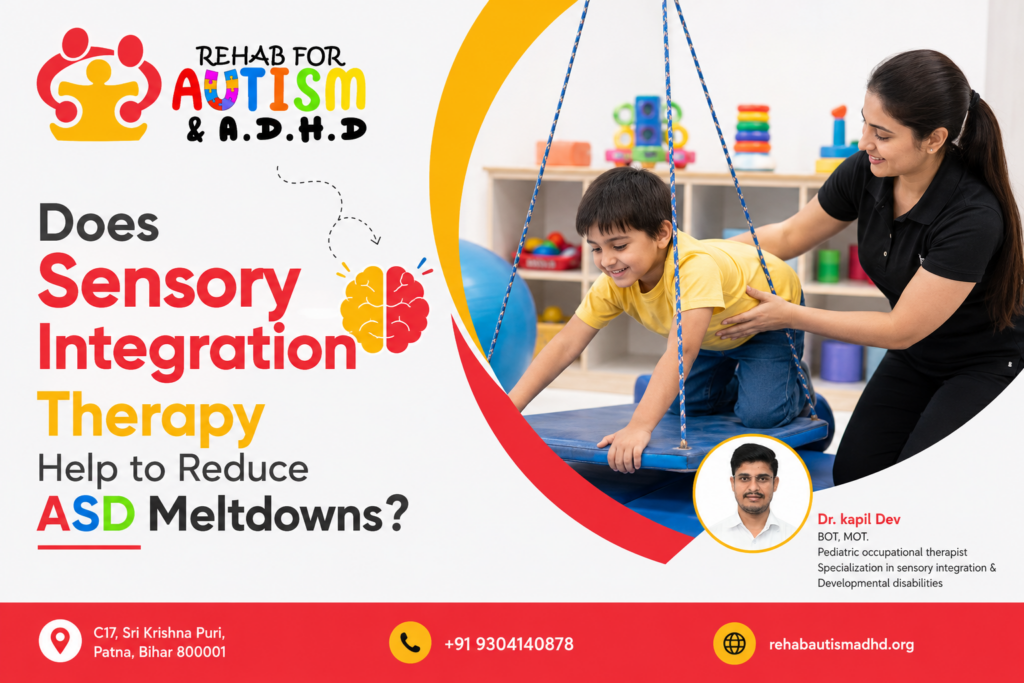
Sensory integration therapy is a tactile, play-based approach used by trained occupational therapists to help the brain organize incoming information from the eight sensory systems: sight, sound, touch, taste, smell, balance (vestibular), body positioning (proprioception), and internal body signals (interoception). Instead of drilling a child on flashcards, an occupational therapist creates controlled, playful sensory experiences — swinging, climbing, bouncing on a therapy ball, pushing weighted objects — so the nervous system slowly learns to respond instead of react.
This is not the same as just entertaining a child. Every activity is structured around what therapists call the “just-right challenge” — not too easy that it’s boring, not too hard that it’s overwhelming. Many children, over weeks and months, learn to tolerate things that used to upset them straightaway, like a haircut or a crowded family party.
Why Do Meltdowns Occur? Science in Simple Words
Meltdowns are not tantrums, nor are they a way to get attention. A tantrum is often goal directed (a toy, a snack, permission to stay up late) and terminates when the goal is achieved or the child is distracted. A meltdown is an involuntary nervous system response to sensory or emotional overload. It does not just stop when a demand is removed – the child needs time and the right sensory input to get back to a regulated state.
Picture a glass filling up with water, one drop at a time, throughout a school day. The itchy sweater, the noisy assembly, the sunlight shining bright on the way home, a sudden change in the timetable. None of these is in itself a problem. But by 4 o’clock the glass is full, and one more drop — a sibling’s laugh, a spoon dropped — makes it overflow. Sensory integration therapy is not about just controlling the overflow, it’s about reducing the water level.
What the Research Is Saying These Days
The evidence base for sensory integration therapy has greatly improved over the past two years:
– A large systematic review and meta-analysis published in Frontiers in Psychiatry in late 2025 pooled data from 16 randomized controlled trials comprising 1,319 autistic children and found meaningful improvement in sensory processing and autism-related behaviors following structured sensory-based intervention.
- A 2023 clinical study of 72 autistic children, ages 5 to 12, found that Ayres Sensory Integration-based occupational therapy led to measurable gains in adaptive behavior and sensory response, adding to a body of research that has been accumulating for over five decades.
- A systematic review of 32 different studies in the American Journal of Occupational Therapy found moderate evidence to support SIT for reducing sensory-driven behaviors including the overload that leads to a meltdown.
Researchers are quick to point out that sensory integration therapy is not a cure-all for every child, and that the results depend on the consistency of the therapy, the training of the therapist and how early the intervention starts. But the trend of evidence, particularly post-2023, is towards real, measurable benefit – which is why more occupational therapy centres across India, including here in Patna, are now incorporating SIT into their core treatment plans instead of keeping it as an optional add-on.
Three Everyday Cases: Examples From Real Life
Example 1 — The school uniform battle Every morning a 6 year old refuses to wear his uniform and mornings end in tears for the whole family. A sensory diet centered on tactile (touch) tolerance can help many children tolerate textures they once couldn’t stand within a few months – brushing protocols, weighted lap pads, and gradual fabric exposure.
Example 2 — The birthday party shutdown. A child covers her ears and falls to the floor at a noisy, crowded party. Consistent practice of therapy centre activities that stimulate vestibular and proprioceptive systems (swinging, jumping, deep pressure play) over time, build up a higher tolerance to noisy and unpredictable environments. Outings that previously ended in meltdowns become manageable.
Example 3 — The classroom shutdown after recess. A child comes back from a noisy playground and can’t focus, sometimes lashes out. Occupational therapists often recommend a quick “sensory reset” – heavy work such as carrying books or pushing a chair – between recess and class, and schools in Patna are increasingly receptive to it when parents bring in a simple written plan from a therapist.
In The News: Autism Awareness Grows In Bihar
Local and national conversation around autism support has accelerated in recent years. Dr. Kapil Dev, Director of Rehab for Autism and ADHD, was recently invited to the Times of India “Understanding Autism” conclave in Patna where he shared the stage with other medical experts to discuss practical, evidence-based care for neurodivergent children in the region. Organizations like India Autism Center have been holding sensory-friendly public events like special movie screening for neurodivergent kids at a national level and this suggests that sensory-conscious spaces are slowly becoming a part of mainstream planning, not an afterthought. This increased visibility is important — it means more families are able to spot meltdown patterns early, before they’re dismissed as “bad behavior.”
Sensory Strategies for Parents to Try at Home
Professional therapy is the biggest difference, but small daily habits support progress between sessions: “
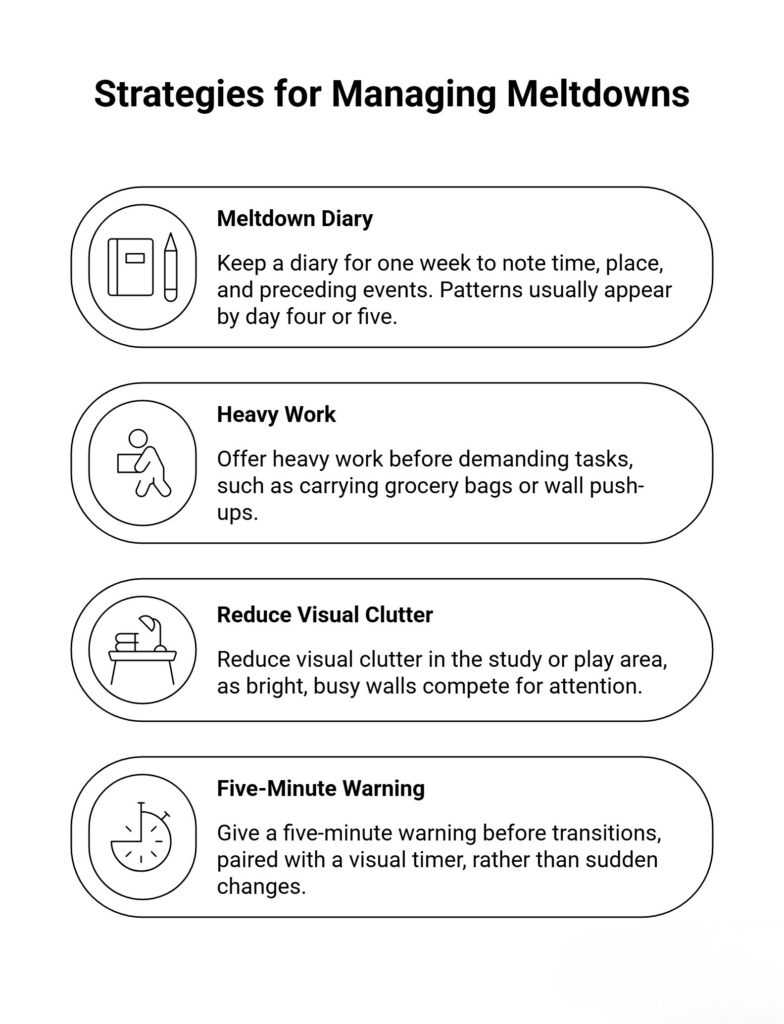
- Keep a ‘meltdown diary’ for a week, writing down the time, place and what happened just prior. “But usually by day four or five you’ll start to see patterns.
- Do some hard work before you do the hard stuff like carrying the grocery bags, doing wall pushups, or jumping on a mat for two minutes before you start your homework.
- Keep the study or play area free of visual clutter; bright, busy walls compete for a child’s limited attention.
- Give a five-minute warning before transitions with a visual timer, and not abrupt transitions.
- Plan sensory breaks as needed, don’t wait for a meltdown to take a break.
When to Consult a Specialist
Home strategies can help, but they work best when combined with a structured plan developed by a trained professional. If your child has frequent and intense meltdowns, or they are impacting school and family life, the next step is to get a proper sensory assessment. A qualified Autism Doctor in Boring Road, Patna can assess if sensory processing issues are the primary driving force or if other factors – communication gaps, anxiety, medical issues – are also contributing.
Every child at our Autism Treatment Center in Boring Road, Patna undergoes a detailed sensory and developmental assessment before the therapy begins. Our Occupational Therapy centre in Boring Road, Patna employ one-on-one, play-based sensory integration sessions tailored to the specific triggers of each child, and when communication delays are also present, our Speech Therapy centre in Boring Road, Patna collaborates with occupational therapy, ensuring progress occurs in all areas a child needs support, not in fragmented parts.
Conclusion
Meltdowns aren’t a discipline problem to solve with tighter rules – they are a nervous system signal to support. Sensory integration therapy provides a structured, evidence-based approach (2023-2025) for children struggling with sensory overload to reduce the everyday sensory load so that children spend less time in overload and more time learning, playing, and connecting with the people around them. Progress is rarely instant, but with the right therapist, a consistent plan, and family involvement at home, most children make real, visible change over time.
If meltdowns feel unpredictable or overwhelming for your child then an assessment can bring clarity sooner than you think and the right support can change your day to day life as a family.
📞 Call Us Now: +91 9304140878
💬 Mail Us : info@rehabautismadhd.org
📅 Book a Sensory Assessment
Questions and Answers
1. Does Sensory Integration Therapy only work for children who have already been diagnosed with autism?
No. It can also be useful for children with sensory processing disorder, ADHD, and developmental delays who are sensitive to touch, sound, or movement, even if they do not have an official diagnosis of autism.
2. How soon after starting therapy do we see the melting down frequency decrease?
Most families see smaller changes, like shorter meltdowns and quicker recovery time, in 8 to 12 weeks of consistent sessions, but every child has a different timeline.
3. Can you do sensory integration therapy with speech therapy?
Yes, and that often works better. Many children have sensory needs and communication needs so combining occupational therapy with speech therapy tackles meltdown triggers from more than one angle at a time.
4. Do we need a doctor’s referral to begin sensory integration therapy?
It helps but is not always a must. Usually the first step is to see an autism specialist or pediatric occupational therapist for an initial evaluation.
5. What is a meltdown and a tantrum?
Tantrums have a purpose and stop when that purpose is achieved or the child is distracted. Meltdown is not a negotiation or a punishment, but an involuntary response to overload that needs time, a calm environment and sensory support to resolve.