Most children begin showing measurable progress from occupational therapy within 6 to 12 weeks of consistent sessions. However, meaningful, lasting change — especially for children with autism or ADHD — typically unfolds over 6 to 18 months, depending on these key factors:
- Age at which therapy begins (earlier = significantly better outcomes)
- Frequency of sessions per week (2–3x per week is optimal)
- Consistency of home practice led by parents between sessions
- Severity and nature of the child’s condition
- Therapist’s expertise, qualifications, and personalized approach.
One of the most common questions asked by parents at our Occupational Therapy centre in Boring Road, Patna is: “When will I actually see a difference in my child?” It is a fair, deeply emotional question — and it deserves an honest, thorough answer rather than vague reassurance.
This article breaks down the timeline of occupational therapy results using real clinical data, recent research, and examples from children much like yours. Whether you are just starting the journey or wondering if your child’s current programme is working, this guide will help you understand what to expect — and when to expect it.
What Occupational Therapy Does — And Why It Takes Time
Occupational therapy (OT) works by rewiring how a child’s nervous system processes information, builds motor coordination, regulates sensory responses, and develops the daily living skills needed to participate in school, play, and social life. Unlike a medication that can show effects within days, OT creates neurological change — and the brain, especially a developing one, changes gradually through repeated, structured experience.
Think of it like learning to ride a bicycle. The first few sessions feel shaky and uncertain. But with the right guidance and consistent practice, a skill that once seemed impossible becomes automatic. The same principle applies to sensory integration, fine motor control, attention regulation, and social communication — all areas addressed at a skilled Autism Treatment Center in Boring Road, Patna.
| Key Insight:- The goal of OT is not just symptom management — it is functional independence. Milestones like buttoning a shirt, holding a pencil correctly, or sitting attentively in class represent weeks or months of deliberate neural rewiring. That takes time, but it genuinely lasts. |
The Stage-by-Stage Progress Timeline
| Phase | What Parents Can Expect |
| Weeks 1–3 | Assessment, baseline testing, building trust between child and therapist. Parents may notice initial curiosity or resistance in the child. |
| Weeks 4–8 | First visible changes: improved attention span during sessions, reduced meltdowns, slightly better grip or coordination. |
| Months 3–6 | Measurable gains in motor skills, self-care tasks (dressing, eating), and sensory tolerance. School performance may begin to improve. |
| Months 6–12 | Generalisation begins — skills learned in therapy start appearing at home, school, and social settings without prompting. |
| 1–2+ Years | Deep, lasting change. Independence in daily tasks, improved peer relationships, measurable academic progress and confidence. |
What a First OT Session Looks Like at Our Patna Centre
Many parents feel anxious about bringing their child for the first time. Understanding exactly what happens from the moment you arrive can ease that anxiety significantly.
Step 1 — Parent Intake Interview (30 minutes)
Your child’s developmental history, current challenges, daily routine, and family goals are discussed with the therapist. This is also an opportunity for you to ask every question you have.
Step 2 — Standardized Assessment with Your Child (45–60 minutes)
The therapist observes and gently interacts with your child using play-based activities that assess sensory processing, fine and gross motor skills, self-care abilities, and attention regulation.
Step 3 — Report and Plan (within one week)
A detailed written assessment report is prepared. It documents your child’s strengths, challenges, and a personalised therapy plan.
Step 4 — Therapy Begins
Sessions are structured around goals set in the plan, using activities that feel like play to your child but deliver precise therapeutic benefit.
Our sensory gym at the Autism Treatment Center in Boring Road, Patna includes swings, weighted blankets, tactile stations, balance boards, and fine motor activity tables — all designed to make therapy feel like an exciting environment, not a clinical one.
What Recent Research Says
| Research Finding — 2024 | American Journal of Occupational Therapy Children with autism who received at least two OT sessions per week showed a significant improvement in adaptive behaviour scores within 12 weeks compared to those receiving once-weekly sessions. Session frequency, not just duration, is a key predictor of early gains. |
| Research Finding — 2023 | Frontiers in Pediatrics A meta-analysis reviewing outcomes across 34 trials involving sensory integration therapy for children aged 3–10 years concluded that early intervention before age 6 yields up to 3 times better long-term outcomes compared to therapy started after age 8. Parental involvement at home was the single biggest amplifying factor. |
| Research Finding — 2025 | The Lancet Child & Adolescent Health Children receiving combined occupational and speech therapy showed 40% faster progress in daily living skills than those receiving either therapy alone. Integrated, multidisciplinary care is increasingly recognised as the global gold standard for autism and ADHD management. |
Real-Life Examples: What Progress Can Actually Look Like
| ★ Aryan, Age 4 — Sensory Sensitivity & Motor Delays Aryan’s parents brought him to our centre after he refused to walk on grass, could not hold a crayon, and had frequent sensory meltdowns at mealtimes. Within 8 weeks of twice-weekly OT sessions focused on sensory integration and fine motor work, he began tolerating different textures. By month 5, he was eating with a spoon independently and participating in group play at his nursery. His mother described it as “watching a completely different child emerge — the same child, but finally comfortable in his own body.” |
| ★ Priya, Age 7 — ADHD with Writing Difficulties Priya struggled to sit for more than two minutes during class and her handwriting was virtually unreadable. Her therapist designed a programme combining core strengthening activities, pencil grip retraining, and attention regulation strategies. After 3 months, her class teacher reported that Priya was completing full writing tasks for the first time. At the 6-month mark, her school performance had improved significantly. |
| ★ Kabir, Age 5 — Non-verbal Autism Kabir’s family started combined OT and speech therapy after he showed no functional communication at age 4. By month 8, he had developed 15 consistent functional words and began using picture exchange cards. This progress represented a profound shift in his daily quality of life — and more importantly, in his family’s hope for his future. |
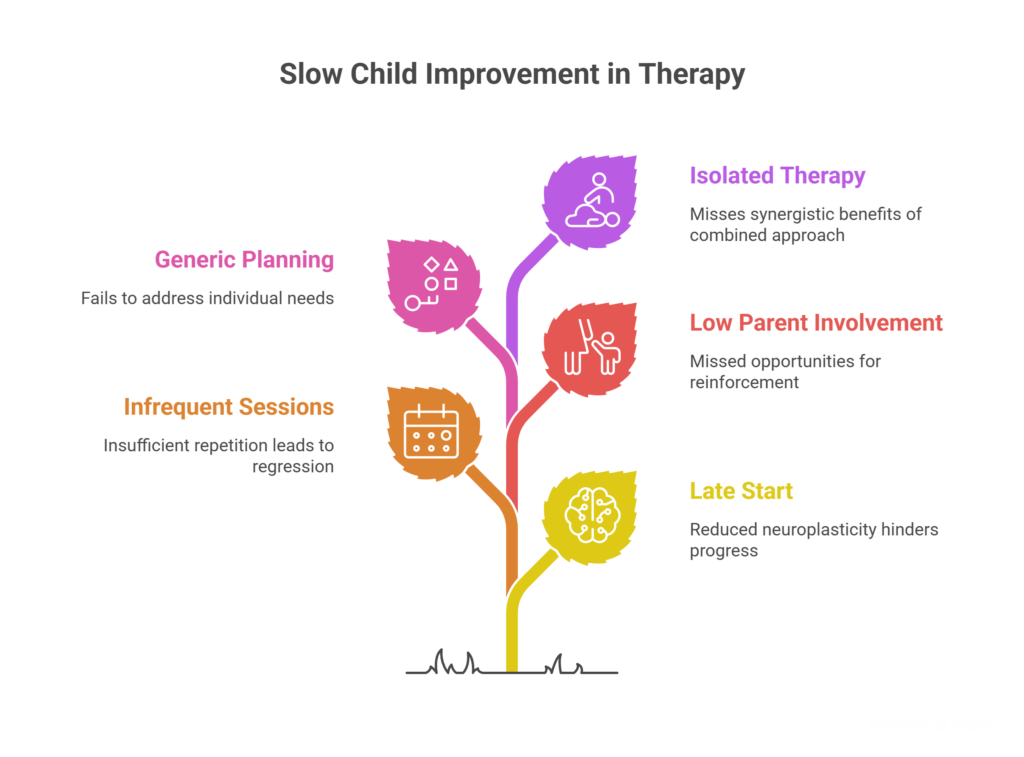
5 Factors That Determine How Fast Your Child Improves
1. Age at Start of Therapy
The brain’s neuroplasticity is at its peak between ages 0 and 6. Starting therapy during this window — whether at a Speech Therapy centre in Boring Road, Patna or an occupational therapy clinic — dramatically increases the speed and depth of change. Older children benefit significantly too, but earlier always produces faster and deeper results.
2. Session Frequency
Research consistently shows that 2–3 sessions per week produces measurably faster results than once-weekly sessions. Neurological learning is consolidated through repetition, and longer gaps between sessions allow regression of newly forming pathways.
3. Parent Participation at Home
The 45–60 minutes a child spends in therapy each day is valuable. But the remaining waking hours are equally important. Families who practise recommended activities at home see progress two to three times faster than those who rely solely on in-clinic sessions.
4. Individualized Planning
A therapy plan built on detailed initial assessment — measuring sensory thresholds, motor benchmarks, and cognitive patterns — will always outperform a generic programme. At our centre, we follow a strict one-child, one-therapist ratio, meaning every session is individually designed and continuously adapted.
5. Combined Therapy Approach
When OT is combined with speech therapy and behavior therapy — as recommended by the 2025 Lancet research — outcomes are dramatically better. An experienced Autism Doctor in Boring Road, Patna assesses all five of these factors before creating your child’s personalized plan.
Recent News Relevant to Families in Patna & Bihar
India, 2025
The Ministry of Social Justice and Empowerment expanded the Unique Disability ID (UDID) scheme to include more provisions for accessing early intervention therapy. Families enrolled in certified autism therapy programmes can now access subsidised sessions under new welfare guidelines.
Global, 2025
The World Health Organization updated its autism support guidelines in 2025, now explicitly recommending occupational therapy as a first-line intervention for children on the spectrum under age 6 — a major global shift toward therapy-first approaches.
Bihar, 2026
Bihar’s government inclusion of neurodevelopmental disorders in school education reform policies has increased demand for certified therapy centres across the state. Patna is seeing a significant surge in families seeking early assessment and structured therapy closer to home.
Red Flags: Signs That Therapy May Not Be Working
Most parents hesitate to ask this question, but it is one of the most important. If you notice any of the following, it may be time to reassess the programme — not abandon therapy, but ensure it is genuinely working for your child.
- No measurable change of any kind after 3 months of consistent sessions
- Your child is consistently distressed before, during, or after sessions
- The therapist cannot show you assessment scores or progress data
- Sessions feel unstructured — more like supervised play than targeted therapy
- You receive no guidance on what to practise at home between sessions
- Your child’s behaviour at home or at school is worsening, not improving
| If you are concerned that your child’s current programme is not progressing, we offer a free second-opinion assessment at our Boring Road centre. Contact us at +91 93041 40878. |
Accessibility from Across Patna
Our centre at C17, Sri Krishna Puri is easily reachable from across central Patna. Families regularly visit from near Bihar Museum (900 m, 3 mins), Eco Park (1.9 km, 6 mins), Patna Museum (2.5 km, 8 mins), ISKCON Temple Patna (2.6 km, 7 mins), and Buddha Smriti Park (3.0 km, 10 mins). Families from the Sanjay Gandhi Biological Park (3.5 km, 9 mins) area, near Golghar (3.7 km, 14 mins), and P&M Mall (4.7 km, 16 mins) all reach us conveniently. Nearby landmarks: A.N. College (1.6 km), Jyoti Punj Hospital (1.1 km), GV Mall near Boring Rd (1.3 km), Panchmukhi Hanuman Mandir (1.8 km). Consistent attendance is one of the most powerful factors in therapy progress. Choosing a centre close to home removes one of the biggest barriers to regular sessions.
How to Choose the Right Occupational Therapy Centre in Patna
Not all therapy centres deliver the same quality of care. Here are 7 questions every parent should ask before enrolling their child:
| Question | What the Right Answer Looks Like |
| Is the therapist RCI registered? | Yes — all therapists should hold a valid Rehabilitation Council of India registration. |
| What is the therapist-to-child ratio? | 1:1 (one therapist per child per session). Group sessions reduce effectiveness. |
| Do they provide a written assessment report? | Yes — a documented baseline is essential for tracking progress over time. |
| Is there a structured home programme? | Yes — parents should receive specific activities to practise at home after every session. |
| How are progress reviews conducted? | Formal reviews with standardised scores every 3 months minimum. |
| Is there a multidisciplinary team? | Ideally OT, speech therapy, and behaviour therapy all available in one place. |
| What is their experience with autism and ADHD? | Specific, demonstrable experience — not just general paediatric therapy. |
At our Occupational Therapy centre in Boring Road, Patna, the answer to every one of these questions is a clear yes — backed by Dr. Kapil Dev’s credentials as a former Senior Consultant Occupational Therapist at AIIMS Patna.
Government Support for Families of Children with Autism in India
Many families in Patna and Bihar are unaware of the government support they are entitled to. Here is a concise guide:
Unique Disability ID (UDID)
A government-issued card for persons with disability. Enables access to welfare schemes, subsidies, and certain therapy cost provisions. Apply at swavlambancard.gov.in.
RCI Registration
All legitimate therapy professionals in India must be registered with the Rehabilitation Council of India. Always verify your therapist’s RCI number before enrolling.
Rights of Persons with Disabilities Act 2016
Guarantees rights to education, healthcare, and appropriate support for children with autism and ADHD across India — including in Bihar.
Bihar State Disability Welfare Schemes
Bihar offers a range of social welfare provisions for children with neurodevelopmental disorders. Contact the District Social Welfare Office in Patna for current entitlements.
What to Do When Your Child Resists Therapy Sessions
Resistance to therapy — refusing to enter the room, crying, running away, or shutting down — is common, especially in the early weeks. Here is how to understand and manage it:
Why It Happens
Children with autism or ADHD often have a strong need for routine and predictability. A new environment, new adult, and new activities can trigger genuine anxiety — not defiance.
At-Home Preparation Strategies
Use visual schedules showing the sequence of the day including therapy. Allow your child to bring a familiar comfort object. Talk about what will happen before you arrive. Keep your own tone calm and matter-of-fact.
What the Therapist Does
An experienced therapist builds trust gradually — following the child’s lead in early sessions, using highly preferred activities, and never forcing participation. Trust is the foundation of all therapeutic progress.
When to Flag It
If resistance persists beyond 4–6 weeks, inform your therapist. It may indicate a mismatch in approach, sensory environment, or communication style that needs adjusting.
OT and School Readiness: What Progress Means for Your Child’s Education
Parents care most about their child succeeding in school. Occupational therapy directly builds the skills that make school possible:
| OT Goal | School Outcome |
| Fine motor skill development | Legible handwriting, using scissors, turning pages |
| Core strength & postural control | Sitting at a desk for sustained periods without fatigue |
| Attention regulation strategies | Following multi-step instructions, completing tasks |
| Sensory tolerance building | Tolerating school noise, different textures, group settings |
| Social communication skills | Taking turns, group work, understanding classroom rules |
Children who begin OT before Class 1 (around age 5–6) and attend consistently for 12+ months frequently transition to mainstream schooling with far less support than those who start later. This is the most tangible, life-changing outcome of early intervention.
Conclusion
The honest answer to “how long until occupational therapy shows results?” is this: sooner than you might fear, and more powerfully than you might hope — if the right conditions are in place.
Small signs of progress often appear within the first 6 to 8 weeks. Functional, life-changing change typically takes 6 to 18 months. And the earlier your child begins, the more transformative the outcome. Whether you are searching for an Autism Treatment Center in Boring Road, Patna, an experienced Autism Doctor in Boring Road, Patna, or a trusted Occupational Therapy centre in Patna — the most important step is not the perfect one. It is simply the first one. At Rehab for Autism & ADHD, our team — led by Dr. Kapil Dev, former Senior Consultant Occupational Therapist at AIIMS Patna — works with one mission: to help your child reach their fullest potential through evidence-based, compassionate, one-on-one care. C17, Sri Krishna Puri, Patna. Open Monday to Saturday, 12 PM to 8 PM.
Frequently Asked Questions
Q: At what age should I start occupational therapy for my child?
The earlier the better. OT is most effective between ages 2 and 6, when the brain’s neuroplasticity is at its highest. Older children benefit significantly too — starting at any point is always better than not starting.
Q: How many OT sessions per week does my child need?
For children with autism or ADHD, two to three sessions per week is generally most effective. Once-weekly sessions produce progress but at a slower rate. Your therapist will recommend the ideal frequency based on your child’s assessment.
Q: What is the difference between occupational therapy and speech therapy?
OT focuses on daily functional skills — motor coordination, sensory processing, self-care, and school readiness. Speech therapy focuses on communication — spoken language, understanding instructions, and social communication. For many children, both are recommended together, which our Speech Therapy centre in Boring Road, Patna provides alongside OT.
Q: Does my child need a formal autism diagnosis before starting OT?
No. A formal diagnosis is not required to begin occupational therapy. Early intervention — even before a definitive diagnosis — produces the best outcomes. Our therapists can work with children showing developmental delays or sensory differences at any stage.
Q: How do I know if the therapy is actually working?
Track functional improvements in daily life — tasks your child can now do independently. At formal 3-month reviews, ask your therapist to show standardised assessment scores. An honest, experienced therapist will always discuss your child’s progress with you openly and with data.
Q: What is the cost of occupational therapy in Patna?
Session costs vary based on assessment complexity, therapy type, and frequency. We encourage families to contact our centre directly at +91 93041 40878 for a transparent conversation about fees, package options, and any government support you may be entitled to.
Q: How is OT different from ABA therapy?
ABA (Applied Behaviour Analysis) focuses on modifying specific behaviours through positive reinforcement. Occupational therapy focuses on building the underlying functional skills — sensory processing, motor control, attention — that make everyday activities possible. Many children benefit from both, used together as part of a multidisciplinary programme.
Q: Is your centre accessible from near A.N. College and Panchmukhi Mandir?
Yes. Our centre at C17, Sri Krishna Puri is easily reachable from A.N. College (1.6 km), Panchmukhi Hanuman Mandir (1.8 km), Jyoti Punj Hospital (1.1 km), and GV Mall near Boring Rd (1.3 km). Families from across central Patna attend our centre regularly.
Is Your Child Ready to Begin Their Therapy Journey?
Book a free initial assessment with Dr. Kapil Dev’s team at our Boring Road centre.
Book Appointment: rehabautismadhd.org/book-appointment
Call Us: +91 93041 40878 Mail Us: info@rehabautismadhd.org
About the Author
Dr. Kapil Dev (BOT, MOT) is the Director of Rehab for Autism & ADHD, Patna. A Pediatric Occupational Therapist with 7+ years of specialised experience in sensory integration and developmental disabilities, he is a former Senior Consultant Occupational Therapist at AIIMS Patna. He leads a multidisciplinary team providing OT, speech therapy, behaviour therapy, and special education at C17, Sri Krishna Puri, Boring Road, Patna.