
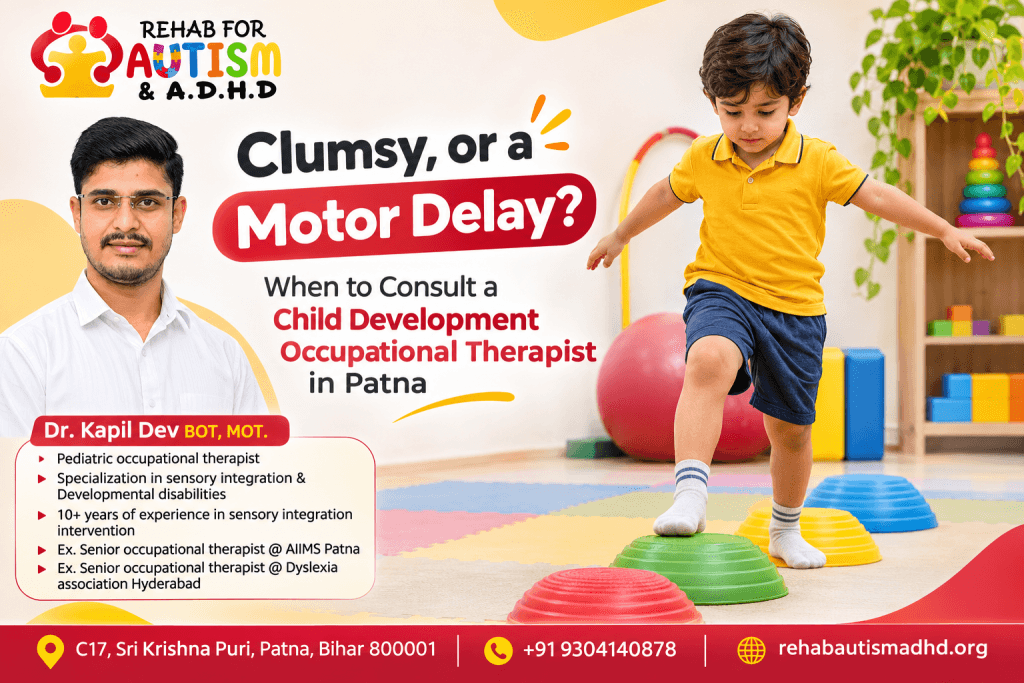
Consult one when motor difficulties interfere with everyday tasks such as writing, dressing, eating or playing, or when your child misses age milestones, avoids movement or loses skills. Do not wait for school age. An early assessment gives you clear answers and a practical plan.
Book an assessment if your child:
- still holds a pencil in a fist after age 4
- trips, falls or bumps into things far more than other children
- needs help with buttons, a spoon or dressing long after peers manage alone
- avoids drawing, swings or ball games
- writes slowly or untidily, or tires after a few lines
- loses a movement skill they once had (see a pediatrician promptly for this one)
Introduction
Most Patna parents have heard it at a family function: “He’s just clumsy. She’ll grow out of it.” Sometimes that is true. Children learn to move at different speeds, and a late walker or messy writer is not automatically a concern.
Sometimes, though, “clumsy” hides a motor coordination delay. The child keeps falling behind in tasks that look easy for classmates, and the gap widens each year. This guide helps you tell the difference. It gives you an age-by-age guide, five examples, recent research and a clear point at which to ask for help. If you decide to act, it also explains what pediatric occupational therapy in Patna looks like.
What Counts as a Motor Coordination Delay?
Motor skills fall into two groups. Fine motor skills use the small muscles of the hands and fingers: gripping a crayon, using scissors, fastening buttons. Gross motor skills use the large muscles: walking, climbing, jumping, catching a ball.
A delay means a child performs well below the expected level for their age, and it affects daily life. When the difficulty has been present since early childhood and has no other neurological or vision explanation, doctors may diagnose developmental coordination disorder (DCD), sometimes called dyspraxia. Researchers estimate that DCD affects between 5% and 8% of school-age children worldwide, and that it often appears alongside ADHD or autism. fapesp
A child development occupational therapist looks at how movement, vision, touch and balance work together so the child can manage activities of daily living: eating, dressing, writing, playing and using the toilet. The therapist does not only train muscles. They look at why a task is hard, then build the skill through play.
Age-by-Age Guide: Watch, or Act?
Use these as prompts for a conversation, not as a diagnosis. Children vary, and one missed item matters less than a pattern.
1 to 2 years. Most children pick up small items between thumb and finger by about 12 months, walk on their own by about 18 months and scribble by themselves around then. If your child is not walking, avoids using one hand, or shows very little interest in handling objects, speak to your pediatrician and ask about an OT or physiotherapy assessment.
3 to 4 years. By age 4, most children catch a large ball most of the time, pour water or serve food with adult supervision, unbutton some buttons and hold a crayon between fingers and thumb rather than in a fist. If your child cannot do several of these, book an assessment rather than waiting for school. understood
5 to 8 years. School exposes motor gaps. Watch for slow, effortful handwriting, trouble with scissors or a tiffin box, difficulty dressing in school uniform, and avoidance of playground games.
9 to 14 years. Older children often hide the problem. Look for messy notebooks, refusal to join sports, trouble organising a school bag, and low confidence after teasing. These children benefit from therapy too, and goals shift toward writing speed, sports participation and independence.
Eight Signs to Act On
- Grip problems. A fist grip on a pencil, or an unusually tight or weak grasp.
- Frequent falls or collisions. Far more than other children of the same age.
- Avoiding movement. The child refuses swings, stairs, ball games or cycling.
- Dependence in self-care. Needing help with spoon, dressing or buttons well beyond peers.
- Handwriting struggles. Large, uneven letters, slow speed, or a sore hand after a few lines.
- Poor hand-eye coordination. Cannot catch, throw or copy shapes.
- Sensory reactions. Distress with clothing labels, messy textures, noise or movement, or seeking constant crashing and spinning.
- Emotional signs. Frustration, “I can’t” statements, tears at homework, or reluctance to attend school.
Fine motor and sensory difficulties often overlap, so many children need occupational therapy for fine motor difficulties and occupational therapy for sensory processing difficulties together.
Five Real-World Examples
These are composite examples written for illustration. They are not real patients, and names are changed.
Aarav, age 4. Aarav refuses to draw and grips crayons in his fist. He tires after two buttons. His parents assumed he was lazy. An assessment found weak finger strength and low hand control, and his therapy goals focused on fine motor play: pegs, putty and threading.
Ananya, age 6. Her Class 1 teacher calls her careless because her letters are huge and she finishes last. Ananya also avoids the playground. The assessment found poor visual-motor coordination, not carelessness. Her plan combined handwriting games with body-awareness play.
Kabir, age 3. Kabir bumps into furniture, hates clothing tags and screams during hair washing. He seems both clumsy and over-sensitive. His therapy focused on sensory regulation through swings, textures and heavy-work activities, with parent coaching for home.
Riya, age 8. Riya cannot ride a cycle or play cricket, and classmates tease her as slow. She has started saying she is “bad at everything.” Her assessment pointed to coordination difficulties that were affecting confidence. Her goals combined motor skills with a sense of success in group play.
Mohit, age 5. Mohit has a developmental diagnosis and still needs full help to eat and dress. His parents wanted functional independence before school. His therapist set small goals for self-care skills: scooping with a spoon, pulling up trousers, then fastening a button. Each goal followed his own pace.
What Recent Research Says
New studies reinforce one message: motor difficulties rarely stay “just motor.”
- 29 January 2026: motor and sensory processing are linked. A Brazilian study of 694 children aged 6 to 11 found that children with DCD more often showed a “bystander” sensory pattern, noticing their surroundings less. About 35% of the DCD group fell into that pattern, and it was linked to poorer motor performance. The message for parents: if movement is hard, ask about sensory processing too. fapesp
- 14 January 2026: coordination and emotions go together. A study of children aged 3 to 6 found a link between weaker motor coordination and more emotional and behavioural problems, and children at risk of DCD did worse in peer interaction and prosocial behaviour. The authors recommend early screening of motor skills. boisestate
- 2025: screen time and motor skills. A study of 1,394 children aged 3 to 4 linked each extra hour of daily screen time with a 0.50-point drop in gross motor score. Children who met screen-time, sitting and overall sedentary guidelines had higher odds of being on track for fine and gross motor skills. strath
- April to June 2026: media use in the early years. A Thai study of children aged 2 to 5 found that more than one hour of electronic media daily was linked to delays in fine motor skills, cognitive skills and expressive language. Parent involvement during media use was linked to better scores. These studies show association, not proof of cause, but they support limiting screens and playing together. tci-thaijo
- 21 July 2026: more therapy options are reaching Patna. A press release carried by The Tribune announced a new multi-therapy centre in Patna, noting that families have often travelled to Delhi or Mumbai for specialist therapy. Access is improving. The question for parents now is fit: an assessment-led plan, a qualified therapist and regular reviews. tribuneindia
Typical Clumsiness vs Time to Consult an OT
| Question | Usually typical | Consult an OT |
|---|---|---|
| Pattern | One or two tasks are late, then catch up | Several tasks are behind and the gap widens |
| Daily life | Child manages with some help | Eating, dressing or school work are affected |
| Practice | Skill improves with practice | Skill stays the same despite practice |
| Emotions | Child shrugs off mistakes | Frustration, avoidance, teasing or low confidence |
| Sensory | Occasional fuss over noise or textures | Strong daily reactions, or constant crashing and spinning |
| Age | Under 2, with steady progress | Aged 4 or over and well behind peers |
| Regression | None | Loss of a skill (see a doctor promptly too) |
What Happens at an Assessment
At Rehab For Autism and ADHD, the process starts with a detailed developmental assessment: fine and gross motor skills, handwriting, sensory processing, visual-motor skills, self-care and play. The team then explains the findings in plain language.
Next comes the plan. Instead of a standard program, the therapist writes individualised therapy goals in occupational therapy Patna families can follow: for example, “uses a spoon without spilling at lunch” or “writes his name on the line.” Each goal has a clear measure. Sessions are one therapist to one child, and the therapist shows you what to practise at home. Goals are reviewed regularly and updated as your child grows.
The clinic is at C17, Sri Krishna Puri, close to Boring Road, so many Patna families can reach an occupational therapy clinic in Patna, Bihar without crossing the city. Read more about our occupational therapy in Patna and sensory integration therapy, or meet Dr. Kapil Dev and our therapy team.
The Cost of Waiting
Motor skills support almost everything a child does at school. When help comes late:
- Handwriting gaps grow. Slow writing limits exam performance and homework time.
- Self-care stays dependent. A child who cannot dress or eat alone misses out on independence.
- Confidence drops. Children avoid sports, group games and activities they find hard.
- Emotions take a toll. The 2026 data above links coordination difficulties with emotional and behavioural problems.
- Effort rises later. The younger the child, the more playful and quicker therapy usually feels.
Waiting rarely makes the problem disappear. It usually makes it harder to treat.
For Teachers and Pediatricians
If you teach or treat children in Patna, consider a referral when a child shows large or very slow handwriting, avoids the playground, needs repeated help with a uniform or lunch box, or loses skills. A short written note on what you have observed helps the therapist.
Families Outside Patna, and Fees
Many families travel to Patna from Motihari, Muzaffarpur, Gaya and Ara. You can book an occupational therapist appointment in Patna by phone or WhatsApp, and the clinic also runs a centre in Motihari. Tell the team where you live so they can plan visits and a home program that works between sessions. If you want to book an occupational therapy assessment in Patna, use the buttons below.
Occupational therapy fees in Patna vary by centre, assessment length and session frequency. Ask any clinic what the assessment covers, how often sessions run and whether parent coaching is included. [Add the clinic’s current fee range here.]
Conclusion
A single clumsy moment is normal. A pattern is a signal. If your child struggles with writing, dressing, eating or play, avoids movement, or seems unhappy about it, ask for an assessment rather than waiting. A pediatric occupational therapy assessment in Patna takes a few visits, gives you clear information and starts a plan built around your child. You can always decide the delay is typical; you cannot get back lost time if it is not.
📞 Call Us | 💬 Message Us | 📅 Book an Appointment
Rehab For Autism and ADHD · C17, Sri Krishna Puri, Patna 800001 · Mon–Sat, 12 PM–8 PM · +91 93041 40878
Frequently Asked Questions
1. At what age should I worry about a motor coordination delay?
There is no single age. Seek advice if a child is not walking by about 18 months, or if from age 3 or 4 several everyday skills (holding a crayon, buttoning, catching a ball) are well behind peers. Loss of a skill at any age needs prompt medical advice.
2. Is clumsiness the same as DCD?
No. Many children are clumsy at times. DCD is a diagnosis made by a clinician when motor performance is well below the expected level, interferes with daily life, began in early childhood and has no other neurological or vision cause. An OT assessment helps clarify which situation applies.
3. Do I need a doctor’s referral to see an occupational therapist in Patna?
Parents can book a first consultation directly by phone, WhatsApp or a clinic visit. If your pediatrician has already assessed your child, bring those notes.
4. How is occupational therapy different from physiotherapy?
Physiotherapy mainly addresses strength, balance and large movements such as walking and climbing. Occupational therapy focuses on everyday tasks: handwriting, dressing, eating, sensory regulation and play. Many children benefit from both.
5. How long does therapy take?
It depends on your child’s needs. The therapist sets how often your child attends after the assessment and reviews progress regularly, so the plan changes as your child grows.
6. What do occupational therapy fees in Patna look like, and how do I choose a centre?
Fees vary by centre and plan. Ask what the assessment includes, how many sessions you should expect, whether sessions are one-to-one, and whether parent coaching is included. Check therapist registration, and ask how goals are written and reviewed.
Medical Disclaimer
This article is for general information and does not replace medical advice, diagnosis or treatment. Children develop at different rates. If you have concerns about your child’s development, speak with a qualified doctor or therapist. Seek urgent medical advice if your child loses skills, has sudden weakness or has other worrying symptoms.

Need expert guidance?
Concerned about your child's development?
Book an assessment with Dr. Kapil Dev (BOT, MOT), Ex-Senior Occupational Therapist, AIIMS Patna, at our center in C17, Sri Krishna Puri, Patna.