
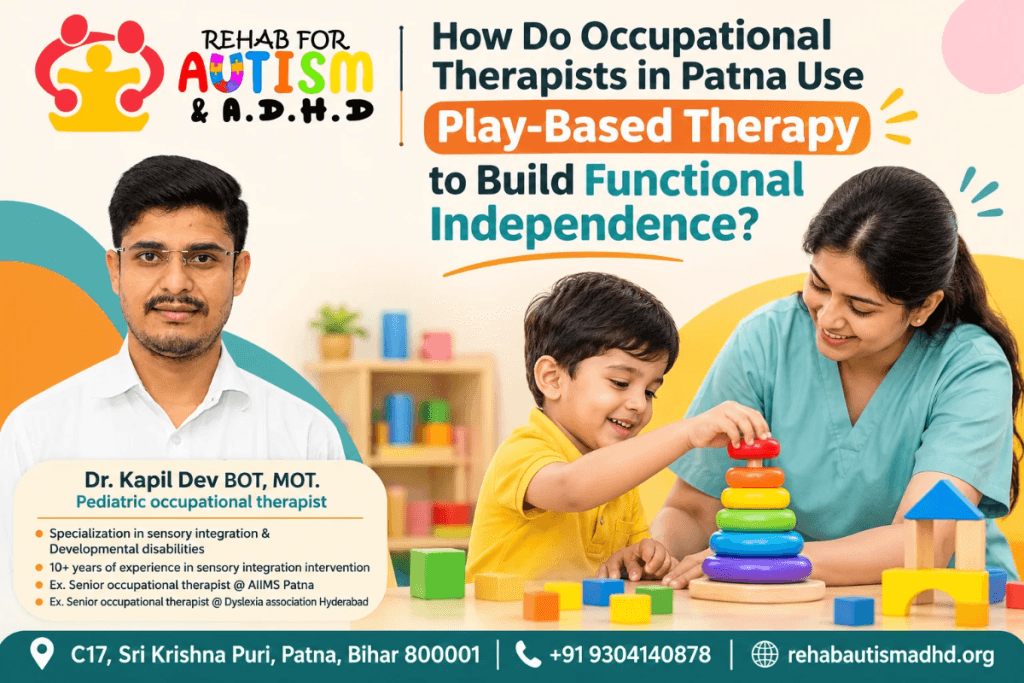
Quick answer: Occupational therapists in Patna use play-based therapy by turning daily skills into games a child wants to play. Stacking rings build grip, swings build sensory regulation, and pretend meals build self-care skills. The therapist sets individualised goals, adjusts each game, and coaches parents so skills carry over to dressing, eating, writing, and school routines.
In short:
- Assess how your child plays, moves, and handles sensory input.
- Set individualised goals tied to daily tasks such as dressing, eating, writing, and toileting.
- Design games that practise those tasks, then make them slightly harder each week.
- Coach parents to repeat the games at home.
Introduction
A five-year-old who refuses to hold a pencil will squeeze playdough for twenty minutes. A child who melts down in a noisy market will laugh through a swing session. Occupational therapists in Patna build therapy around that difference. They do not ask a child to practise a skill. They design a game where the skill is the only way to win.
This guide explains how that works in occupational therapy in Patna: what a session looks like, which goals therapists set, and how parents in Kankarbagh, Bailey Road, Sri Krishna Puri, and nearby districts can tell whether therapy is working.
What Play-Based Occupational Therapy Actually Means
Play is a child’s main occupation. So in pediatric occupational therapy in Patna, play is the method and functional independence is the result. Functional independence means a child manages the activities of daily living (ADL), such as dressing, eating, grooming, and toileting, plus school tasks like holding a pencil and sitting through a lesson, without constant adult help.
Play-based therapy is structured, not random. Every activity has a target skill, a measurable goal, and a plan for making it slightly harder next week. Therapists call this the just-right challenge: easy enough for the child to succeed, hard enough to build something new. Free play at home is wonderful, but it does not follow that plan.
How a Play-Based Session Works
Step 1: The assessment
The therapist talks with parents and watches the child play. She looks at hand use, balance, body awareness, sensory reactions, and daily skills. At Rehab for Autism & ADHD, every session is one child with one therapist, and the first visit is this assessment.
Step 2: Individualised therapy goals in occupational therapy Patna families can measure
A good goal names the skill, the support level, and the time frame. For example: “Within 12 weeks, a five-year-old will fasten three large buttons on a school shirt in under two minutes with one verbal reminder.” That goal is specific enough that parents can see it happen at home. If a goal says only “improve motor skills”, ask the therapist to rewrite it.
Step 3: Game design
The therapist picks a game that forces the target skill. Pulling toys out of putty trains the pinch grip. Carrying a heavy bucket across a room trains posture and body awareness. The child feels like they are playing because they are.
Step 4: Sensory regulation first
A child who feels overwhelmed cannot learn. Therapists often start with swinging, crawling, or pushing to bring the body to a calm, alert state, then introduce the task. Families who want to know more can read about sensory integration therapy at the centre.
Step 5: Parent coaching and review
The therapist shows parents two or three games for home and reviews the goals every few weeks. Progress speeds up when the same game continues at home between sessions.
Five Real-World Examples
These scenarios are illustrative composites of common therapy activities, not records of individual children.
1. Occupational therapy for fine motor difficulties
A four-year-old drops the crayon after ten seconds. The therapist hides plastic coins in playdough, and the child pulls them out with tongs, then squeezes a clothes peg to feed a paper crocodile. Pinching, squeezing, and finger control get practised before the child ever holds a pencil. Over several weeks the therapist swaps in thinner tools and short drawing tasks.
2. Occupational therapy for sensory processing difficulties
A six-year-old with autism covers his ears in a crowded market and refuses wet or sticky textures. In the sensory gym, the therapist starts with heavy-work play: pushing a weighted cart, crawling through a tunnel, swinging. Only then does she add a bowl of dry rice, and later soft atta dough. The child decides how far to go. This builds sensory regulation by letting him set the pace.
3. Occupational therapy for self-care skills
A five-year-old with global developmental delay needs an adult to dress him. The therapist starts with a teddy bear in a school shirt. The child buttons the bear’s shirt, then a large-button vest on his own body, then his own shirt. The therapist breaks dressing into small steps and teaches the last step first, so every attempt ends in success.
4. Sitting tolerance for a child with ADHD
An eight-year-old cannot sit through ten minutes of homework. The session opens with an obstacle course of jumping, crawling, and carrying, followed by a short seated puzzle. The therapist adds a minute or two of seated time as the child manages. Movement first, focus second, gives the body the input it seeks before the task begins.
5. Feeding play for a picky eater
A three-year-old eats only dry biscuits. In a pretend kitchen, the therapist and child make dal from coloured water, roll roti from playdough, and serve a doll. Touch, smell, and spoon use come first. Real food follows slowly. If a child gags often, refuses most foods, or loses weight, a pediatrician should check first.
Five Recent Developments Parents and Referrers Should Know
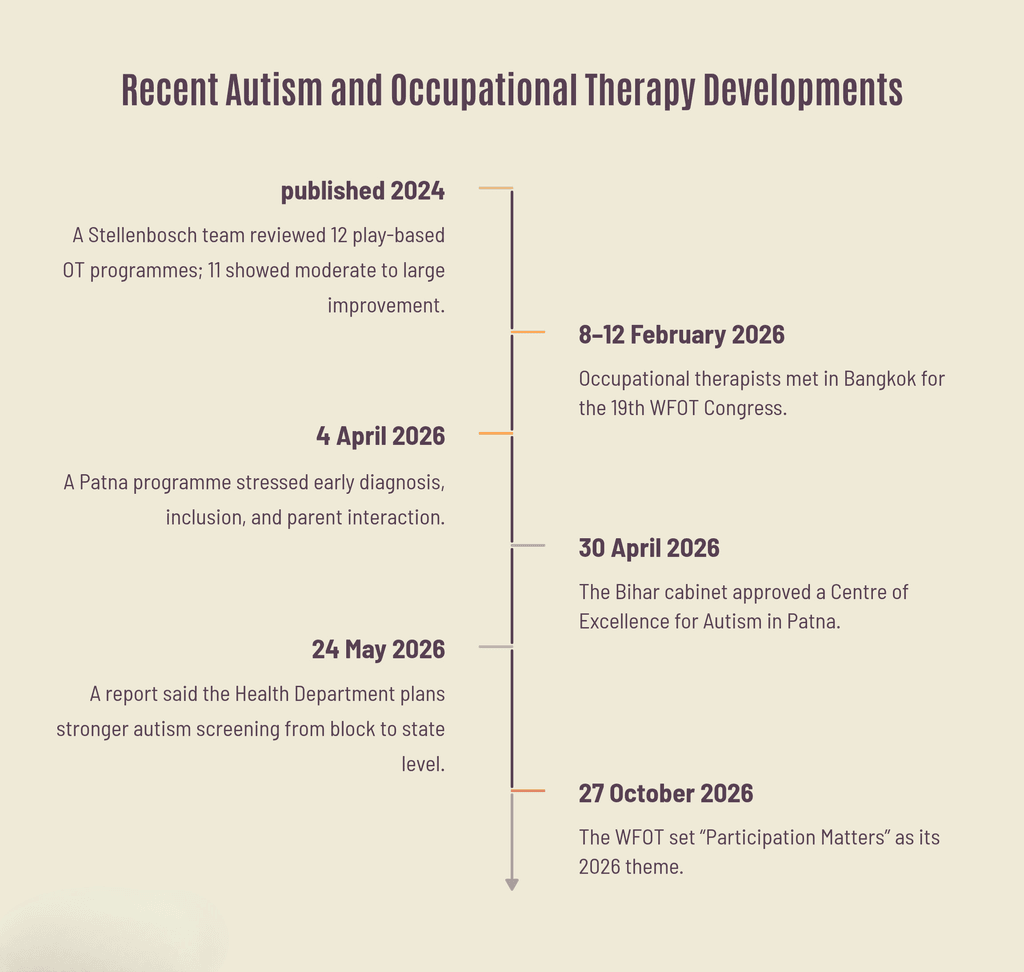
- Bihar approves an autism Centre of Excellence (30 April 2026). The Bihar cabinet approved a Centre of Excellence for Autism in Patna to strengthen diagnosis, therapy, training, and research (Patna Press). A report dated 24 May 2026 said the Health Department also plans to strengthen autism screening from block to state level. More screening will identify more children, and families will then need therapy, not only a diagnosis.
- World Autism Awareness Day programme in Patna (4 April 2026). A local event stressed early diagnosis, inclusion, and parent interaction (Patna Press). Parents are asking earlier questions about next steps.
- 19th WFOT Congress in Bangkok (8–12 February 2026). Occupational therapists from around the world met to share research and practice, according to an attendee’s account on Therapy Insights.
- World Occupational Therapy Day (27 October 2026). The World Federation of Occupational Therapists set the 2026 theme as “Participation Matters”. That idea sits at the centre of play-based therapy: a child who joins in learns more.
- Systematic review of play-based OT for autism (published 2024). A Stellenbosch University team reviewed 12 play-based occupational therapy programmes. Eleven showed moderate to large improvement in playfulness and social play for children with autism (African Journal of Disability, protocol published 18 December 2024).
What the Evidence Does and Does Not Say
The research is encouraging but young. The review above covers a small number of studies, mostly outside India. A 2023 randomised trial from Iran noted that sensory integration therapy is widely used but has limited evidence overall. The same trial found that sensory integration therapy combined with parent-led sensory play improved sensory patterns more than the therapy alone. Treat any therapist who promises a fixed outcome with caution. A good therapist tracks goals and changes the plan when progress stalls.
Play-Based OT vs Other Approaches
| Feature | Play-based OT | Worksheet or drill practice | Waiting to see if the child grows out of it |
|---|---|---|---|
| Child’s motivation | High; games sit inside a plan | Often low; children resist repetition | Not applicable |
| Skill carry-over to home and school | Better when parents repeat the games | Limited; skills stay on paper | Uncertain |
| Goal tracking | Measurable goals, reviewed regularly | Pages completed | None |
| Sensory needs | Built into every activity | Usually ignored | Unaddressed |
| Parent role | Home coach | Supervisor | Observer |
| Main risk | Needs a trained therapist to grade the challenge | Frustration and avoidance | Missed early-intervention window |
What Makes the Best Occupational Therapy Centre in Patna for Your Child?
No ranking can tell you that, but a checklist can. Look for these:
- A registered occupational therapist who leads the assessment (ask for the registration number).
- One-to-one sessions, not a crowded room.
- Written, measurable goals reviewed on a schedule.
- A sensory space with swings, balance tools, and varied textures.
- A home programme after every session.
- Clear answers about session length, frequency, and cost.
Rehab for Autism & ADHD is an occupational therapy clinic in Patna, Bihar at C17, Sri Krishna Puri, close to Boring Road, so families searching for occupational therapy near Boring Road Patna can reach it from Kankarbagh, Bailey Road, Rajendra Nagar, and Danapur. It is led by Dr. Kapil Dev (BOT, MOT), a former Senior Occupational Therapist at AIIMS Patna, and treats children from 12 months to 14 years. The centre is open Monday to Saturday, 12 PM to 8 PM. There is also a centre in Motihari.
Fees. Occupational therapy fees in Patna vary with session length, how often your child attends, and the therapist’s experience. Ask for the fee and the expected frequency during the first call so you can plan, instead of finding out after the assessment.
Families from Muzaffarpur, Gaya, Ara, and other districts. Ask how often your child needs to attend in person and how the home programme can cover the gaps between visits.
For pediatricians, teachers, and counsellors. A useful referral names the concern (for example, difficulty with handwriting, dressing, or sitting), the child’s age, and any diagnosis already made. The therapist will run a full assessment either way.
The Cost of Delay
Skills build on each other. A child who cannot grip well at four often avoids drawing at five, writes slowly at six, and falls behind in class at seven. Each year of avoidance adds frustration for the child and extra workload for the family. Early assessment does not commit you to years of therapy. It gives you a baseline and a clear answer on what to do next.
Conclusion
Play-based therapy works because it matches how children learn. Occupational therapists in Patna turn goals for fine motor skills, sensory regulation, and self-care into games, then coach parents to continue them at home. The result to watch for is functional independence: more buttons fastened, more spoonfuls eaten, more minutes seated, with less adult help. If you notice two or more difficulties with daily tasks, book an occupational therapy assessment in Patna and ask for written goals.
Call Us: +91 93041 40878 | Message Us | Book an Appointment
Frequently Asked Questions
1. What is play-based therapy in occupational therapy? It is a method where the therapist uses structured games to practise motor, sensory, and daily-living skills. Each game targets a written goal and gets harder as the child improves.
2. Is play-based therapy only for toddlers? No. Games change with age. Older children may cook, build, or play rule-based games that practise the same skills. The centre works with children from 12 months to 14 years.
3. How will I know it is working if it looks like play? Check the goals. If the goal was fastening three buttons with one reminder, you can watch for that at home. Ask the therapist to review goals with you every few weeks.
4. How do I get an occupational therapist appointment in Patna? Call +91 93041 40878, send a WhatsApp message, or use the online form. The first visit is an assessment, where the therapist sets goals and explains the plan.
5. What are occupational therapy fees in Patna? Fees differ by clinic, session length, and frequency. Ask for the exact fee and the suggested number of weekly sessions when you call.
6. Can I do play-based activities at home? Yes, with guidance. Simple options include pulling coins from atta dough, matching katoris, or dressing a doll. Ask the therapist which games match your child’s goals so practice supports therapy.
Medical Disclaimer
This article gives general information and does not replace a medical diagnosis or individual advice. Every child develops differently. Consult a qualified pediatrician or occupational therapist about your child’s needs. The scenarios above are illustrative and do not describe real clients.

Need expert guidance?
Concerned about your child's development?
Book an assessment with Dr. Kapil Dev (BOT, MOT), Ex-Senior Occupational Therapist, AIIMS Patna, at our center in C17, Sri Krishna Puri, Patna.