
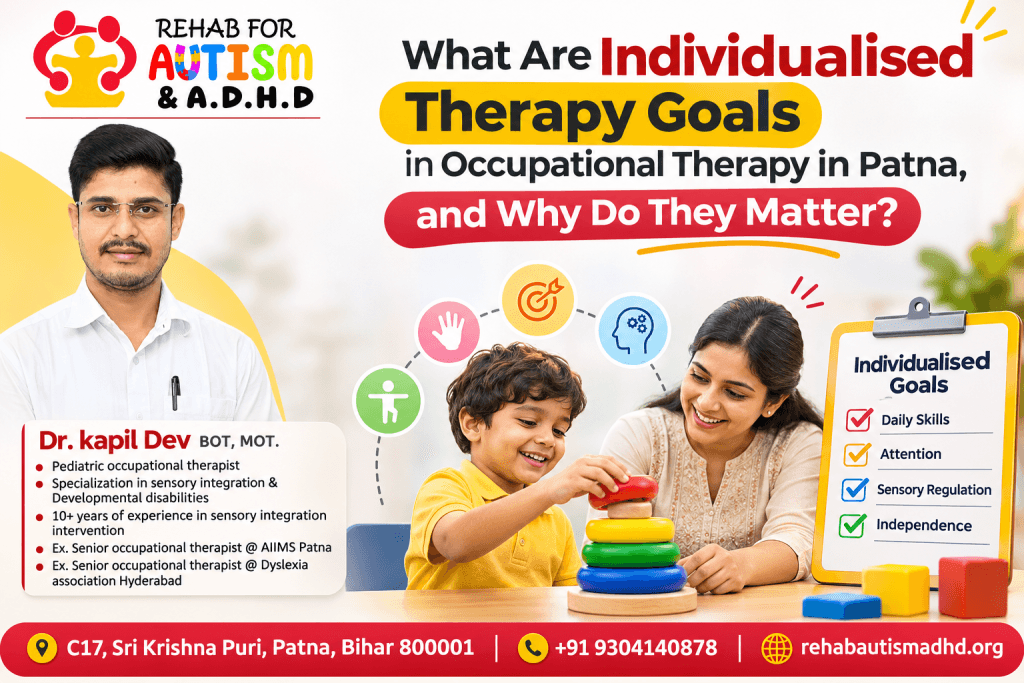
Individualised therapy goals in occupational therapy are written targets built around one child’s daily life, not a generic checklist. A therapist assesses the child, agrees priorities with parents, and sets measurable goals, such as fastening buttons or tolerating a haircut within 12 weeks. Progress is reviewed and goals are updated.
In four steps: Assess → Agree priorities → Set measurable goals → Review and update
Introduction
Ask parents what they want from occupational therapy and the answers are practical. “I want him to button his school shirt.” “I want her to sit through dinner without covering her ears.” Those wishes are where individualised therapy goals begin.
A goal turns a worry into a target that your child, your family and your therapist can all see. Without one, therapy drifts. Sessions feel busy, yet nobody can say what changed. With one, every activity has a reason.
This guide explains what individualised goals are, how a pediatric team sets them, what strong and weak goals look like, and why they matter for children aged 1 to 14 with autism, ADHD, speech delay, sensory processing difficulties or motor delays. It also covers recent developments in Bihar and in research, so you know what to ask at your first visit to occupational therapy in Patna.
What Are Individualised Therapy Goals in Occupational Therapy?
Occupational therapy looks at a child’s “occupations”: play, schoolwork, dressing, eating, and getting along with others. An individualised goal names one of those occupations, the skill that blocks it, where it happens and by when.
A useful goal answers five questions:
- Who? Your child, by name.
- What? The activity, such as fastening four shirt buttons.
- Where? Home, school or a salon chair.
- How well? For example, without hand-over-hand help on four of five tries.
- By when? Usually 8 to 12 weeks.
Researchers often check goals with Goal Attainment Scaling. It scores progress on a five-point scale from −2 to +2, where 0 is the expected result after treatment. You don’t need the jargon, but the idea helps: the therapist agrees with you, in advance, what “success” looks like.
Goals usually sit under three headings. Activities of daily living cover dressing, eating, toileting and grooming. School skills cover handwriting, scissor use and sitting tolerance. Sensory regulation covers staying calm and focused when sounds, textures or movement feel too much. The end point is functional independence: your child does more for themselves, with fewer prompts.
Why Do Individualised Therapy Goals Matter?
They give therapy a direction. A child who “needs work on motor skills” could spend months on activities that never reach the school bag or the dinner table. A named goal keeps every session pointed at something real.
They make progress measurable. “She seems better” is a feeling. “She now fastens three of four buttons” is a result. Measurable goals let you and the therapist spot a plan that isn’t working and change it early.
They put parents in the room. You know which morning routine causes tears and which school task your child avoids. Good goals come from that knowledge, which is why the best plans start with a parent interview, not just a test.
They connect clinic, home and school. A goal about handwriting stamina means little if the teacher never hears about it. Written goals give teachers, pediatricians and counselors one shared description of what you are working on.
They show when to stop or step up. Goals that are met free up time for the next priority. Goals that stall prompt a fresh look at the plan.
How Goals Are Set at a Clinic Near Boring Road, Patna
At Rehab for Autism & ADHD, the process starts with a developmental assessment covering gross and fine motor skills, handwriting, sensory processing, visual-motor skills, self-care and daily living, among other areas, leading to a plan with clear, measurable goals. In practice, goal-setting runs in four stages: rehabautismadhd
- Assessment. The therapist observes your child, uses standard tools and asks about daily routines.
- Priority conversation. You rank what matters most. A child may have five difficulties, but not all five are goals this quarter.
- Writing three to five goals. Many pediatric clinics limit the plan to three to five functional goals and re-assess formally about every 12 weeks. Fewer goals means more focus. lovable
- Review and update. Goals change as your child grows. Your therapist should tell you when each review will happen.
The clinic at C17, Sri Krishna Puri works on a 1 child : 1 therapist basis. It is led by Dr. Kapil Dev (BOT, MOT), a former Senior Occupational Therapist at AIIMS Patna. Parents get home activities after sessions so that practice continues between visits.
Five Examples of Individualised Goals
These are illustrative scenarios, not records of real clients.
1. Fine motor difficulties (age 6). A Class 1 student grips her pencil in a fist and stops writing after two lines. Her goal: hold the pencil with a three-finger grip and copy her name on lined paper within 10 weeks, with one reminder. Sessions use dough, tongs and clothespins to build hand strength before pencil work. This is occupational therapy for fine motor difficulties in action.
2. Sensory processing difficulties (age 4). A boy with autism cries at the salon clippers and at wedding band music. His goal: sit through a five-minute haircut with ear defenders and a familiar song, with no more than one break, in eight weeks. The plan builds sensory regulation step by step, as in sensory integration therapy in Patna. It does not push him through the noise.
3. Self-care skills (age 7). A child with global developmental delay depends on his mother to dress for school. His goal: fasten four shirt buttons in under two minutes by week 12. Therapy starts with oversized buttons on a practice board. This is occupational therapy for self-care skills, and it moves him toward functional independence.
4. ADHD and homework (age 9). A girl leaves her seat every few minutes during homework. Her goal: stay seated for ten minutes, using a planned movement break, on four of five evenings within six weeks. Attention, sensory needs and routine all feed into the plan. Some children also benefit from behavior therapy alongside OT.
5. A family travelling from another district (age 5). A child comes weekly from outside Patna. Her goal: eat half a meal with a spoon at home, without help, in eight weeks. Her parents practise in Hindi at mealtimes and note progress in a small notebook, so the home program does most of the work between visits.
What Recent Developments Tell Us
- 30 April 2026: The Bihar cabinet approved a Centre of Excellence for Autism in Patna, to strengthen diagnosis, treatment and research. The planned facility in Gardanibagh will offer preliminary diagnosis, speech therapy, behavioural therapy and training. (Patna Press) patnapresspatnapress
- 4 April 2026: A World Autism Awareness Day programme in Patna stressed early diagnosis, inclusion and equal rights for children with autism. (Patna Press) patnapress
- 17 April 2025: CDC data reported that about 1 in 31 eight-year-olds in the US had an autism diagnosis. These figures describe US children, not Bihar, but the same report found that the median age of diagnosis was 47 months, a reminder of how long many families wait. (CDC MMWR) rutgerspathfindersforautism
- 2025: A trial in Autism Research found that both Ayres Sensory Integration OT and ABA produced significant gains on individualised goals compared with no treatment. (Schaaf et al.) behavioristbookclub
- 2025: A randomised trial in the Journal of Autism and Developmental Disorders enrolled 35 children aged 3 to 10 with autism, giving 16 weekly sessions over four months and measuring individualised goals with Goal Attainment Scaling. The OT group with a home program improved occupational performance and goal attainment. (Çorakcı Yazıcıoğlu et al.) hacettepehacettepe
A new government centre will add capacity. Your child will still need a written plan with goals built around their own life.
Generic Plan vs Individualised Goals
| Feature | Generic therapy plan | Individualised goals |
|---|---|---|
| Starting point | Diagnosis label | Assessment plus your priorities |
| Goal wording | “Improve motor skills” | “Fasten four buttons in two minutes by week 12” |
| Parent role | Receives updates | Helps choose and practise goals |
| Measurement | Impressions | Scored against a set target |
| Review | When asked | Scheduled, with goals updated |
| Home practice | Occasional tips | Short routines linked to each goal |
| School link | Rare | Goals shared with teachers where useful |
The Cost of Delay
Skills build on each other. A child who avoids pencils at six may dodge writing at eight and lose confidence by ten. Self-care that stays with parents grows harder to hand over as children get older. Early goals don’t guarantee an outcome, but they give you more time to work with. Parents of children aged 1 to 3 who notice missing gestures, strong sensory reactions or late motor milestones don’t need a diagnosis before asking for an assessment.
Fees and Choosing a Centre
Occupational therapy fees in Patna depend on the assessment, session length, how often your child attends, and whether other therapies, such as speech therapy in Patna or special education, are part of the plan. Ask for the fee in writing after the assessment, so you can compare plans fairly.
When you compare any occupational therapy clinic in Patna, Bihar, check these points:
- Written goals you can read and keep
- One therapist per child during sessions
- Registered therapists (ask for AIOTA or RCI registration)
- A stated review date
- Parent coaching and home activities
- A clear fee before you commit
Conclusion
Individualised therapy goals turn “my child struggles” into “this is what we’re working on, this is how we’ll know, and this is when we’ll check.” They keep therapy honest, keep parents involved and give teachers and doctors one shared picture.
If you live near Boring Road, Sri Krishna Puri, Kankarbagh or Bailey Road, or you travel in from Motihari, Muzaffarpur, Gaya or Ara, start with an assessment and ask for your child’s first three goals in writing.
📞 Call Us: +91 93041 40878 | 💬 Message Us on WhatsApp | 📅 Book an Appointment
C17, Sri Krishna Puri, Patna, Bihar 800001 · Monday to Saturday, 12 PM to 8 PM
Frequently Asked Questions
1. What are individualised therapy goals in pediatric occupational therapy?
They are measurable targets written for one child, covering daily skills such as dressing, handwriting or tolerating sensory input. Each states the skill, the setting and the time frame.
2. How many goals does my child need?
Usually three to five at a time. Fewer goals keep sessions focused, and your therapist adds new ones as earlier goals are met.
3. How do I know if my child’s goals are working?
You should see the target skill in daily life and be able to compare it with the written goal. If nothing has changed by the review date, ask your therapist to adjust the plan.
4. Can parents change the goals?
Yes. Parents set priorities. If a goal no longer matches what your family needs, tell the therapist and the plan can be updated.
5. Does my child need a diagnosis before an OT assessment?
No. An assessment looks at what your child can and can’t do in daily life. A diagnosis isn’t required to request one.
6. How often should goals be reviewed?
Many clinics review about every 12 weeks. Ask your therapist for a date at the first visit.
Medical Disclaimer
This article is for general information and isn’t a medical diagnosis or a substitute for professional advice. Every child develops differently. Please consult a qualified occupational therapist or pediatrician for your child’s assessment and treatment plan.
Sources and Further Reading
- Patna Press, “Bihar Government to Establish Autism Centre of Excellence in Patna’s Gardanibagh,” 30 April 2026
- Patna Press, “World Autism Awareness Day Event in Patna Emphasises Inclusion, Early Diagnosis and Support for Autistic Children,” 4 April 2026
- CDC, Autism and Developmental Disabilities Monitoring (ADDM) Network, MMWR report, 17 April 2025: cdc.gov/autism/data-research
- Schaaf et al., comparative trial of OT using Ayres Sensory Integration and ABA for autistic children, Autism Research, 2025, doi:10.1002/aur.70099
- Çorakcı Yazıcıoğlu et al., OT using sensory integration and occupational performance in children with autism, randomised controlled trial, Journal of Autism and Developmental Disorders, 2025 (trial NCT05718362)
- Alduraidi et al., Goal Attainment Scaling use by entry-level OT students, Occupational Therapy International, 15 January 2025, doi:10.1155/oti/6034855
- Rehab for Autism & ADHD: rehabautismadhd.org

Need expert guidance?
Concerned about your child's development?
Book an assessment with Dr. Kapil Dev (BOT, MOT), Ex-Senior Occupational Therapist, AIIMS Patna, at our center in C17, Sri Krishna Puri, Patna.