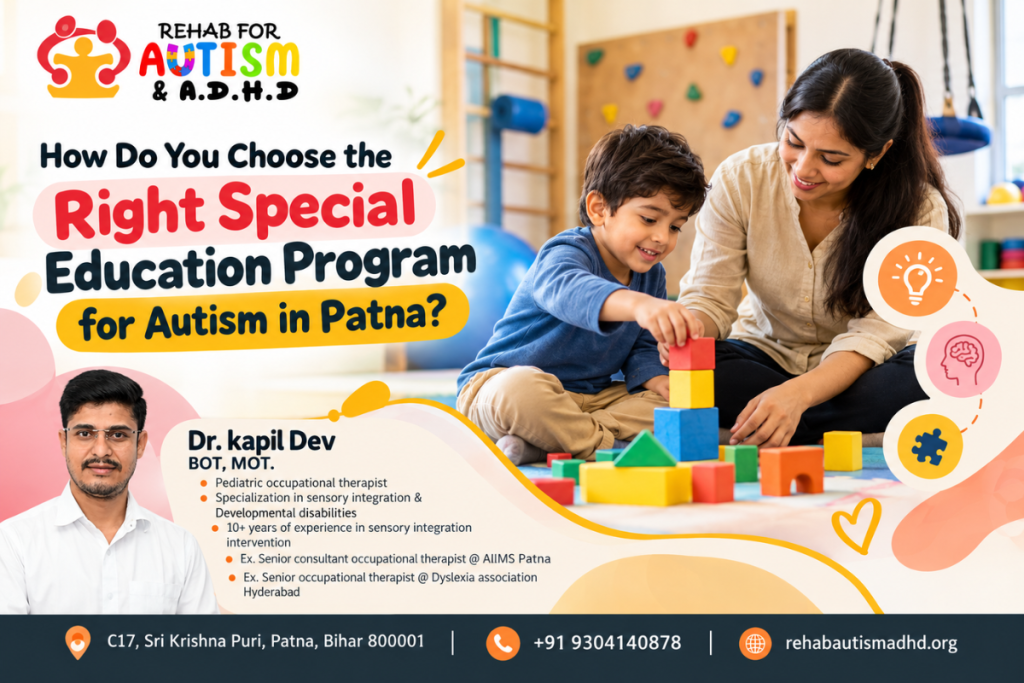
The right special education program for a child with autism combines a certified special educator, a written Individualized Education Plan (IEP), measurable monthly goals, and close coordination with speech and occupational therapy — not a generic classroom with a “special needs” label on the door. Before enrolling, visit at least two or three centres, ask to see a sample IEP, and check the special educator’s registration with the Rehabilitation Council of India (RCI).
In this article:
- What actually separates a special education program from a therapy session
- The warning signs that tell you it’s time to look for support
- What a good special educator for autism in Patna should be able to show you, on paper
- The government rights and schemes most Patna parents don’t know they can use
- What changed in Bihar’s autism support system in 2025–2026
- What recent research says about which approaches work
- A short, honest look at what waiting actually costs a family
Why This Decision Matters More Than It Looks
A community-based study led by the INCLEN Trust — one of the first of its kind conducted directly in Indian households rather than through hospital records — found that roughly 1 in 100 children in India under age 10 has autism, and close to 1 in 8 has at least one neurodevelopmental condition. That is far higher than earlier census estimates ever suggested, largely because those numbers relied on self-reporting rather than direct assessment. Separately, a 2021 Global Burden of Disease analysis published in The Lancet Psychiatry placed autism spectrum disorder among the top ten causes of non-fatal health burden in Indian children and adolescents under 20.
None of this is meant to alarm you. It simply explains why, if you’re a parent in Kankarbagh, Sri Krishna Puri, Boring Road, or anywhere else in Patna searching for answers right now, you are far from alone — and why the choice you make about a special education program in the next few months can shape your child’s next several years.
A 5-Step Framework for Choosing the Right Program
- Get a formal developmental assessment before you pick a program, not after — this tells you what kind of support your child actually needs.
- Ask every centre for a sample IEP and how often it’s reviewed (once a term, at minimum).
- Check the special educator’s credentials — a diploma or degree recognised by the Rehabilitation Council of India, plus specific experience with autism, not only general special needs.
- Confirm how therapy and classroom teaching are linked — the speech therapist and the special educator should be working from the same goals, not separate ones.
- Visit during an actual class, not just an office tour, and watch how staff respond when a child is overwhelmed or non-compliant.
What Is a Special Education Program, Really?
A special education program is a structured, ongoing plan — usually running across a school year — that combines academic learning, communication development, and daily-life skills, delivered by a trained special educator who adjusts the pace and method to how a specific child learns. It is different from a general classroom because it is built around an Individualized Education Plan (IEP): a written document listing the child’s current abilities, specific goals for the term, the methods being used to reach them, and how progress will be measured.
Under the Rights of Persons with Disabilities (RPWD) Act, 2016, autism is formally recognised as a specified disability, and the Act mandates free education for every child with a benchmark disability between the ages of 6 and 18. That right includes reasonable accommodation and, where needed, an individualised plan — which means special education is not simply a private option families pay for out of goodwill; it is something the law in India already recognises children are entitled to.
Special Education vs Therapy for Autism: What’s the Difference?
This is the single most common confusion parents in Patna describe when they first start looking for help — and most local listings don’t explain it clearly, because they lump “special education” and “therapy” into one paragraph.
Therapy — speech therapy, occupational therapy, or Applied Behaviour Analysis (ABA) — targets a specific skill in focused sessions, usually 30 to 60 minutes, delivered by a speech-language pathologist, occupational therapist, or behaviour therapist. Special education is a broader, ongoing academic and life-skills program, delivered by a certified special educator, that is meant to run for months or years and folds therapy goals into daily learning rather than treating them as separate appointments.
Most children with autism benefit from both together — special education gives the day-to-day structure, while therapy sharpens specific skills that then get practised inside that structure.
| Aspect | Special Education Program | Standalone Therapy (Speech / OT / ABA) |
|---|---|---|
| Primary goal | Academic learning + functional life and social skills over time | One targeted skill (speech sound, motor coordination, a specific behaviour) |
| Setting | Classroom or resource room, structured daily routine | Clinic session, typically 30–60 minutes |
| Delivered by | RCI-registered Special Educator | Speech-Language Pathologist / Occupational Therapist / ABA Therapist |
| Planning document | Individualized Education Plan (IEP) | Session or therapy goal sheet |
| Duration | Ongoing, usually school-year based | Can be short-term or long-term, session by session |
| Legal standing in India | Backed by the RPWD Act, 2016 (free education, ages 6–18) | Not a legal education entitlement, though often medically recommended |
| Best suited for | Building sustained routines, classroom behaviour, peer interaction | Closing a specific developmental gap quickly |
Signs Your Child May Need Special Education Support
You don’t need a diagnosis in hand before you start asking questions. Some signs parents in Patna commonly describe before formal assessment include:
- Limited or no response to their name being called by age 12–18 months
- Little interest in pointing, showing objects, or sharing attention with a caregiver
- Repeating words or phrases without using them to communicate (echolalia)
- Strong distress over small changes in routine
- Difficulty following simple multi-step instructions in a mainstream classroom
- A teacher noting the child is “quiet,” “in their own world,” or “not keeping up,” without further explanation
That last point matters more than it might seem — India’s Ministry of Education, under the Samagra Shiksha programme, issued a directive asking schools to specifically identify children who “speak less and keep to themselves” for autism screening, precisely because these quieter presentations are so often missed. If a teacher has said something similar about your child, it’s worth treating that as a prompt to seek an assessment rather than a passing remark.
What to Look for in a Special Educator for Autism in Patna
Not every special educator has hands-on experience with autism specifically — many are trained more broadly across intellectual disability, learning disability, and hearing impairment. When you’re evaluating a special educator for autism in Patna, ask for:
- RCI registration and a diploma or degree with specific coursework in Autism Spectrum Disorder
- A written sample IEP from a previous or current student (names removed) so you can see how goals are actually documented
- A low student-to-educator ratio — autism-specific classrooms generally work best with no more than 4–6 children per educator
- Regular, documented parent meetings — not just a WhatsApp update, but a structured review of progress against goals
- Willingness to coordinate directly with your child’s speech therapist, occupational therapist, or paediatrician
- A behaviour-support approach that avoids punishment-based methods, relying instead on positive reinforcement and predictable routines
Government Support and Your Child’s Legal Rights
This is the part most local articles skip entirely, and it’s worth knowing before you enrol anywhere:
- RPWD Act, 2016: Guarantees free education for children with benchmark disabilities aged 6–18, and specifically lists autism among the recognised disabilities.
- Samagra Shiksha screening directive: As noted above, this national programme now specifically instructs schools to work with block resource centres to identify and support children showing early autism-related signs, including access to special educators and psychologists.
- UDID (Unique Disability ID) card: Needed to access most government disability benefits, including school reservations and travel concessions.
- Niramaya Health Insurance Scheme, run by the National Trust for autism, cerebral palsy, intellectual disability, and multiple disabilities, offers coverage of up to ₹1 lakh a year for hospitalisation, therapy, and corrective treatment, with no pre-insurance medical test required. According to figures the Union Government placed before the Rajya Sabha, the scheme covered 71,537 beneficiaries nationally in 2025–26, with around ₹20.32 crore released and used that year. Enrolment happens through the National Trust directly or through a registered organisation.
Very few parents in Patna are told about Niramaya or the UDID card process by the centres they visit — but both can meaningfully reduce the financial pressure of long-term therapy and special education costs.
What’s New for Autism Learning Support in Patna Right Now
A few developments from the past year change what autism learning support in Patna will look like going forward:
- In April 2026, the Bihar Cabinet approved a Centre of Excellence for Autism to be built in Gardanibagh, Patna, on roughly 4.55 acres of land originally set aside for a multi-specialty hospital. The centre is planned to offer early diagnosis, therapy, specialised training, and act as a hub for professional development — and officials said it will support a structured screening system running from the block level up to the state level.
- On World Autism Awareness Day 2026, Patna’s Inspire Kids Child Development Center held a public programme under the theme “Autism and Humanity – Every Life Has Value,” bringing together medical professionals and education experts to talk through early identification and the rights of autistic children.
For families, the practical takeaway is this: state-level infrastructure for autism is finally catching up to demand, but it will take time to be fully operational. In the meantime, choosing a private special education program with a properly documented IEP remains the most reliable way to make sure your child isn’t losing developmental time while systems are still being built.
Four Families, Four Paths
(The scenarios below are composite illustrations built from common patterns Patna families describe — not records of real, identifiable children.)
A 3-year-old, non-verbal. His parents, from Sri Krishna Puri, started with a play-based early intervention classroom running four mornings a week, paired with twice-weekly speech therapy. Within two terms, his IEP shifted from “responds to name” to “uses three picture cards to request an object.”
A 7-year-old, verbal but socially withdrawn. She attends a mainstream school but spends two periods a day in a resource room with a special educator, plus weekly occupational therapy for sensory regulation. Her family chose this route specifically because she was already academically on pace — she needed social-skill scaffolding, not a full-time special classroom.
A 10-year-old with strong sensory sensitivities. Loud, crowded mainstream classrooms were triggering frequent meltdowns. His family moved him to a dedicated special education centre with a smaller group size and a sensory-friendly room, which reduced escalation episodes noticeably within the first month, according to what his parents reported to his educator.
A 15-year-old preparing for independence. Her program shifted toward the National Institute of Open Schooling (NIOS) track combined with functional and vocational training — practical skills like using money, following a work schedule, and basic workplace communication, rather than a purely academic curriculum.
A family relocating within Patna. After a job change moved them closer to Boring Road, they specifically searched for a special education centre near Boring Road so their son wouldn’t lose continuity mid-term — ultimately prioritising a shorter, predictable commute over a marginally larger facility further away, since long or unpredictable travel time was itself a source of daily distress for him.
What Recent Research Says About Special Education for Autism
- A 2025 systematic review and meta-analysis, published in the Pakistan Journal of Medical Sciences, evaluated trials of the TEACCH structured teaching approach — one of the most widely used special education models for autism — against no treatment or alternative approaches, and found consistent support for its use as part of a child’s rehabilitation plan.
- A study published in the journal Autism in November 2025 looked at combining the Early Start Denver Model with TEACCH-style structured teaching, examining whether pairing a developmental therapy model with a structured education approach produced better results than either alone.
- Research from Jordan published in the European Journal of Educational Research in 2025 surveyed 150 families whose children were enrolled in special education centres, and found that structured programs were associated with meaningful gains in self-regulation and social interaction, as reported by the families themselves.
- An earlier but still frequently cited study in the Journal of Autism and Developmental Disorders directly compared structured special education approaches against general inclusive education with no specific autism methodology, over three years, and found the structured approaches produced stronger outcomes for children with autism and significant learning needs.
The pattern across this research is consistent: structure, individualisation, and consistency over time matter more than any single branded method — which is exactly what an IEP-driven special education program is designed to provide.
The Cost of Delay: Why Timing Matters
It’s tempting to take a “wait and watch” approach, especially when a diagnosis feels uncertain. A widely cited Canadian study, published in JAMA Pediatrics by researchers at Toronto’s Holland Bloorview Kids Rehabilitation Hospital, modelled what happens when intervention is delayed — comparing children who received support at an average age of 2.7 years against those who waited until around 5.24 years. The delay was associated with meaningfully worse long-term independence outcomes and a significantly higher lifetime cost of ongoing support, driven mainly by the extra caregiving burden families carried into adulthood.
The exact figures don’t translate directly to India’s cost structure or public systems, and this data comes from Canada, not Bihar. But the underlying pattern — that early, structured support tends to reduce the total support a child will need over a lifetime, while delay tends to increase it — is one of the most consistently repeated findings in autism research worldwide. In practical terms: the months spent deciding are months your child’s brain is also developing, for better or worse.
Finding a Special Education Centre Near Boring Road or Elsewhere in Patna
Proximity affects consistency, and consistency is what makes a special education program actually work. A centre that’s brilliant on paper but 45 minutes away in Patna traffic often means missed sessions, tired children, and IEP goals that quietly stop being reviewed. When you’re comparing a special education centre near Boring Road against one further out, weigh the daily commute as seriously as you weigh the facility itself — a slightly smaller, closer centre with strong staff consistency frequently outperforms a larger one your child can only attend inconsistently.
Rehab For Autism & ADHD works with families across Patna — including Sri Krishna Puri, Kankarbagh, Boring Road, and neighbouring localities — and can help you compare what a program near you would actually look like for your child’s specific needs.
Frequently Asked Questions
At what age should a child with autism start a special education program? Most specialists recommend starting as soon as a developmental delay is identified, often between ages 2 and 4, since early structured support is consistently linked to stronger long-term outcomes in research.
Is special education the same thing as therapy for autism? No. Therapy targets a specific skill in focused sessions; special education is a broader, ongoing academic and life-skills program built around a written IEP, usually delivered alongside therapy rather than instead of it.
How is an IEP actually created for a child with autism? A special educator, often alongside a therapist and the parents, assesses the child’s current skills, sets specific and measurable goals for the coming term, decides on teaching methods, and schedules a review point — typically every 3 to 6 months — to update the plan.
Does the RPWD Act guarantee free special education in Patna? The RPWD Act, 2016 mandates free education for children with benchmark disabilities, including autism, between ages 6 and 18, through government and government-aided institutions. Private special education centres are not automatically covered by this provision, though families may be eligible for support through schemes like Niramaya.
How much does a special education program cost in Patna? Costs vary widely depending on the centre, the child’s specific needs, and how many sessions per week are included. It’s worth asking each centre for a written cost breakdown, and separately checking your eligibility for the Niramaya Health Insurance Scheme, which can offset some costs.
Can a child move from special education into a mainstream school later? Yes, this is a common and realistic goal for many children, particularly when special education starts early and includes a clear plan for building the social, communication, and self-regulation skills a mainstream classroom requires.
Sources & Further Reading
- INCLEN Trust community-based prevalence study on neurodevelopmental conditions in Indian children — thetransmitter.org
- Global Burden of Disease 2021 analysis on autism spectrum disorder in India, published in The Lancet Psychiatry — reported via Morung Express
- Rights of Persons with Disabilities Act, 2016 — overview via LiveLaw
- National Institute for Empowerment of Persons with Intellectual Disabilities, RPWD Act overview — niepid.nic.in
- Samagra Shiksha autism screening directive coverage — Patna Press
- Niramaya Health Insurance Scheme, National Trust — nationaltrust.nic.in
- Niramaya Scheme 2025–26 beneficiary data reported to Rajya Sabha — Kashmir Life
- Bihar Cabinet approval of Autism Centre of Excellence, Gardanibagh, Patna — Patna Press
- World Autism Awareness Day event coverage, Patna — Patna Press
- Structured teaching (TEACCH) systematic review and meta-analysis, Pakistan Journal of Medical Sciences, 2025 — pjms.org.pk
- Cost of delayed autism intervention, Holland Bloorview Kids Rehabilitation Hospital / JAMA Pediatrics — research.hollandbloorview.ca
How We Researched This Article
This article was put together by reviewing peer-reviewed research on special education and autism interventions published between 2009 and 2025, current Indian disability law and government scheme documentation, and recent local news coverage of autism-related developments in Bihar and Patna through 2026. Facts and figures are cited with their original source above so parents and fellow professionals can verify them directly rather than taking them on trust.
Abbreviations Used in This Article
- ASD — Autism Spectrum Disorder
- IEP — Individualized Education Plan
- RPWD Act — Rights of Persons with Disabilities Act, 2016
- RCI — Rehabilitation Council of India
- OT — Occupational Therapy
- ABA — Applied Behaviour Analysis
- TEACCH — Treatment and Education of Autistic and Related Communication Handicapped Children
- UDID — Unique Disability ID
- NIOS — National Institute of Open Schooling
Conclusion
Choosing between programs, therapists, and centres can feel overwhelming, especially in the middle of an emotional and uncertain time. But the decision comes down to a few concrete, checkable things: Does the centre use a written IEP? Is the special educator RCI-registered with specific autism experience? Is therapy coordinated with classroom goals, rather than running on a separate track? Is the location realistic for your family to sustain, week after week, for the next several years? Get those four questions answered clearly, from more than one centre, and the right choice usually becomes obvious.
Ready to Take the Next Step?
[ 📞 Call Us Now ] — Speak directly with our team about an assessment for your child (+91 9304140878)
[ 💬 Mail Us ] — Ask a quick question or share your child’s current reports (Rehabforautismandadhd2019@gmail.com
info@rehabautismadhd.org)
[ 📅 Book a Free Consultation ] — Visit rehabautismadhd.org/book-appointment to schedule a time that works for you.
Medical and Educational Disclaimer
This article is provided for general educational purposes and does not replace a formal developmental, medical, or psychological evaluation. Every child with autism has a different profile of strengths and needs, and decisions about diagnosis, therapy, or a special education placement should be made in consultation with a qualified developmental pediatrician, psychologist, or RCI-registered special educator. If you have concerns about your child’s development, please seek a professional assessment rather than relying on this article alone.