Yes Multiple clinical investigations from 2025 show children treated with occupational therapy before age 3 for Global Developmental Delay (GDD) make significantly more gains in motor skills, daily-living independence and cognitive function than those treated later. Age at diagnosis is among the strongest predictors of long-term outcome.
In this paper:
- What GDD really means (and why it’s not a “wait and see” condition)
- What the latest 2025 research says on timing
- The patterns of real progress parents can expect
- How the therapy centre you choose and its distance from home can affect outcomes
- Direct answers to questions every parent in Patna asks us
What Is Global Developmental Delay, and Why Does Timing Matter So Much?
Global Developmental Delay (GDD) is diagnosed when a child under age 5 shows a significant lag in two or more areas of development — gross motor, fine motor, speech and language, cognition, social skills, or daily living activities. According to a 2025 narrative review published in Frontiers in Pediatrics, GDD is characterised by considerable delays across these domains, and early, well-structured rehabilitation has a meaningful impact on motor function, cognition, social skills, and language development.
The same review makes a point that many parents don’t hear often enough: occupational therapy specifically helps children build independence and daily living skills, while speech therapy shows increasingly strong results for language comprehension and expression when the intervention plan is followed consistently. In other words, GDD is not one condition treated by one therapy — it needs a coordinated team.
This is exactly why families searching for an Autism Treatment Centre in Patna or an Autism Doctor in Boring Road, Patna are often told the same thing by paediatricians: don’t wait for the child to “grow out of it.” The data doesn’t support waiting.
The 2025 Research: What Changed in Our Understanding of Early Intervention
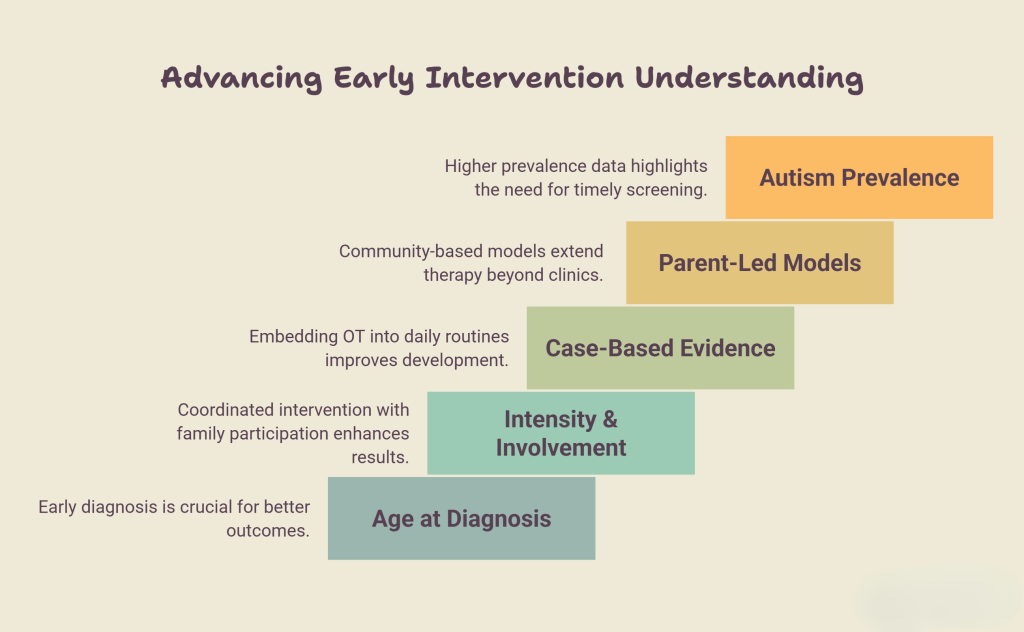
1. Age at diagnosis predicts prognosis. A 2025 retrospective study of 155 infants with GDD, published in Frontiers in Neurology, used the Gesell Developmental Schedules to measure progress across three age groups (3–6 months, 7–12 months, and 13–18 months). Logistic regression showed that a later age at initial diagnosis, along with prematurity and neonatal asphyxia, was a statistically significant risk factor for poorer outcomes. Every additional month before intervention begins is a month of lost ground.
2. Intensity and family involvement multiply results. The Frontiers in Pediatrics 2025 review concluded that a coordinated, integrated intervention plan — delivered with adequate intensity and genuine family participation — produced meaningfully better developmental outcomes than isolated or inconsistent sessions.
3. Case-based evidence supports embedding OT into daily routines. Published case-report literature on early-intervention OT shows that when therapists work within a family’s actual daily routines (feeding, play, sleep), postural control and self-regulation improve faster than with clinic-only sessions.
4. Parent-led, community-based models are gaining traction across India. Marking World Autism Day 2026, several Indian neurodevelopmental care providers highlighted a shift toward training parents as co-therapists — extending occupational and speech therapy gains beyond the clinic and into the home, particularly to reach families in smaller cities.
5. Autism prevalence data reframes the urgency. Recent Indian epidemiological estimates put ASD prevalence at roughly 1 in 100 children under age 10, with nearly 1 in 8 children showing at least one neurodevelopmental condition — a figure far higher than earlier census data suggested. For Bihar and Patna families, this means GDD and autism-related delays are far more common locally than most people assume, and formal screening should never be delayed on the assumption that “it’s rare here.”
What the Numbers Look Like in Practice
| Age Therapy Begins | Typical Motor/Cognitive Gain Pattern* | Family Training Involved |
|---|---|---|
| Under 18 months | Fastest catch-up curve; strongest long-term prognosis | Central to progress |
| 18–36 months | Good gains, slightly slower plateau | Still highly effective |
| 3–5 years | Meaningful but slower gains; more sessions typically needed | Essential to sustain gains |
| After age 5 | Gains still possible, but developmental gap is harder to close | Critical, longer timeline |
*Pattern summarised from 2025 GDD rehabilitation literature; individual results vary by child, comorbidities, and consistency of therapy.
GDD, Autism, and ADHD: Why the Overlap Matters for Treatment Planning
Parents often ask why a centre would evaluate for GDD, autism, and ADHD together instead of picking one label and moving forward. The honest answer is that these conditions frequently overlap in young children, and the therapy plan has to reflect that. A child with GDD may later be re-assessed as being on the autism spectrum, and a child with autism may also show ADHD-type attention and impulse-control patterns. Recent clinical guidance on child development notes that autism primarily affects social communication and sensory processing, while ADHD mainly affects attention, impulse control, and activity level — but when both occur together, therapy has to address communication difficulties alongside focus and behavioural regulation at the same time, not one after the other.
This is why a good Autism Doctor in Boring Road, Patna will usually recommend a broad developmental assessment rather than testing for a single condition in isolation. It’s also why occupational therapy, speech therapy, and behaviour support are typically run in parallel at a well-structured centre: a plan built only around “autism” or only around “ADHD” can miss delays sitting just outside that label.
Real-World Example Patterns We See in Early Intervention
While every child’s file is different, these patterns come up again and again in early-intervention literature and clinical practice:
- The late-talker who wasn’t “just shy.” A toddler referred around 20 months for minimal speech and low eye contact, who by age four is communicating in full sentences after consistent speech and occupational therapy — a pattern documented in recent Indian case reporting on early diagnosis.
- The sensory-avoidant child who discovers a strength. Children with sensory processing difficulties often show strong gains in focus and self-regulation once sensory integration techniques are introduced early, sometimes uncovering an interest in art, music, or building play.
- The infant with feeding and postural delays. Case-report literature on early-intervention OT shows a child’s feeding behaviour, sitting balance, and sleep routine all improving together once therapy is folded into the family’s daily schedule instead of treated as a separate 45-minute session.
- The child assessed as premature with early risk factors. The 2025 Gesell Developmental Schedules study found that infants who began comprehensive rehabilitation soon after diagnosis — despite prematurity being a known risk factor — still achieved meaningful developmental-quotient improvement within three months of consistent therapy.
- The child who needed the whole team, not one therapist. Multi-domain delays (motor + speech + social) responded best when occupational therapy, speech therapy, and behaviour support ran in parallel rather than sequentially — echoing the “integrated, family-centred approach” recommendation from the 2025 Frontiers review.
Why an Occupational Therapy Centre Near You Actually Changes the Outcome
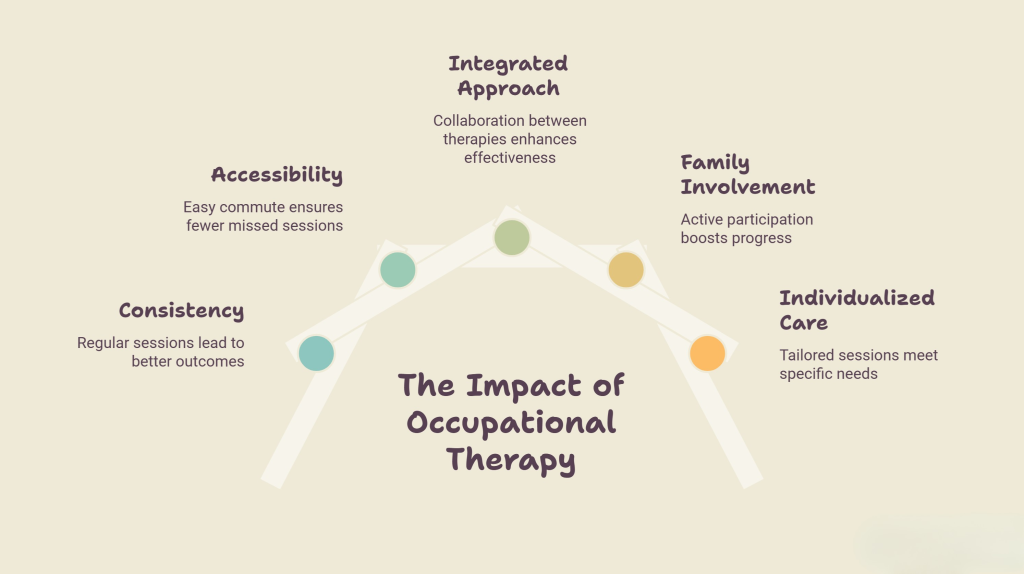
Here’s a detail that rarely makes it into research papers but matters enormously in daily practice: consistency beats intensity. A child who attends two sessions a week without fail, for a year, tends to outperform a child who attends four sessions a week in bursts with long gaps in between. This is precisely why choosing an Occupational Therapy Centre in Boring Road, Patna that your family can reach without a long, tiring commute is not a convenience issue — it’s a clinical one. Missed sessions due to travel fatigue, traffic, or school-pickup conflicts are one of the most common, and most preventable, reasons therapy plans lose momentum.
At our Autism Therapy Centre in Patna, we structure every plan the same way the 2025 research recommends: occupational therapy, speech therapy, and behaviour support working together, with parents actively trained as co-therapists — not passive spectators in the waiting room. Our founder, Dr. Kapil Dev, a pediatric occupational therapist and former Senior Consultant Occupational Therapist at AIIMS Patna, built the centre’s model around exactly the two things the evidence says matter most: starting early, and involving the family in every step.
We also follow a strict 1 child : 1 therapist ratio rather than group-style sessions, so pace and technique can be adjusted every session — the practical difference between a plan that looks good on paper and one that produces visible change in six months.
FAQs
Q1. At what age should GDD or autism screening begin? Formal developmental screening can begin as early as 9–18 months if a parent, paediatrician, or Anganwadi worker notices delays in motor skills, babbling, eye contact, or social response. Waiting until school age significantly narrows the window for the fastest gains.
Q2. Can occupational therapy help even if my child hasn’t been formally diagnosed yet? Yes. Many children begin OT for specific delays (motor, sensory, self-care) while the full diagnostic picture is still being confirmed. Early support doesn’t need to wait for a final label.
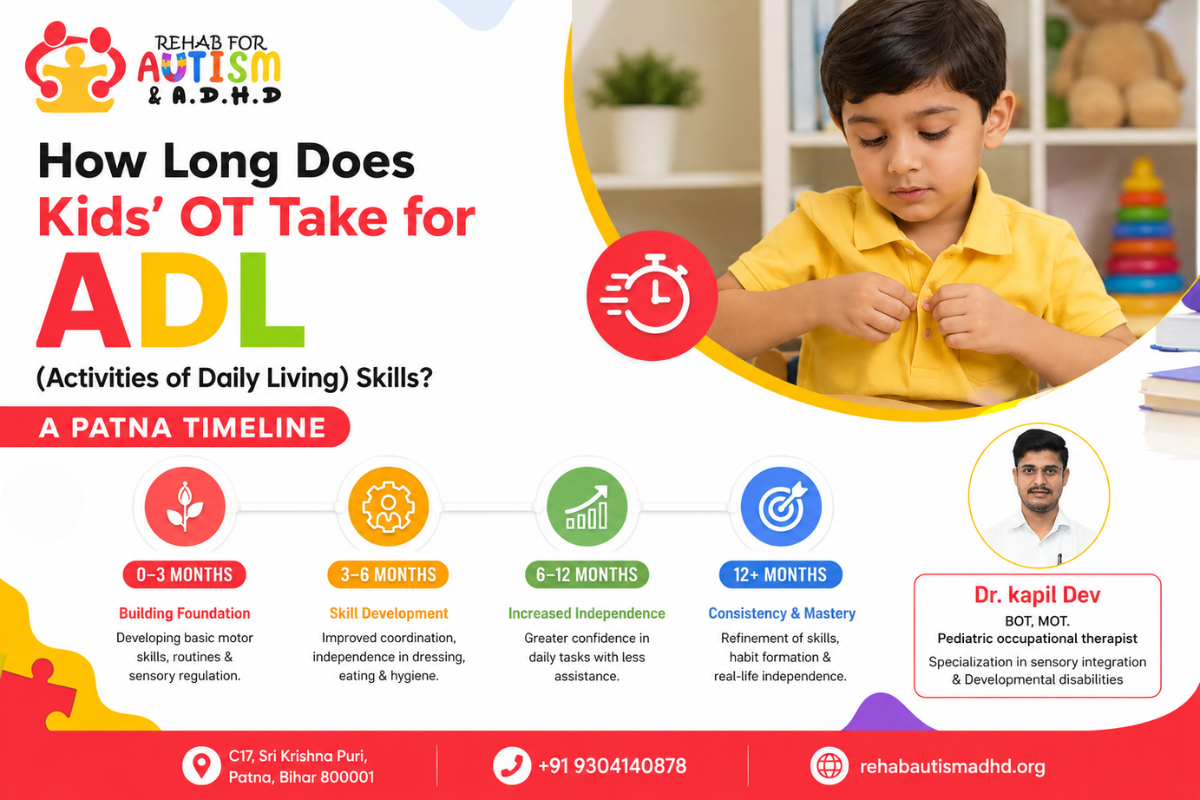
Q3. How long before we see improvement after starting therapy? Recent clinical data shows measurable developmental-quotient improvement is often seen within three months of consistent, structured therapy, though full outcomes are typically assessed over 6–12 months.
Q4. Is GDD the same as autism? No. GDD is a broader description of delay across two or more developmental domains in children under five. Some children with GDD are later diagnosed with autism, cerebral palsy, or another condition; others catch up fully. Either way, early therapy improves the outlook.
Q5. Do you treat both autism and ADHD at the same centre? Yes. Our centre provides occupational therapy, speech therapy, behaviour therapy, and sensory integration for Autism Spectrum Disorder, ADHD, GDD, cerebral palsy, Down syndrome, and related developmental conditions, all under one roof at our Autism Treatment Centre in Patna.
Q6. What if we live far from Boring Road — is it still worth traveling for therapy? Many of our families do travel across the city, and we support that fully. That said, research and our own clinical experience both point the same direction: a centre you can reach consistently, without it becoming a weekly ordeal, tends to produce steadier results than a “better on paper” centre that’s hard to get to every week.
Accessibility from Across Patna
Our centre at C17, Sri Krishna Puri is easily reachable from across central Patna. Families regularly visit from near Bihar Museum (900 m, 3 mins), Eco Park (1.9 km, 6 mins), Patna Museum (2.5 km, 8 mins), ISKCON Temple Patna (2.6 km, 7 mins), and Buddha Smriti Park (3.0 km, 10 mins). Families from the Sanjay Gandhi Biological Park area (3.5 km, 9 mins), near Golghar (3.7 km, 14 mins), and P&M Mall (4.7 km, 16 mins) all reach us conveniently. Nearby landmarks include A.N. College (1.6 km), Jyoti Punj Hospital (1.1 km), GV Mall near Boring Road (1.3 km), and Panchmukhi Hanuman Mandir (1.8 km).
Consistent attendance is one of the most powerful factors in therapy progress. Choosing a centre close to home removes one of the biggest barriers to regular sessions — and regular sessions are what the research says actually moves the needle.
Conclusion
The evidence from 2025’s most recent clinical studies is consistent and clear: early occupational therapy intervention does improve GDD developmental outcomes, and the earlier it begins, the wider the gains — in motor skills, communication, independence, and confidence. Age at diagnosis, therapy intensity, family involvement, and how realistically a family can sustain regular sessions all shape the final result. If you’ve noticed developmental delays in your child, the single most protective decision you can make right now is to get a proper assessment — not to wait and watch.
At our Autism Treatment Centre in Boring Road, Patna, every child is assessed individually and every plan is built around the child’s family, schedule, and pace — combining occupational therapy, speech therapy, and behaviour support under one experienced team led by Dr. Kapil Dev.
Is Your Child Ready to Begin Their Therapy Journey?
Book a free initial assessment with Dr. Kapil Dev’s team at our Boring Road centre.
Book Appointment: rehabautismadhd.org/book-appointment
Call Us: +91 93041 40878
Mail Us: info@rehabautismadhd.org
About the Author
Dr. Kapil Dev (BOT, MOT) is the Director of Rehab for Autism & ADHD, Patna. A Pediatric Occupational Therapist with 7+ years of specialised experience in sensory integration and developmental disabilities, he is a former Senior Consultant Occupational Therapist at AIIMS Patna. He leads a multidisciplinary team providing OT, speech therapy, behaviour therapy, and special education at C17, Sri Krishna Puri, Patna, Bihar 800001.