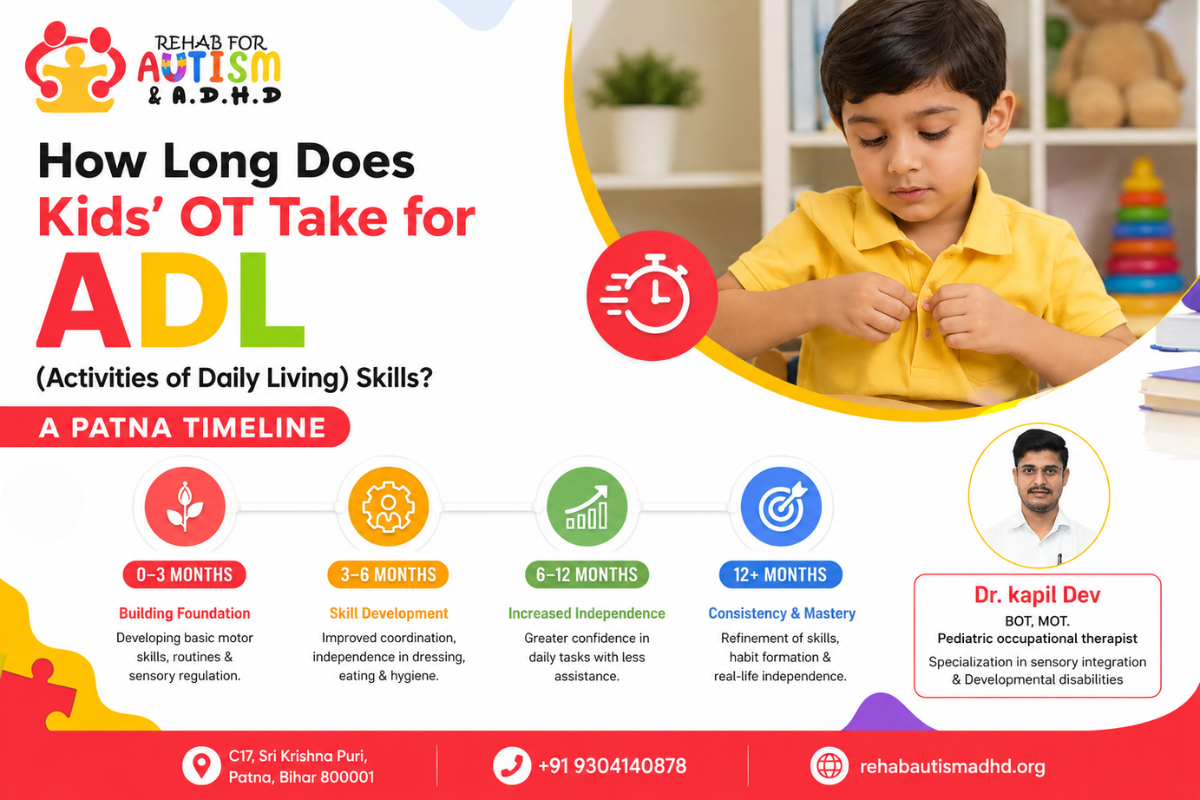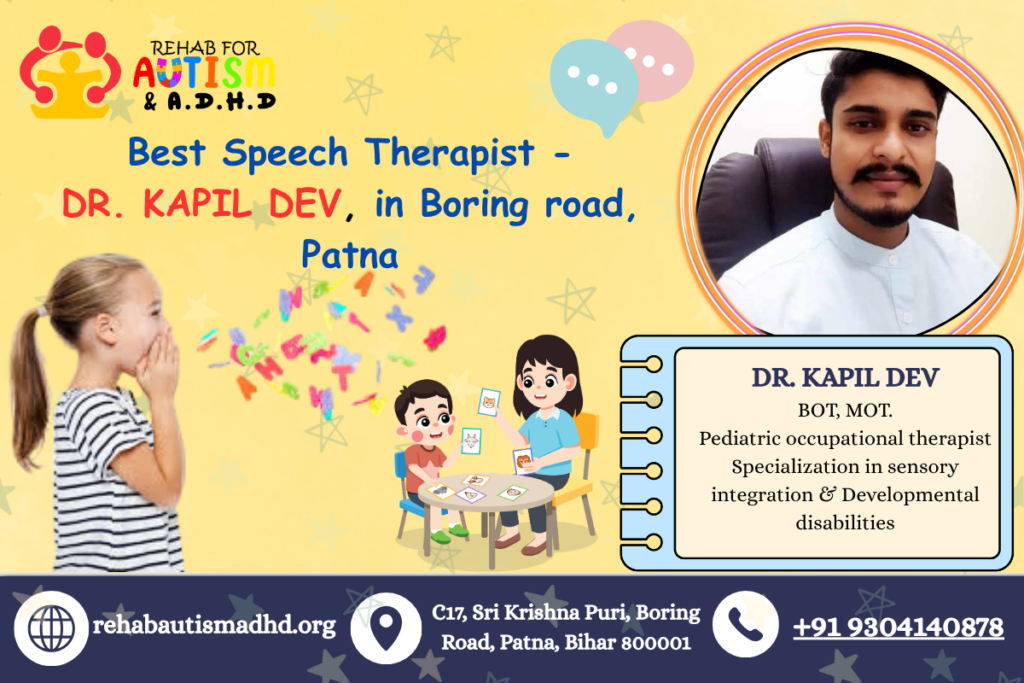
If you’re searching for an Autism Doctor in Boring Road, Patna, here’s the most important thing to keep in mind — don’t just look for someone who teaches children to talk. Look for someone who truly listens to them first. The best specialists are those who combine speech therapy with sensory-based approaches, because for neurodivergent children, communication is never just about words. Dr. Kapil Dev is one such specialist — someone who takes the time to understand your child before designing a path forward, which is exactly why families across Patna trust him.
Beyond Words: A New Approach to Speech Therapy with Dr. Kapil Dev in Boring Road, Patna
Imagine not being able to tell someone you’re hungry. Or scared. Or that something hurts.
For most of us, that’s unthinkable. But for many children with neurodevelopmental conditions, this is everyday life — and the helplessness that comes with it affects not just the child, but the entire family. Parents often describe a particular kind of ache that comes from watching their child struggle to reach out and connect.
But here’s what we want you to know — it doesn’t have to stay that way.
If you’re exploring Speech Therapy in Boring Road, Patna, you’re already doing something right. Understanding how the brain develops language — and where that process sometimes gets interrupted — is the first step toward finding support that actually works. And when you find the right support, things can change in ways you might not even dare to hope for right now.
Understanding the Role of Speech Therapy in Autism Care
When most people hear “speech therapy,” they picture a child sitting across from a therapist, repeating words. And while that’s part of it, speech therapy is so much bigger than that.
It’s about helping a child understand that a raised eyebrow means someone is surprised. That silence in a conversation is okay. That they don’t have to speak perfectly to be understood — they just need a way to be heard.
For children on the autism spectrum, language is deeply tied to how their brain processes the world around them — sounds, patterns, emotions, and meaning all tangled together. A good therapist doesn’t fight that. They work with it.
At a dedicated Autism Treatment Center in Boring Road, Patna, that’s exactly the philosophy Dr. Kapil Dev follows. He doesn’t walk in with a checklist of things to fix. He walks in genuinely curious about your child — who they are, what lights them up, and what gets in their way. From there, everything else follows.
Why Boring Road, Patna is Becoming a Hub for Specialized Rehab
Not too long ago, families dealing with neurodevelopmental challenges in Bihar often felt like they had two choices — settle for whatever local support was available, or uproot their lives and move to a bigger city. Neither felt fair.
That story is changing. Boring Road has grown into something genuinely impressive — a place where families can access world-class specialized care without leaving their community. Modern clinics, experienced professionals, and a growing understanding of what neurodivergent children actually need — it’s all here now.
And that matters more than people realize. Because therapy only works when it’s consistent. And consistency is only possible when help is close to home.
Recent Research: What Science Says About Speech and Neurodiversity
Science has come a long way in how it thinks about autism and communication — and thankfully, the conversation has shifted from “how do we make these children more normal?” to “how do we help these children thrive in their own way?”
Here’s what recent research is telling us:
The Impact of Early Intervention: A 2024 study published in the Journal of Neurodevelopmental Disorders found that children who received targeted speech intervention before the age of four showed a 40% higher rate of social-emotional adaptation by school age compared to those who started later.
Gestalt Language Processing: New research suggests that many children with autism are “Gestalt Language Processors.” This means they learn language in chunks (like movie lines) rather than single words. Modern therapists now use these “scripts” as a building block for original speech rather than trying to stop them.
The Gut-Brain Connection: Emerging data from the Lancet highlights that addressing nutritional and gastrointestinal issues can actually improve a child’s focus during therapy sessions, making speech interventions more effective.
None of this is abstract. Every one of these findings has changed how therapists like Dr. Kapil Dev approach sessions — and the results speak for themselves.
Real-Life Examples: Success Stories in Communication
Example 1: The Transition from Silence to Symbols
There was a five-year-old boy who came to the center without a single word. No speech, no gestures, no way to tell his parents what he needed. The frustration in the house was overwhelming — not because his parents weren’t trying, but because everyone felt stuck.
Instead of pushing him toward speech immediately, the team started with pictures. A simple system where he could point to what he wanted. Within three months, something remarkable happened — the meltdowns reduced, the tension eased, and a little boy who had been locked inside himself began to reach out. Those pictures became a bridge. And slowly, sounds started to follow.
Example 2: Social Skills in Group Settings
Then there was a girl — articulate, bright, and completely lost in social situations. She could talk. What she couldn’t figure out was the invisible rulebook that everyone else seemed to know by heart. When to speak, when to wait, how to join a conversation without it feeling awkward.
Group therapy gave her a safe space to practice. Real scenarios — asking for something at a shop, disagreeing with a friend without it turning into a fight, reading a room. Slowly, she stopped dreading school. Eventually, she didn’t need a shadow teacher anymore. She just needed someone to believe in her long enough for her to believe in herself.
News in the Field of Neurorehabilitation (2025–2026)
Digital Integration in Therapy: Clinics across India are beginning to adopt AI-assisted speech tools that track vocal patterns — pitch, frequency, rhythm — and give therapists real-time insights to sharpen their approach. It’s exciting, not because technology replaces human connection, but because it makes that human connection more informed and more precise.
Policy Changes in India: Updated guidelines under the Rights of Persons with Disabilities (RPwD) Act now make it easier for parents to secure school accommodations — but only if they have a certified report from a recognized specialist. This means that visiting a qualified Autism Doctor in Boring Road, Patna isn’t just about therapy anymore. It can directly shape your child’s experience in school and open doors that might otherwise stay closed.
What Makes Dr. Kapil Dev’s Approach Unique?
Plenty of clinicians know their textbooks. What’s harder to find is someone who genuinely cares — and whose care shows up in the room with your child, not just in the certificates on the wall.
Dr. Kapil Dev has built a practice around three things that most places talk about but few actually deliver:
- Evidence-Based Protocols: Every session is rooted in proven methodologies.
- Parent Empowerment: Parents are not just observers; they are trained on how to continue the work at home.
- Integrated Care: If a child needs sensory integration alongside speech work, the center provides a unified plan.
The result is a place where children don’t just make progress in a clinical sense. They grow into themselves.
The Importance of an Autism Treatment Center in Boring Road, Patna
There’s something that happens when you walk into a space that was genuinely built for your child — not just adapted, not just “good enough,” but actually designed with them in mind. The lights aren’t harsh. The noise doesn’t overwhelm. The people there understand what your morning probably looked like before you arrived.
That’s what an Autism Treatment Center in Boring Road, Patna offers — and it’s something you simply can’t replicate in a general clinic.
- Minimizing “sensory overload” (calm lighting, reduced noise).
- Using specialized equipment that helps with motor skills related to speech.
- Access to a network of professionals who understand the specific challenges faced by families in the Bihar region.
It’s not just therapy. It’s a community that gets it.
Practical Tips for Parents Starting the Journey
- Observe the “Why”: Before trying to fix a behavior, look at what the child is trying to communicate.
- Consistency is Key: Missing sessions can lead to regressions. Make therapy a non-negotiable part of the weekly routine.
- Celebrate Small Wins: Whether it’s a new sound, a shared look, or a finger point, every step counts.
FAQs (Frequently Asked Questions)
Q1: How do I know if my child needs speech therapy?
Trust your instincts first — parents usually sense when something feels off. More specifically, if your child isn’t babbling by 12 months or putting simple words together by age 2, that’s worth looking into. An early screening can rule out hearing issues and catch delays while there’s still the most room to grow.
Q2: Can speech therapy help an older child who is non-verbal?
Yes — and this is something we want parents to hear clearly, because many arrive feeling like they’ve waited too long. Therapy for older children focuses on what’s called “Functional Communication” — finding whatever channel works, whether that’s voice, sign language, or a device that speaks for them. It is never too late to start.
Q3: Does an Autism Doctor only prescribe medicine?
This is a common misconception. Medication might occasionally be used to manage something specific, like sleep difficulties or anxiety, but the heart of the work is always therapy — behavioral approaches, communication strategies, and practical adjustments that make daily life more manageable and more joyful.
Q4: How long does it take to see results?
We wish we could give you a neat answer here, but honestly — every child is different. Some families notice something shifting within weeks. For others, progress is slower and steadier. What we can promise is that every step forward, however small, is real. The goal is steady, sustainable growth rather than a quick fix.
Q5: Is Speech Therapy in Boring Road, Patna expensive?
There are options available at different price points, and most clinics are genuinely willing to have that conversation with you. Think of it less as an expense and more as one of the most meaningful investments you’ll ever make. It is always better to check directly with the clinic for the latest fee structure and session durations.
Conclusion
If you’ve read this far, you’re probably a parent who loves their child fiercely and just wants to find the right help. That instinct — that refusal to stop looking — is one of the most powerful things your child has going for them.
Finding the right Speech Therapy in Boring Road, Patna can genuinely shift the trajectory of your child’s life. Not overnight. Not without effort. But steadily, meaningfully, in ways that compound over time. Dr. Kapil Dev and his team have dedicated their work to making sure that every child who walks through the door has a real shot at being understood — and at understanding the world around them.
Whether you’re exploring an Autism Treatment Center in Boring Road, Patna for the first time, or you’ve been on this journey for a while and are looking for something better, the most important thing you can do right now is take that next step. Your child is waiting.
Get in Touch with Our Experts Today
[Call Us: +91 9304140878] [Mail us: info@rehabautismadhd.org] [Book an Appointment: rehabautismadhd.org]