
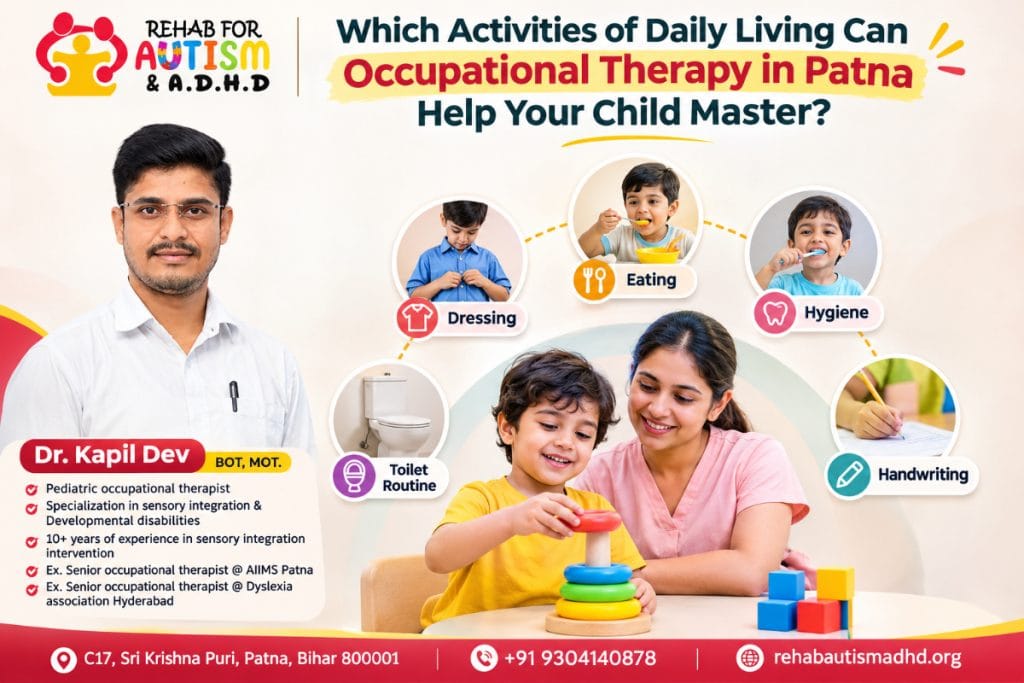
Occupational therapy in Patna can help children master activities of daily living: dressing, eating, toileting, grooming, bathing, and handwriting-related school routines. A pediatric occupational therapist first finds why a task is hard (weak fine motor control, sensory sensitivity, or poor motor planning), then teaches it in small, playful steps and coaches parents to repeat them at home.
Skills occupational therapy commonly builds:
- Dressing, buttons, zips and shoes
- Self-feeding and mealtime routines
- Toilet training and hygiene
- Brushing, hair care and bathing
- Pencil grip, handwriting and school routines
Introduction
It is 8:15 on a school morning in Patna. Your seven-year-old stands half-dressed, staring at a shirt button. You have asked three times. He is not being lazy. His fingers do not do what his mind plans.
Many parents live this scene daily. When a child struggles with the small jobs of the day, families often assume “stubborn” or “slow.” Often the real reason sits underneath: fine motor difficulties, motor planning trouble, or a nervous system that finds touch, sound or movement overwhelming.
Occupational therapy in Patna exists for exactly this. At our Boring Road centre, pediatric occupational therapy looks at the child’s day, finds the exact step where the skill breaks down, and rebuilds it through play. This article explains which daily activities therapy can improve, why they are hard, what sessions look like, and when to seek help.
What Counts as an Activity of Daily Living?
Activities of daily living (ADLs) are the routine tasks that let a person look after themselves: dressing, eating, toileting, grooming and bathing. For children, therapists also include school and play routines, such as packing a bag, holding a pencil, sitting to work and joining a game. Together, these build self-care and functional independence.
Children do not learn these skills overnight, and every child moves at their own pace. A delay becomes worth checking when a child falls well behind peers, when a skill disappears, or when daily routines cause constant distress.
Why Daily Tasks Feel Hard: Three Hidden Causes
Fine motor difficulties
Buttons, zips, spoons and pencils need small, precise hand movements. A child with weak hand muscles or poor finger coordination tires fast and avoids the task. Occupational therapy for fine motor difficulties builds hand strength, finger control and hand-eye coordination through dough, tongs, beads and drawing games. (Fine and gross motor skills work together: a child who slumps at the table has less control of the hand too, so therapists train posture and core strength as well.)
Motor planning difficulties
Some children know what to do but cannot sequence the movements. Putting on a T-shirt means finding the hole, lifting the arm and pulling in order. Occupational therapy for motor planning difficulties breaks the task into steps, practises each one, and then links them. Children often show this pattern as clumsiness or “always needing help with new tasks.”
Sensory processing differences
A scratchy label, the sound of the hair dryer, a wet face or a mixed-texture meal can feel painful to some children. They refuse the task, and parents read it as defiance. Our team uses sensory integration therapy in a sensory gym, with swings, textures and movement play, to help children feel calm enough to take part.
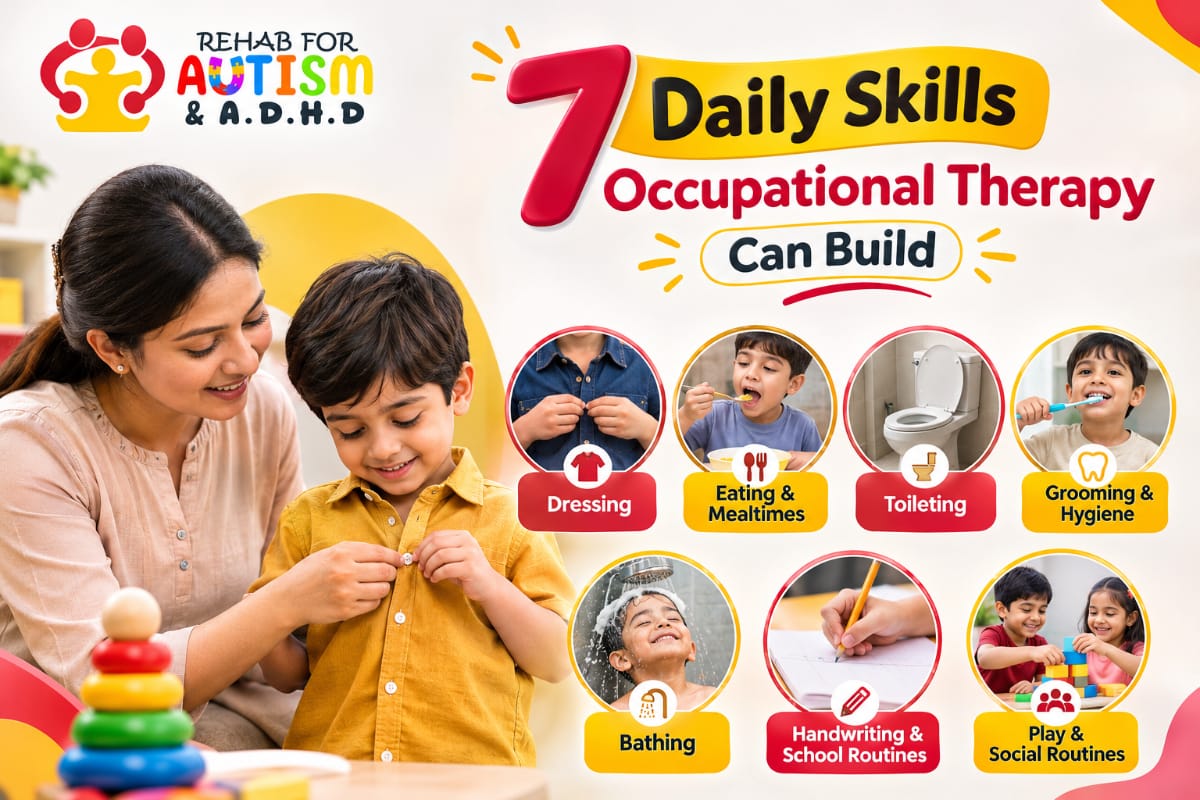
7 Daily Skills Occupational Therapy Can Build
1. Dressing
Therapists teach the order of clothing, how to find the front and back, and how to use buttons, zips and shoelaces. They start with big buttons and loose clothes, then shrink the challenge. Practice at home on a favourite old shirt works well.
2. Eating and mealtimes
This covers using a spoon, holding a glass, chewing properly and tolerating new textures. A child who stuffs food in the cheek or only accepts three foods needs a plan, not pressure. Therapists work on oral-motor skills and gradual food exposure with play.
3. Toileting
Toilet training needs body awareness, balance, clothing management and routine. OT looks at each part: Does the child sense the urge? Can they manage the waistband? Does the toilet seat or flush sound frighten them?
4. Grooming and hygiene
Brushing teeth, washing hands, combing hair and nose care involve touch tolerance and sequencing. A visual chart showing each step often helps children who forget the order.
5. Bathing
Pouring water, soaping, rinsing and drying demand coordination and sensory comfort. Therapists adjust the routine, such as water temperature, towel texture and a fixed order, so bath time stops being a battle.
6. Handwriting and school routines
Pencil grip, letter formation, sitting tolerance, opening the tiffin box and packing a bag all count. These feed into school readiness and confidence. Our special education team and occupational therapists often work together here.
7. Play and social routines
Taking turns, joining group play and coping with change are daily skills too. Play-based sessions let children practise them safely before they try them at school or a family function.
How a Child Development Occupational Therapist Works
A child development occupational therapist follows a clear path:
- Assessment. The therapist observes motor skills, handwriting, sensory responses, self-care and play, and talks with you about the child’s day. Findings are explained in plain language.
- Goals. You and the therapist agree on a few specific targets, such as “buttons own school shirt in two minutes.”
- One-to-one sessions. At Rehab For Autism & ADHD, each child works with a dedicated therapist: 1 child, 1 therapist. Sessions look like play but carry a purpose.
- Parent coaching. You leave each session with a short home activity.
- Review. Goals change as your child grows.
The centre is led by Dr. Kapil Dev (BOT, MOT), former Senior Occupational Therapist at AIIMS Patna, with our therapists holding AIOTA registration. Learn more on our occupational therapy in Patna page.
Real-World Examples
These are illustrative scenarios based on common patterns in pediatric practice. They are not individual patient records.
Example 1: The button battle (age 6, fine motor). A first-grader cries every morning over her uniform. Assessment shows weak finger strength. Therapy uses putty, clothes pegs and a buttoning board. In a few weeks of consistent home practice, she manages the top two buttons herself, and mornings calm down.
Example 2: The picky eater (age 4, sensory). A boy eats only dry chapati and biscuits. Gagging at wet textures drives the refusal. His therapist starts with messy play, then touching food, then tasting. Parents stop forcing bites. His list of accepted foods grows slowly.
Example 3: The child who forgets the steps (age 8, motor planning). A third-grader can brush his teeth only when someone guides him. A picture sequence on the bathroom wall and step-by-step practice help him finish the routine alone. Occupational therapy for children in Patna often uses visual charts like this.
Example 4: The toilet-training stall (age 3, autism). A toddler holds urine all day because the flush sound scares him. The therapist introduces the sound gradually, adds a footstool for stability, and sets a fixed routine. The family reports fewer accidents and less fear.
Example 5: The tired writer (age 9, handwriting). A fourth-grader writes slowly and complains of pain. Therapy strengthens his grip, improves his sitting posture and adjusts pencil grip. Homework time shortens.
What’s New: Recent Developments
- Bihar approves a Centre of Excellence for Autism in Patna (May 24, 2026). Patna Press reported that the state approved a facility in Gardanibagh offering preliminary diagnosis, speech therapy, behavioural therapy, training and research. Health officials linked the plan to a rising number of autism cases among Bihar’s children. For families, it signals growing public attention to early support.
- Telehealth sensory integration trial (published online March 30, 2026). A feasibility trial in the American Journal of Occupational Therapy (vol. 80, issue 3, May 2026) tested a telehealth version of Ayres Sensory Integration for autistic children. Children improved in individual goals, functional skills and socialization, and autism symptom scores fell. It was a feasibility study, so larger trials must confirm the results.
- Parent coaching for self-care (Disability and Rehabilitation, May 2026). A pilot randomized trial added a mindful parenting programme to OT for autistic children’s self-care. Parents reported higher satisfaction with their child’s self-care. The trial was small, but it supports the value of involving parents.
- A new multi-centre provider opens in Patna (August 26, 2026). The Tribune reported that The Blessed Ones opened its ninth centre in Patna, offering occupational therapy for motor, sensory and daily living skills. More providers mean more choice, so ask any centre about assessments, written goals and progress tracking.
- World Autism Awareness Day programme in Patna (April 4, 2026). Patna Press reported an event stressing early diagnosis, inclusion and parent interaction. Local awareness is rising, and so is demand for early assessment.
Home Practice vs OT-Guided Therapy
| Factor | Practising at home alone | OT-guided plan |
|---|---|---|
| Finding the cause | Guesswork (“he is lazy”) | Standardised observation of motor, sensory and planning skills |
| Task breakdown | Repeats the whole task and frustration | Splits the task into small, achievable steps |
| Sensory needs | Often missed | Addressed in a sensory gym and daily routine |
| Goals | Vague (“be independent”) | Specific and measurable, reviewed regularly |
| Parent role | Trial and error | Coached after each session with a home plan |
| Progress tracking | Memory | Recorded goals and reviews |
| Best for | Mild, short-term hurdles | Skills stuck for months, or those causing daily distress |
Home practice matters. Therapy works best when both go together.
Cost of Delay
Small gaps rarely close on their own when the cause is motor or sensory. A child who cannot dress or eat independently may avoid school activities, lose confidence and depend on adults for longer. Parents spend more time and stress each morning. Handwriting struggles can slide into reading and homework refusal. Early assessment does not guarantee a result, but it shortens the time a child spends frustrated, and the earlier you start, the more practice time the child gets.
Assessment, Sessions and Fees in Patna
Fees for pediatric occupational therapy sessions in Patna depend on the therapist’s experience, session length, one-to-one or group format, and how often your child attends. Assessment is normally a separate first step. Be cautious about any centre that quotes a fixed price before seeing your child, and ask for fees, session frequency and review points in writing. For current fees at Rehab For Autism & ADHD, call +91 93041 40878. You can also book an occupational therapy assessment in Patna by WhatsApp, phone or a visit.
Our clinic is at C17, Sri Krishna Puri, near Boring Road (Monday to Saturday, 12 PM to 8 PM). Families also travel from Kankarbagh, Bailey Road, Motihari, Muzaffarpur, Gaya and Ara. We have a Motihari centre as well.
Conclusion
Daily routines are where childhood independence begins. When buttons, spoons, toothbrushes or pencils turn into daily struggles, occupational therapy in Patna gives your child a method and gives you a plan. Look for the cause, set small goals, practise in play, and review often. If your child’s daily tasks worry you, a short assessment will tell you where to start.
Call Us: +91 93041 40878 | Message Us | Book an Appointment
Frequently Asked Questions
1. At what age can a child start occupational therapy? Our centre works with children from about 12 months up to 14 years. Start whenever you notice a skill gap that affects daily life; an assessment can clarify.
2. How do I know if my child needs occupational therapy for self-care skills? Watch for a child who needs far more help than peers with dressing, eating or toileting, who avoids certain textures or tasks, or who lost a skill. These signs do not confirm a diagnosis, but they justify an assessment.
3. How long does it take to see progress? It depends on the child, the skill and how consistently you practise at home. Your therapist should set short-term goals and review them regularly.
4. How do I choose the best occupational therapy centre in Patna? Check therapist registration (AIOTA), ask whether sessions are one-to-one, whether you get written goals and home plans, and whether fees are explained clearly. Visit the clinic before deciding.
5. Is occupational therapy only for autism? No. It also helps children with ADHD, speech delay, cerebral palsy, Down syndrome, learning difficulties and sensory or motor problems.
6. Will I need to bring my child every day? Session frequency depends on the assessment. Many plans combine clinic sessions with home practice, and therapists adjust frequency as goals change.
Medical Disclaimer
This article is for general information and awareness. It is not a diagnosis or a substitute for professional medical advice. Please consult a qualified pediatrician or occupational therapist for your child’s evaluation. Illustrative examples are not individual patient records, and results vary from child to child.

Need expert guidance?
Concerned about your child's development?
Book an assessment with Dr. Kapil Dev (BOT, MOT), Ex-Senior Occupational Therapist, AIIMS Patna, at our center in C17, Sri Krishna Puri, Patna.