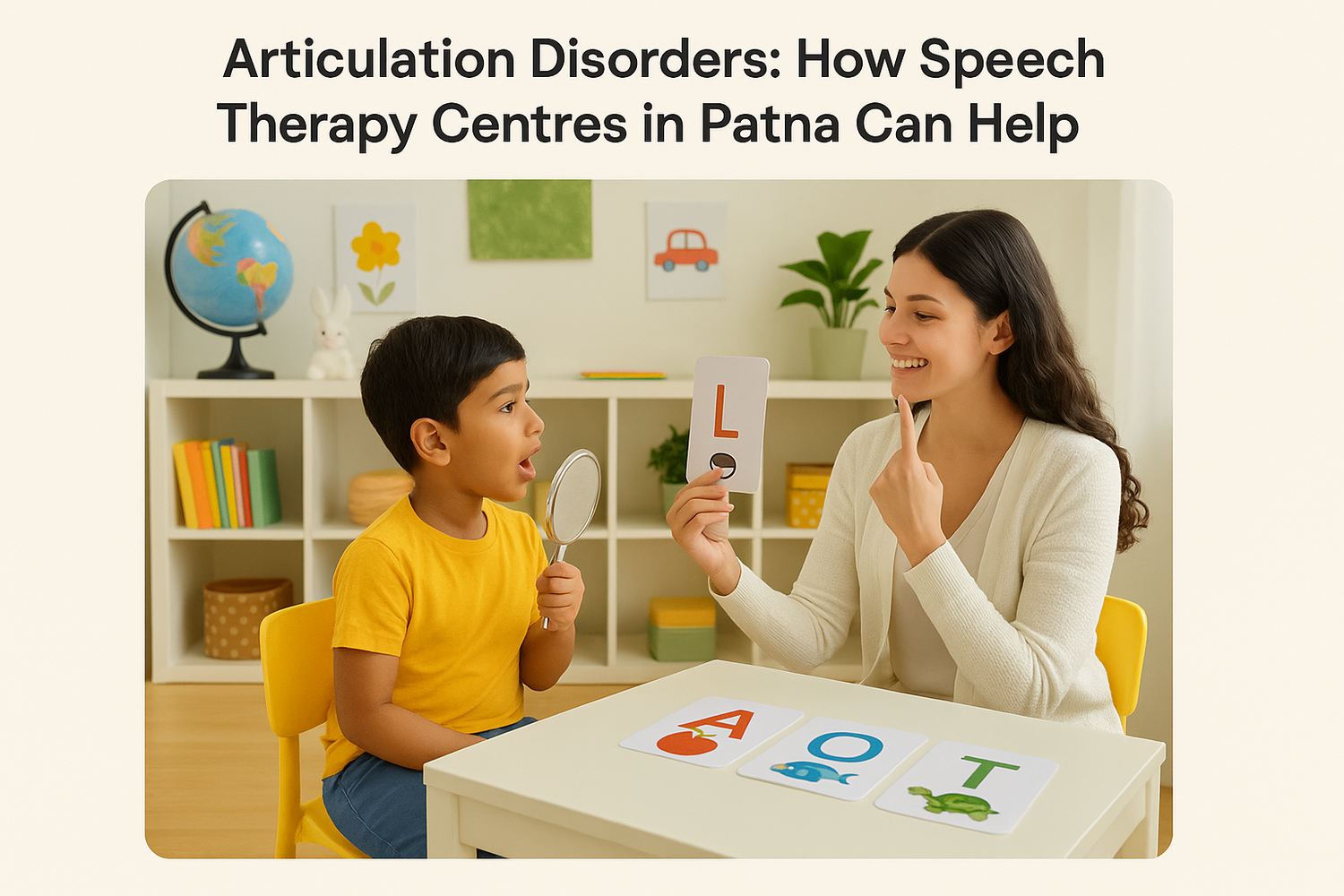
Blog Outline
- What Are Articulation Disorders?
- How Articulation Problems Affect Your Child
- Signs Your Child May Have an Articulation Disorder
- How Speech Therapy Can Transform Your Child’s Communication
- Proven Techniques Used by Speech Therapists
- The Important Role of Family Support
- When Occupational Therapy Can Help Too
- Working with Autism Specialists for Complex Cases
- Frequently Asked Questions
- Getting Started with Professional Help
Introduction
Does your child struggle to pronounce certain sounds clearly? Do friends and family sometimes struggle to understand what your child is saying? You are not alone in this concern, and help is available.
Articulation disorders are among the most common speech challenges children face. The good news is that with help from qualified Speech Therapy Centres in Patna, most children can overcome these challenges. They can learn to communicate with confidence.
This guide will help you understand articulation disorders. We will explain what they are and how they affect kids. Most importantly, we will show how speech therapy can help your child speak clearly and with confidence.
What Are Articulation Disorders?
Articulation disorders happen when children have trouble making specific speech sounds correctly. Instead of using sounds that most people expect, they might use different sounds. They may also leave some sounds out or add extra sounds.
Common Examples Include:
- Saying “wabbit” instead of “rabbit”
- Pronouncing “car” as “tar”
- Leaving out sounds like saying “poon” for “spoon”
- Adding sounds like “balue” for “blue”
These aren’t just cute toddler mistakes. When speech problems last longer than usual, they can hurt a child’s ability to communicate well.
Different Types of Articulation Errors:
- Substitutions: Replacing one sound with another
- Omissions: Leaving sounds out completely
- Distortions: Making sounds that are close but not quite right
- Additions: Adding extra sounds where they don’t belong
Most children make some speech mistakes as they learn to talk. If these mistakes keep happening or seem unusual for your child’s age, consider getting a professional evaluation.
How Articulation Problems Affect Your Child
Articulation disorders can impact much more than just how your child sounds when they speak. These challenges often create ripple effects throughout their daily life.
Academic Challenges
Children with articulation disorders may struggle in school in several ways:
- Classmates and teachers might not understand them clearly
- Reading aloud becomes stressful and embarrassing
- Participation in class discussions decreases
- Self-confidence in academic settings drops
Social and Emotional Impact
Clear communication is essential for building friendships and social connections:
- Other children might tease or exclude them
- Your child may become frustrated when not understood
- External factors can greatly affect self-esteem.
- They might start avoiding social situations
Daily Communication Struggles
Simple everyday interactions can become challenging:
- Ordering food at restaurants
- Asking for help from adults
- Playing with peers
- Expressing needs and wants clearly
The emotional toll on both children and parents can be significant. Many parents report feeling helpless when they can’t understand their child’s attempts to communicate.
Signs Your Child May Have an Articulation Disorder
Recognizing the signs early can help you get support sooner. Here are some indicators to watch for:
Age-Related Red Flags:
- By age 3: Remains quite hard to grasp.
- By age 4: Strangers can’t understand most of what they say
- By age 5: Still making many sound errors
- By age 6: Continuing to substitute or omit sounds regularly
Daily Situations to Notice:
- Your child becomes frustrated when trying to communicate
- They avoid speaking in certain situations
- Other kids or adults often ask, “What did you say?”
- Your child repeats themselves often to be understood
- They seem to give up on trying to communicate
Specific Sound Concerns:
- Difficulty with common sounds like “r,” “l,” “s,” or “th”
- Trouble with sound combinations
- Inconsistent sound production
- Sounds that seem to be getting worse rather than better
Keep in mind, each child develops uniquely.. If you notice several of these signs, talking to speech therapists can help you understand and feel better.
How Speech Therapy Can Transform Your Child’s Communication
Professional speech therapy provides clear, proven methods to help children with speech problems. The change can be amazing when children get the right support.
The Therapy Process:
Speech therapists begin with a comprehensive evaluation to understand your child’s specific needs. They identify which sounds are problematic and develop a personalized treatment plan.
What Makes Therapy Effective:
- Individual attention: Therapists work one-on-one with your child
- Structured practice: Sessions follow proven methods for sound development
- Positive reinforcement: Children feel successful and motivated
- Gradual progression: Skills build systematically from simple to complex
Benefits You Can Expect:
– Clearer speech that others can understand.
– Increased confidence in communication.
– Better participation in school and social activities.
– Improved self-esteem and social connections.
– Less frustration for both the child and family.
– The timeline for improvement varies. Most children show progress within the first few months of regular therapy.
Proven Techniques Used by Speech Therapists
Modern speech therapy uses various engaging techniques to help children master correct sound production. These methods aim to be both effective and enjoyable for children.
Traditional Articulation Therapy:
- Sound isolation: Learning to make sounds clearly on their own.
- Syllable exercises: Combining sounds with vowel sounds.
- Word-level exercises: Applying sounds in actual words.
- Sentence practice: Adding correct sounds into conversations.
Play-Based Approaches:
- Games and activities: Learning through fun, engaging play
- Storytelling: Practicing sounds through narratives
- Arts and crafts: Combining creativity with speech practice
- Movement activities: Using physical movement to support speech learning
Modern Technology Tools:
- Apps and software: Interactive programs for practice
- Visual feedback: Helping children see their sound production
- Recording devices: Allowing children to hear their progress
- Tablet-based activities: Engaging digital learning experiences
Multisensory Techniques:
- Visual cues: Using pictures and visual prompts
- Tactile feedback: Feeling sound production through touch
- Auditory training: Developing listening skills
- Kinesthetic learning: Using body movement to support speech
Each child responds differently to various approaches, so therapists adapt their methods to match individual learning styles and preferences.
The Important Role of Family Support
Your involvement as a parent or caregiver is crucial to your child’s success in speech therapy. Home practice and family support significantly accelerate progress.
How You Can Help at Home:
- Practice regularly: Spend a few minutes daily on assigned exercises
- Stay positive: Celebrate small improvements and progress
- Create opportunities: Encourage communication throughout the day
- Be patient: Remember that progress takes time and consistency
Daily Activities That Help:
- Reading together: Books provide natural opportunities for sound practice
- Cooking activities: Following recipes encourages clear communication
- Playing games: Board games and activities that require talking
- Car conversations: Using travel time for speech practice
Communication Strategies:
- Listen actively: Give your child your full attention when they speak
- Ask for clarification: Help them practice clearer speech
- Model correct sounds: Demonstrate proper pronunciation naturally
- Avoid overcorrection: Balance support with allowing natural communication
Working with Therapists:
- Attend sessions: Be present when possible to learn techniques
- Ask questions: Understand how to support therapy goals
- Share observations: Report progress and challenges you notice
- Follow through: Implement recommended strategies consistently
Your support and encouragement create the foundation for lasting improvement in your child’s communication skills.
When Occupational Therapy Can Help Too
Many children with speech problems can also benefit from occupational therapy. Occupational Therapy Centres in Patna can help with issues that affect speech development.
How OT Supports Speech Development:
- Oral motor skills: Strengthening muscles used for speech
- Sensory integration: Addressing sensory issues that impact communication
- Fine motor development: Supporting overall developmental coordination
- Attention and focus: Helping children concentrate during therapy
Signs Your Child Might Need Both Services:
- Difficulty with eating or drinking
- Sensory sensitivities that affect communication
- Attention challenges during speech practice
- Overall developmental delays affecting multiple areas
Coordinated Care Benefits:
When speech and occupational therapists work together, children often improve more quickly. This team approach helps with many factors that affect communication development.
Working with Autism Specialists for Complex Cases
Some children with articulation disorders may also have autism spectrum disorder or other developmental conditions. In these cases, working with Best Autism Doctors in Patna ensures comprehensive care.
When to Consider Autism Evaluation:
- Articulation issues combined with social communication challenges
- Repetitive behaviors or restricted interests
- Difficulty with social interaction and play
- Sensory sensitivities affecting daily life
Benefits of Specialized Care:
- Comprehensive assessment: Understanding all aspects of your child’s development
- Coordinated treatment: Multiple professionals working together
- Specialized techniques: Approaches designed for children with autism
- Family support: Guidance for the whole family
Integrated Treatment Approach:
The best results often come from teams that have speech therapists, occupational therapists, and autism specialists. They work together to support your child’s unique needs.
Frequently Asked Questions
Q: When will speech therapy begin to show effects?
A: Most children begin showing some improvement within 3-6 months of consistent therapy. However, the timeline varies depending on the severity of the articulation disorder and individual factors. Some children may see progress in weeks, while others may need a year or more for significant improvement.
Q: Is it possible for my child to outgrow articulation disorders without therapy?
A: Although minor articulation mistakes might correct themselves over time, more severe articulation issues often need expert treatment. Early intervention usually results in quicker and more thorough improvement of speech challenges.
Q: How often should my child attend speech therapy sessions?
Most children benefit from one to two sessions each week. This depends on their needs and how serious their speech challenges are. Your speech therapist will recommend the best frequency based on your child’s evaluation and progress.
Q: Will my child need to attend therapy forever?
A: Most children with articulation challenges can achieve clear speech and successfully finish therapy. The goal is always to help your child cultivate independent, clear communication skills that will serve them well throughout their lives.
Q: How can I tell if my child is making progress?
A: Signs of progress include clearer pronunciation of sounds, a greater willingness to communicate, and more confidence when speaking. Positive feedback from teachers or others who interact with your child often is also a good sign.
Getting Started with Professional Help
If you are worried about your child’s speech, getting a professional evaluation is important. Early help usually leads to better results and faster progress.
At Rehab for Autism and ADHD, we know the challenges families face when their children have trouble communicating. Our skilled speech therapists focus on helping children with speech problems using personalized and proven treatment methods.
Our comprehensive services include:
- Detailed speech and language evaluations
- Individual therapy sessions tailored to your child’s needs
- Family training and support
- Coordination with other specialists when needed
- Progress monitoring and regular updates
We collaborate with children across various ages and abilities. This encompasses toddlers beginning to speak and school-aged youngsters requiring assistance with certain sounds. Our nurturing and encouraging atmosphere ensures children feel at ease and self-assured as they enhance their communication abilities.
Don’t wait to get the help your child needs. Clear communication is essential for academic success, social relationships, and overall confidence. Contact Rehab for Autism and ADHD today. Schedule a consultation to help your child communicate clearly and confidently.
Explore our website at rehabautismadhd.org or give us a call. We are here to assist in enhancing your child’s communication skills. Your child’s voice is important, and we will aid them in expressing it effectively.
For More Information:-
Call Us: +91 9304140878
Mail Us: Rehabforautismandadhd2019@gmail.com, info@rehabautismadhd.org
Address: C17, Sri Krishna Puri, Patna, Bihar 800001
Take the first step toward empowering your child’s communication today.